Are you visiting Berlin and only have a short amount of time to explore the city?
Or, maybe you are looking to be efficient in your exploration of Berlin.
Hi, I’m Steve with Experience Berlin Tours.
In this post, I’m going to walk you through a one-day itinerary of Berlin starting at 9:00 am and ending sometime in the evening.
You can also watch the video version of this post.
This itinerary follows closely to the route of our Berlin in a Day walking tour.
And as a side note, just about everything suggested here is free of charge, though you may need to make a few reservations in advance to ensure that you execute this itinerary without a hitch.
So, with that, let’s get started.
Tränenpalast
Your first stop of the day is one of Berlin’s best free attractions - the Tränenpalast, or in English, the Palace of Tears.
It’s located in the heart of Berlin, just outside of the Friedrichstrasse S and U Bahn Station.
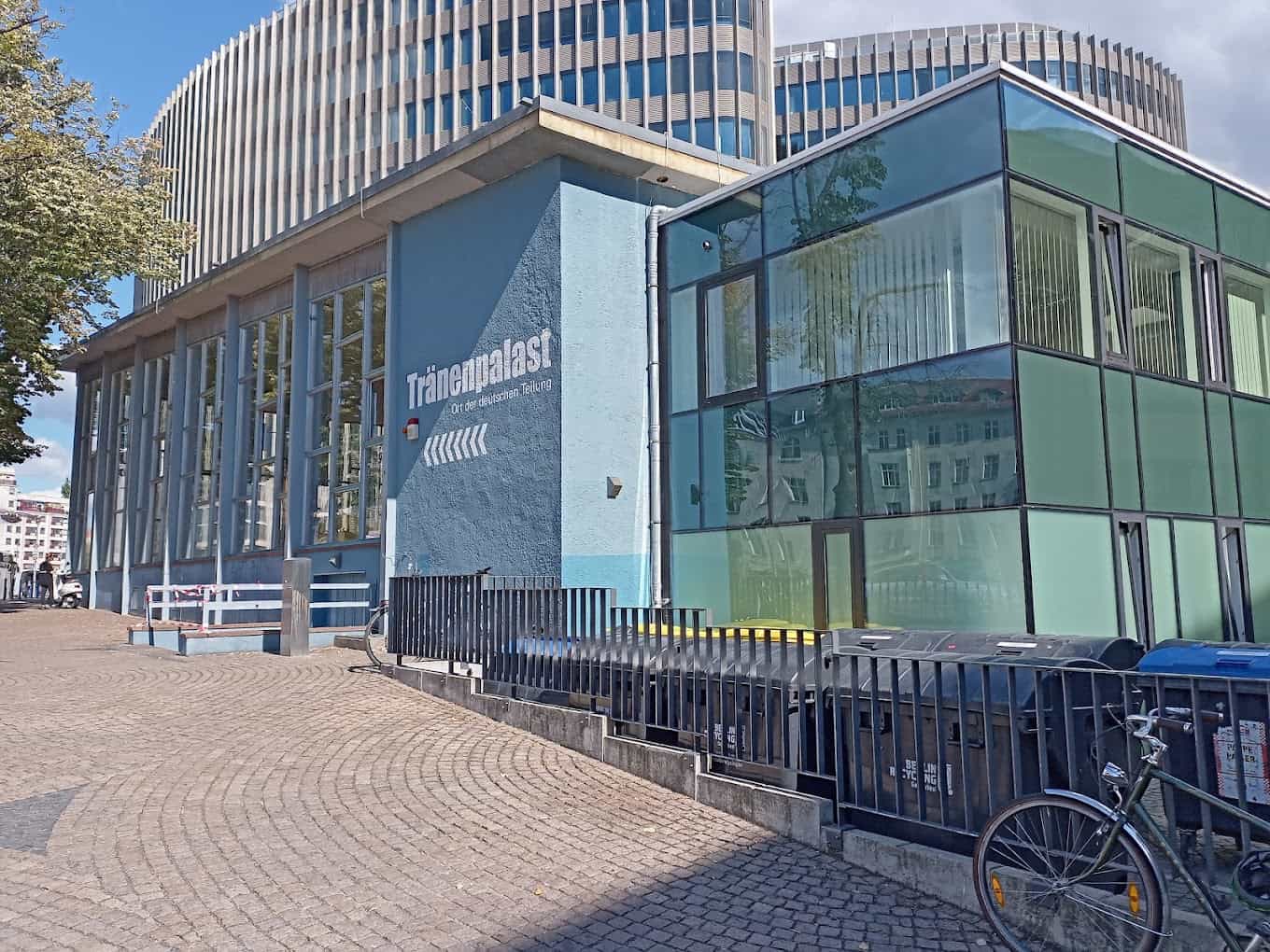
During the partitioning of Berlin, it served as a border-crossing station, processing visitors from West Germany, as well as visitors from other countries.
Translated into English as the Palace of Tears, the name Traenenpalast is a result of the main tearful goodbyes that residents of the GDR experienced saying goodbye to their family members.
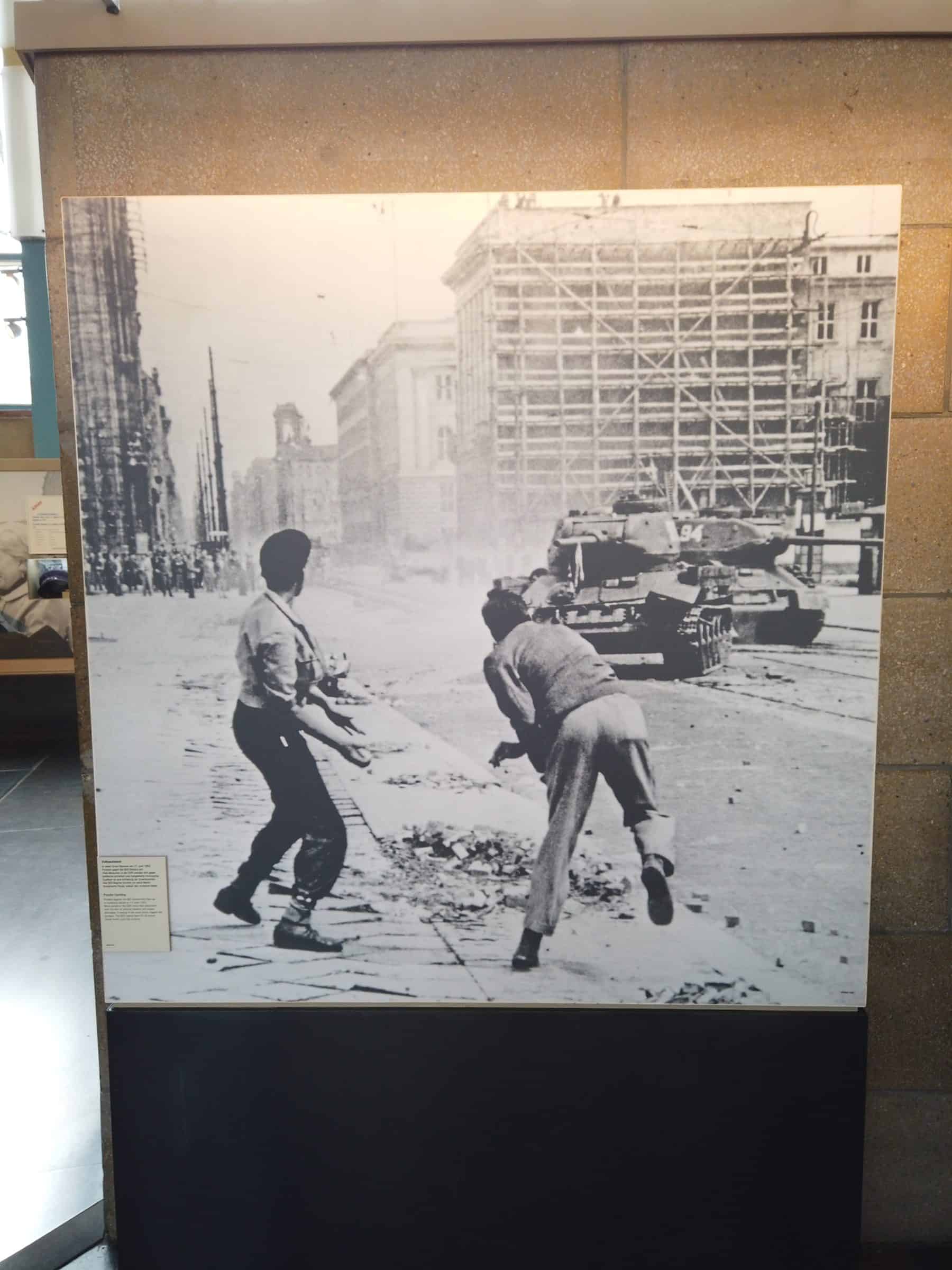
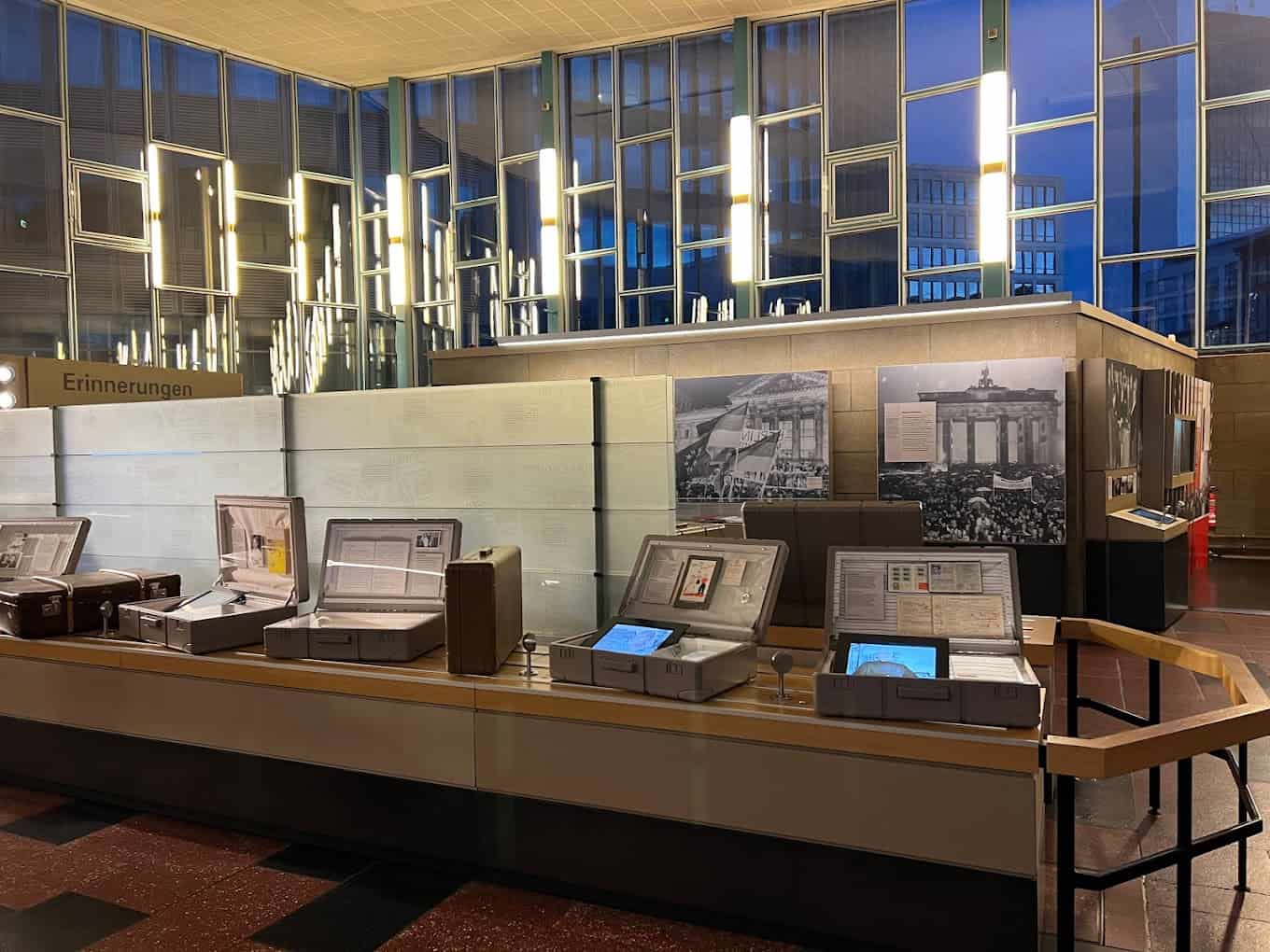
Today, it is a museum focusing on the division of Germany and the erection of the Berlin Wall.
There are audio and visual stations as well as photographs and tangible items to help tell the story.
It also tells the story of how this checkpoint worked, and you can even experience the process by walking through passport control.
There is an audio tour to guide you along.
The museum is open at 09:00 am Tuesdays through Fridays and at 10:00 am on weekends. The museum is closed on Mondays.
Most visitors spend between 30-60 minutes here. For this itinerary, we split the difference.
09:45 am - Now, head into Friedrichstrasse Station and follow the signs for the S-bahn lines S1, S2, and S25 heading northbound.
It’s just 2 stops to your next destination, Nordbahnhof S-bahn Station
Nordbahnhof Ghost Stations Exhibit
From the S-bahn platform, you need to climb one flight of stairs to reach an exhibit called Border and Ghost Stations.
Nordbahnhof Station was one of 16 stations on 2 U-bahn and S-bahn lines that were located either on the border between East and West Berlin or completely inside of East Berlin.
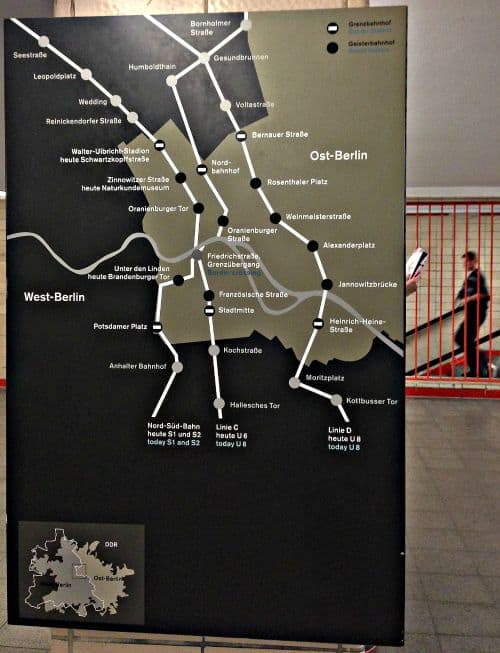
The lines all started in West Berlin, passed through the East, and then returned to the West.
Nordbahhof was a ghost station, which meant that nobody got on or off the train here. The trains just passed through with West Berlin passengers.
The name ghost station was coined by West Berliners due to the sinister atmosphere in these dimly lit and heavily patrolled stations.
The exhibit here explains how the East German government sealed off these tunnels to stop escape attempts from citizens, rail workers, and even the guards themselves.
It also covers how citizens from both East and West Berlin experienced these ghost stations.
I recommen spending 20 minutes to read everything.
When you are finished, take the exit down the corridor to Gartenstrasse and the Berlin Wall Memorial.
Berlin Wall Memorial
There are several places in Berlin to see the wall in situ, with the most famous location being the East Side Gallery.
But, if you really want to learn about this border crossing, then I think that you have to come here to the Berlin Wall Memorial.
Bernauer Strasse was witness to some of the most dramatic early attempts of escape and became a symbolic area for resistance to the wall and the regime behind it.
And shortly after the Wall fell in 1989, locals here organized to save at least a small section from wall peckers and land developers.
And thus, the Berlin Wall Memorial was born.
It stretches 1.5 kilometers along Bernauer Strasse from Nordbahnhof Station and consists of four sections.
Through plaques, memorial markers, audio, as well as visual aids, the memorial explains the border’s construction, development, and maintenance.
It also covers how the barrier blocked off streets, removed buildings, churches, cemeteries, anything that got in its way.
Most notably, the memorial contains the Monument, a relatively well-preserved section of the intact border wall system, containing both an inner and outer wall, the death strip, and a watchtower.
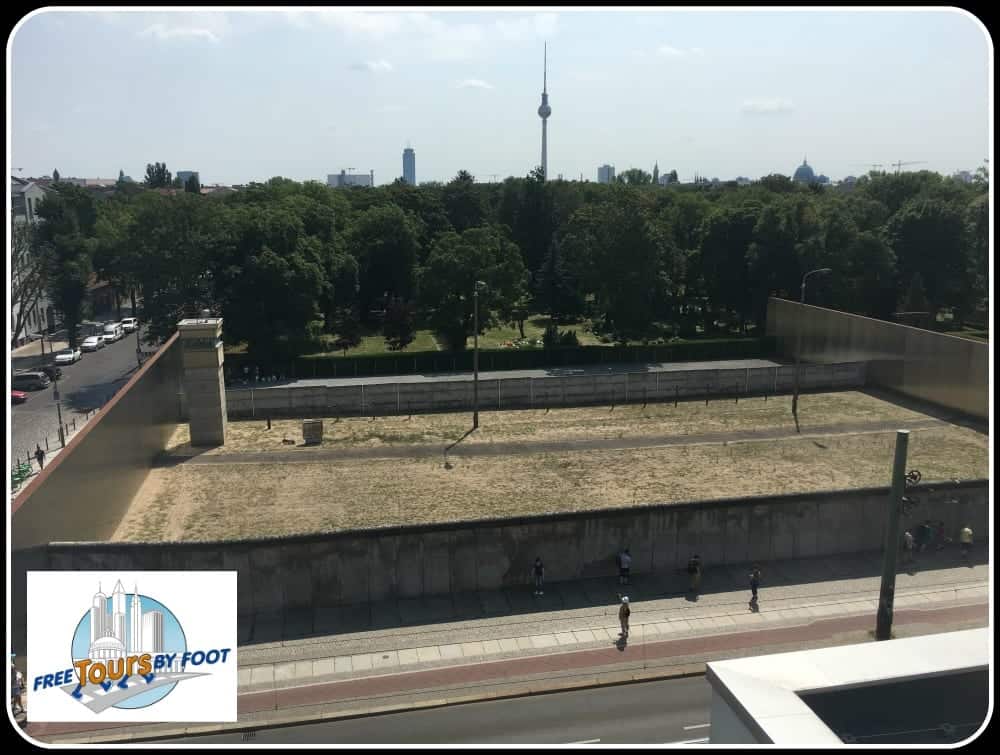
And more than a fair share of the escape tunnels bored their way underneath Bernauer Strasse.
Most importantly, it honors the victim of the GDR regime, and in particular, those who died trying to escape to West Berlin
There is no cost to visit the memorial, and you can visit the outdoor exhibit any day of the week.
There is also a visitor center with an observation tower and a documentation center.
You could easily spend a couple of hours here, but I recommend using the 60-min audio guide.
11:00 am - Spandauer Vorstadt
At BrunnenStrasse, there is an entrance to the Bernauer Strasse U-bahn station, where you will take the U-8 southbound just 2 stops to Weinmeisterstr.
You’ve now entered the Spandauer Vorstadt. This area was the first area in today's Berlin to be developed as a suburb outside of the old city walls.
Prior to the Second World War, it was a hub of Jewish-Berlin life, and today remnants of that society can be found in the Neue Synagogue on Oranienburger Strasse, the Memorial Jewish Cemetery on Grosse Hamburger Strasse and the Stolpersteine, small bronze plaques on the street noting where past residents lived before being shipped off to concentration camps.
Hackescher Markt
But, arguably the highlight of the district is a network of 8 interconnected courtyards, called the Hackeschen Hoefe.
It’s a great place to get a sense of Berlin’s love for hinterhoefe.
Built at the start of the 20th century, the complex was designed in the Jugendstil, or the Art Nouveau style, which becomes apparent the moment you enter the first yard.
In all, there are 41 different window styles, along with an array of brick and tile features, taken together to emphasize flowing motions.
To get a taste of some interior Art Nouveau, peek inside of Askania watches or Restaurant Hackescher Hof, where you will find a large and a small ballroom, both part of the original ensemble.
There are guide stations throughout with audio clips on the history and styles of the buildings.
Today, the entire complex is a historically protected landmark.
All in all there are 32 shops selling everything from clothing and accessories to art to sweets, there’s even an Ampelmann store.
Additionally, there is a cinema, a theater, a billiards hall, 103 homes, 12 offices as well as restaurants, cafes, and more.
According to its website, the entire 16k square meter compound is the largest mixed-use compound in all of Germany.
You’ll also want to take a short walk through its smaller neighbor, Rosenhof, where you can see this beautiful staircase.
The area offers even more, including the Volksbuehne (the People’s Theater), founded in 1914 by workers who wanted their own theater with affordable admission and plays that reflected their own situation more than traditional theater did.
Another standout is the Sophienkirche, a protestant church dating to the start of the 18th-century.
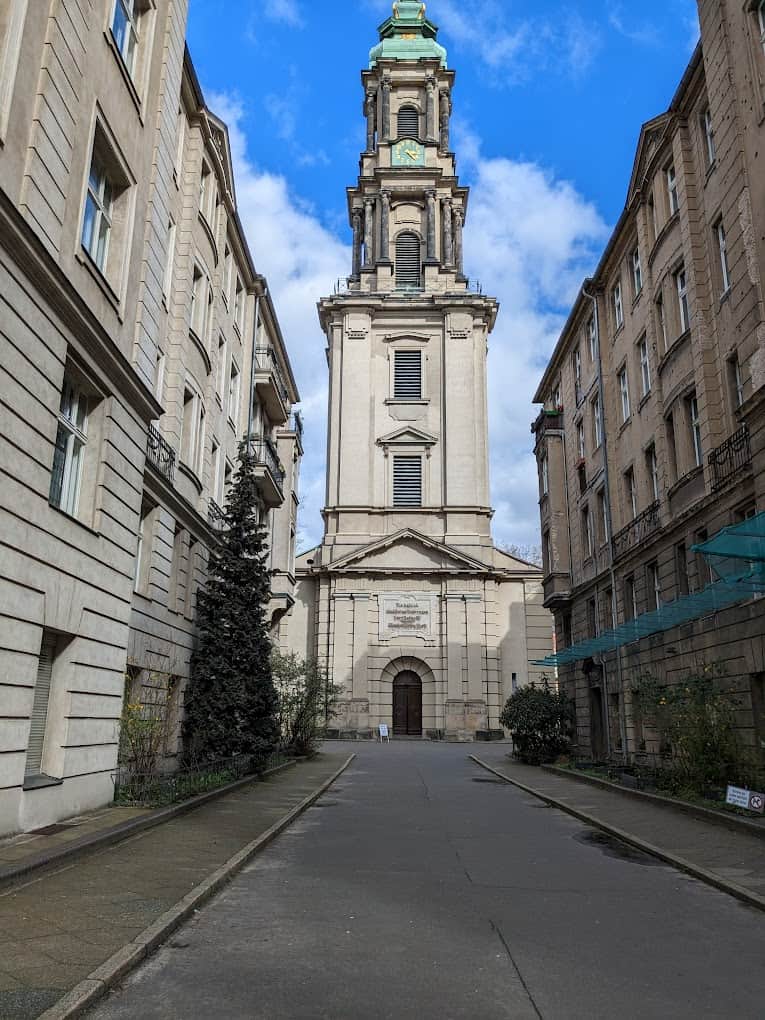
American Martin Luther King Jr. visited and gave a sermon here.
You won’t want to miss Haus Schwarzenberg, a project by artists with an art gallery, a cinema and several small museums.
The backyards themselves are a museum of the early 1990s.
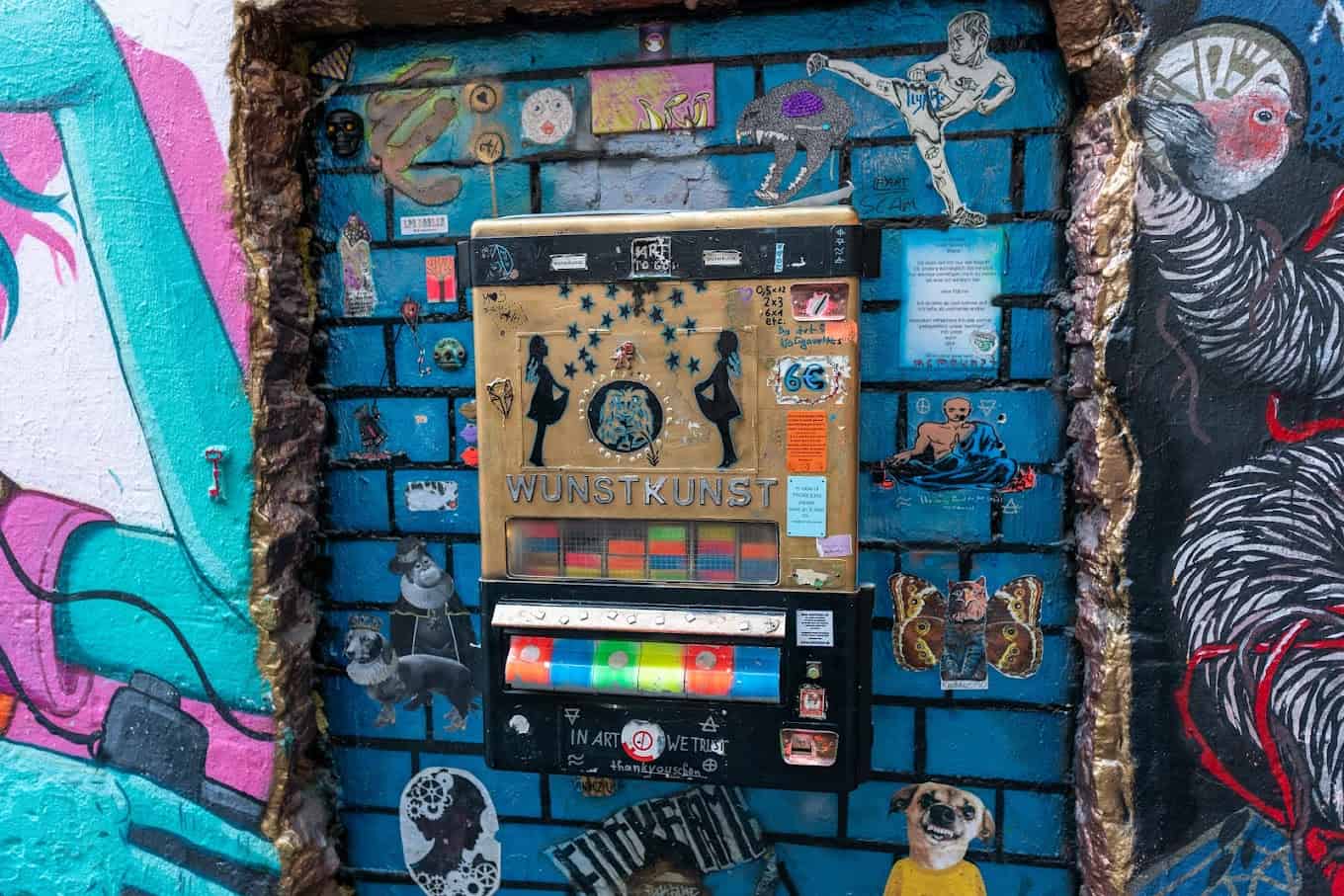
This exhibition shows what the whole Spandauer Vorstadt looked like around the time of German unification: crumbling plaster or naked brickwork, graffiti and street art and bizarre sculptures.
Here you’ll also find the Anne-Frank-Zentrum (though Anne Frank never came to Berlin) and “Otto Weidts Blindenwerkstatt”.
In the 1940s, the legally blind Otto Weidt managed to save some of the Jewish employees at his workshop for the blind, which was in the side wing of the tenement.
There’s even more here to see. We have a self-guided tour that you could use to guide you around.
12:15 pm - Lunch
OK. Now it’s time for lunch. You have a lot of options here, especially around Hackishermarkt.
If you are interested in sampling Berlin’s famous currywurst, then I recommend checking out Curry 61 at Oranienburger Str. 6.
Or, satisfy your hunger with a doener at Mustafa’s Gemuese Doner, a kebab shop with a good reputation.
There are many other places to choose from.
13:00 pm
OK. On with our itinerary. Head under the tracks on the westside of Hackischermarkt and walk south along the River Spree.
Cross Friedrichbruecke (Friedrich Bridge) on to Museum Island.
Berlin’s famous island of 5 museums is the result of Prussian ambitions for Berlin to be a world capital.
These five museums exhibit impressive collections of art and artifacts ranging from the Ancient Egyptians to modern Europe.
There isn’t time to explore any of these museums with this one day itinerary, but take some time to visit the colonnaded garden, where you can admire the view of the neoclassical Alte National Gallery (the Old National Gallery).
Museum Island stretches to Unter den Linden and today sits on what was once a part of the original city settlement.
So, it’s here where today’s city started.
Museum Island also includes the Berliner Dom, or the Berlin Cathedral.
The cathedral’s history dates back to the early 15th-century when the Hohenzollern Dynasty made Berlin its royal headquarters.
In a way, it's Berlin’s version of Westminster Abbey.
And, in my opinion, the Berliner Dom’s observation deck offers one of the nicest views in the city.
But, at the time of filming, it costs €10/adult and requires a vigorous climb, so we’ll leave that off this itinerary.
Humboldt Forum (Berliner Schloss)
Instead, head across the street to the Berlin Palace, home of the Humboldt Forum.
The was once the home of Brandenburg Electors, Prussian Kings, and German Emperors from the 15th century until the end of the First World War.
The reconstructed palace was opened in 2020, and today, it houses the Humboldt Forum, a museum of world cultures, which includes some interesting exhibits, both free and ticketed.
The palace offers a rooftop terrace for wonderful views of Unter den Linden, Museum Island and the TV Tower.
And it costs just €5, so we are including this in the itinerary.
You should be able to just walk in, depending on the time of year, but better safe than sorry - book your spot online and in advance.
There are also several free exhibits, and we have a short video on it, which we will link to in the description.
14:00 - Bebelplatz
Onwards we go, and not too far away. Just around the corner from the palace is Bebelplatz.
Formally known as Opera Square, the public space features the Berlin State Opera, as well as some other architectural beauties, including St. Hedwig’s Cathedral, Berlin's Catholic Cathedral.
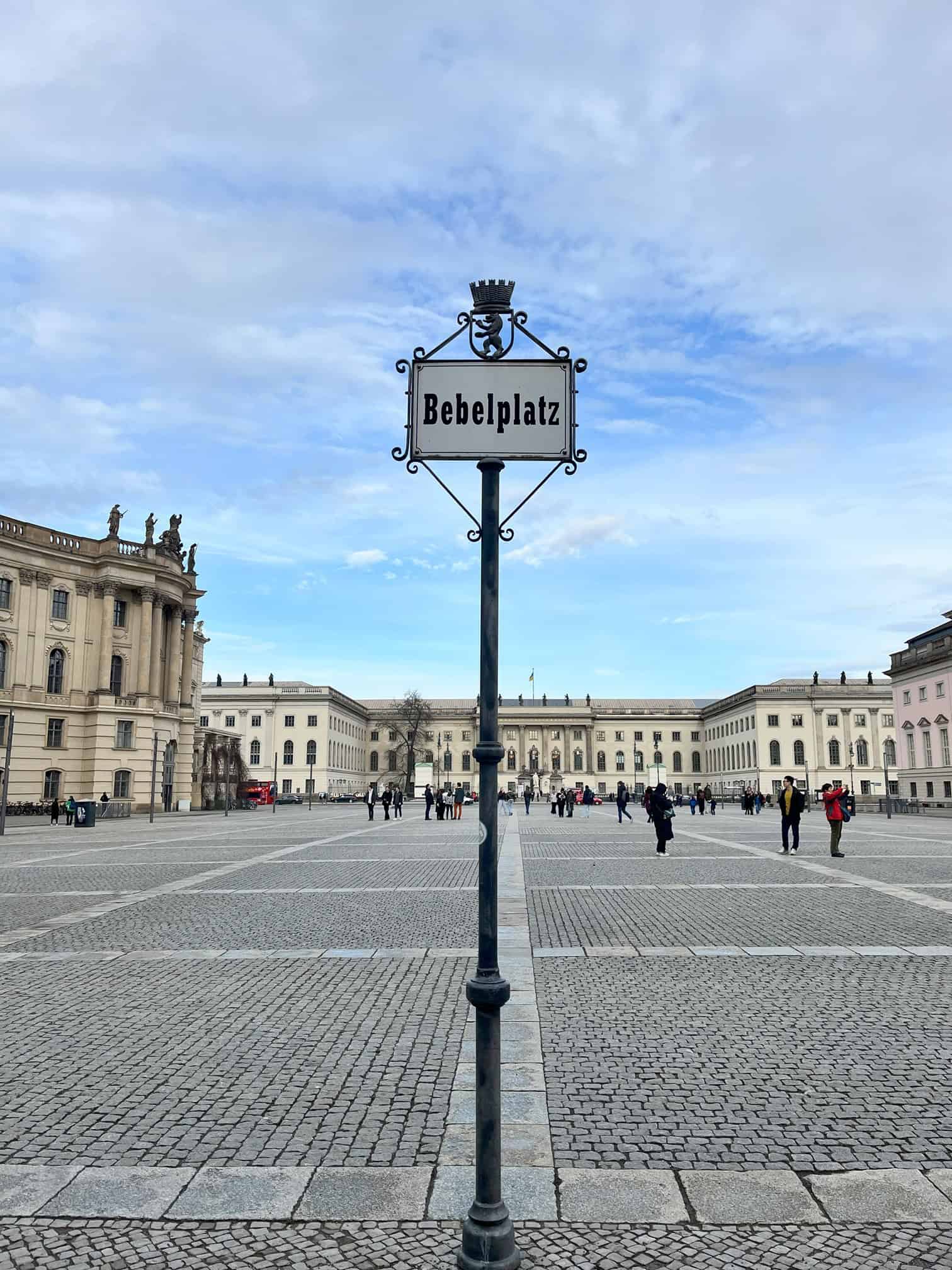
Another standout is the Law Library of Humboldt University, whose main campus is just across Unter den Linden.
With all these eye-catching buildings, you could be forgiven for not noticing a small window in the ground.
Peek inside and you will find a vast space of empty shelves and bleach-white.
It’s called the Sunken Library, and it’s a memorial to the Nazi book burnings in May of 1933, on the spot of one of the burnings.
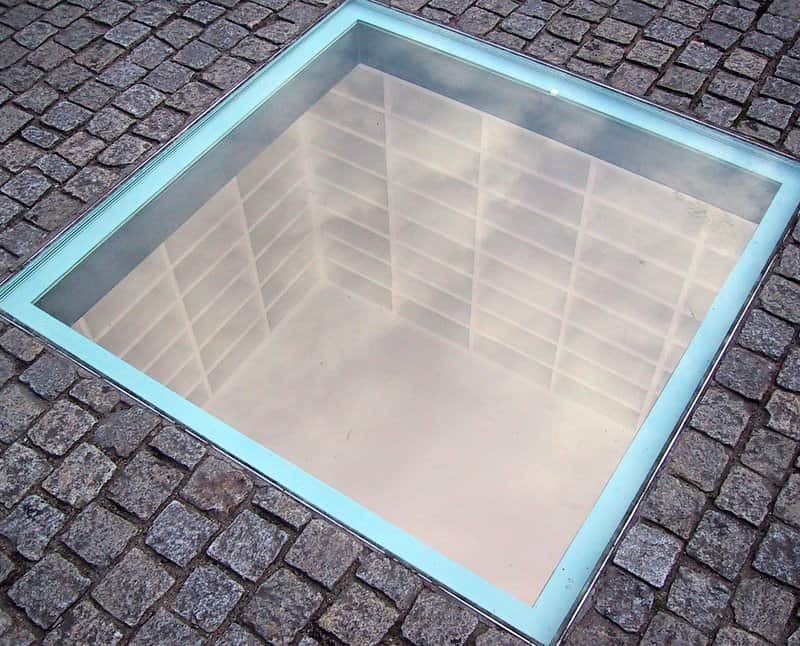
An estimated 20,000 books from writers, academics, poets, journalists, books from anyone the Nazi’s considered dangerous or un-German.
And in this memorial, there’s space for each book.
There is a plaque with a quote taken from a Henrich Heins novel that predates the book burnings.
where they burn books,
they will ultimately burn people as well.
Gendarmenmarkt
And just around the corner from Beblepltaz is Gendarmenmarkt, a beautiful square that features a concert hall and two large and almost identical cathedrals.
Gendarmenmarkt is named after the stables of a cavalry regiment of Prussian King Frederick William I, which were located on the site.
The Franzosischer Dom (or French Cathedral) is not a cathedral, or even a church.
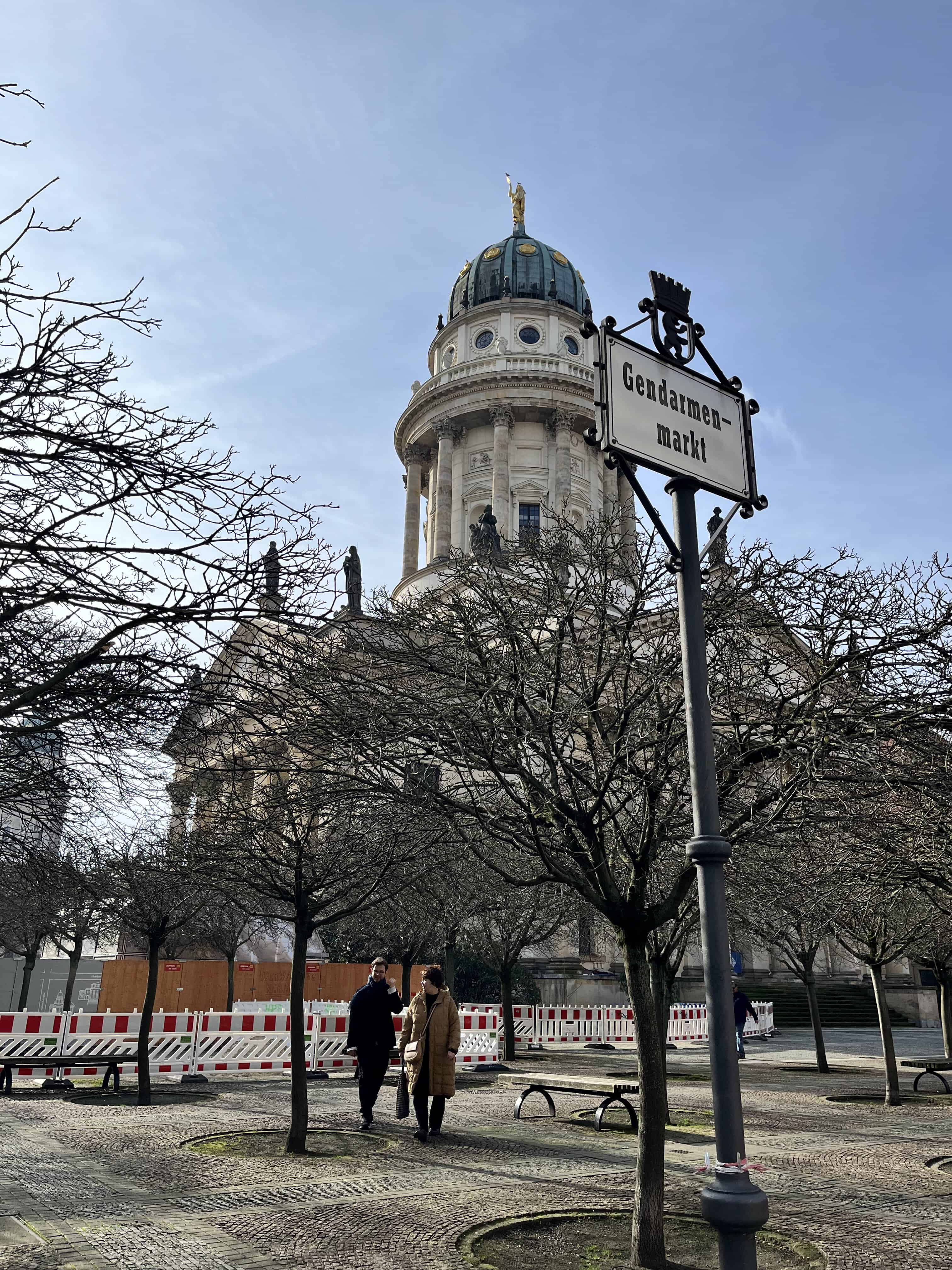
It’s a tower that was built in the early 18th-century for a local French Protestant community that resided here.
It’s a beautiful interior that’s worth a peek inside and it has an observation deck that’s worth skipping.
There’s also a museum on the French Huguenots.
The Deutscher Dom on the south side of the square is also not a cathedral, though it was once a church.
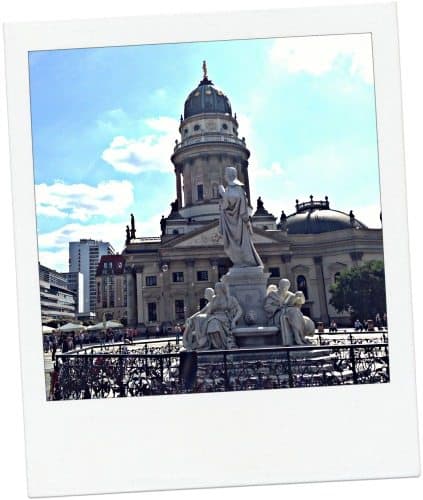
Today, it houses a free exhibition on the turbulent history of German parliamentary democracy.
And at the center of the square is the neoclassical Konzerthaus, arguably Berlin’s premier venue for classical music. You can only enter during events or for guided tours (which are only in German).
So, we’ll be moving on. And this next stop is delicious.
Rausch Chocolatier
This is a chocolate store you won’t want to miss. It’s a good opportunity for a souvenir or just an interesting browse.
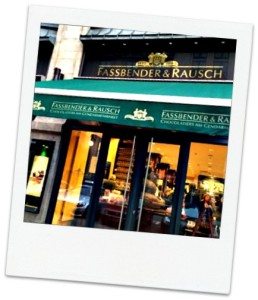
Their chocolate sculptures of iconic Berlin monuments have been photographed by many guests.
This chocolate house has a sit-down cafe upstairs specializing in hot chocolates (of course) and the chocolate shop downstairs.
Checkpoint Charlie
Next, just 2 blocks away is Checkpoint Charlie, Berlin’s best-known crossing point between communist East and democratic West Berlin.
It was here that a tense standoff between American and Soviet tanks almost ignited World War 3.
The border post, sand bags, and the signs warning you that you are leaving the American sector are replicas and all that is left.
There is a museum that covers the checkpoint, the Cold War, escapes to the West, and more.
There’s also the Black Box exhibit 16 media stations, a small movie theater, documents, and original objects to demonstrate the East-West conflict that dominated the international political arena after World War II.
The exhibits, consisting of old newsreels and newspaper articles, photos, and videos offer a trip back in time.
There’s also the Wall Panorama which shows scenes of East and West Berlin on an autumn day in the 1980s.
All three have ticketed entries and will take some time to get through, so we don’t include them on this one day itinerary.
However, you should spend some time browsing the Photo Gallery, 320 informational panels that include 175 large-format photos accompanied by written narratives.
The gallery focuses on three themes: the daring escape attempts at the border crossing, information about other memorial sites, and lastly the dramatic tank showdown.
Now, off to our next destination.
But along the way, you’ll pass the Trabi Museum, which is dedicated to the iconic GDR vehicle.
And just behind it is the Die Welt balloon, a 22 meter wide helium balloon that ascends 150 meters for great views of the city.
But we are continuing on to a much more important landmark.
Topography of Terror
The Topography of Terror Documentation Center is a free museum located both in and outdoors on the former site of the Gestapo and SS headquarters and the Reich Security Main Office.
Topography of Terror can be a truly chilling experience, as one must confront the evil that took over Germany while standing at the site of countless abuses against human dignity.
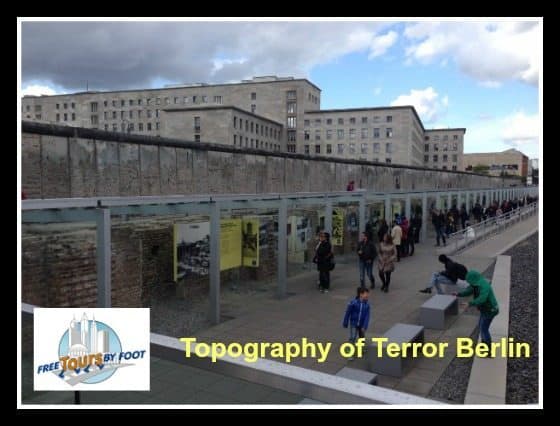
Nowadays, little physical evidence of its dark past remains on the site, as allied bombs damaged the buildings in 1945 and its remnants were torn down by 1956.
Part of the site is situated along Niederkirchnerstraße, formerly Prinz-Albrecht-Straße, which was the border between the Soviet and American sectors in postwar Berlin.
As a result, the Topography of Terror is home to the longest stretch of the Berlin Wall in the city center.
You could be engrossed here for hours, but a walk through the exterior grounds can be done in 30 minutes.
Hitler’s Bunker
Can you believe that below this rather unremarkable parking lot for local residents, once existed an air raid shelter?
And this was no run of the mill shelter.
This was the location of the gardens of the Reich Chancellery, and roughly 9 meters underground was the Fuherbunker.
And this is where Hitler and his staff relocated to as the Battle of Berlin raged on.
And this is where it all ended once and for all for the German leader.
All that exists is a plaque describing the bunker systems and showing a map of the area during the Second World War.
And if you continue around the corner, you can also visit the memorial to Johann George Elser, a German worker, who attempted to assassinate Adolph Hitler and other -ranking Nazi officials in 1938.
Memorial to the Murdered Jews of Europe
And just one single block away is arguably Berlin’s most important landmark.
The purposefully provocative name of this memorial says it all.
It's the sheer size of the installation that first impresses, over 19,000 square meters (205,000 sq. ft).
The field consists of 2,711 blocks, which are all roughly 2.5 meters wide by 1 meter long.
It’s only their heights above the ground that differ.
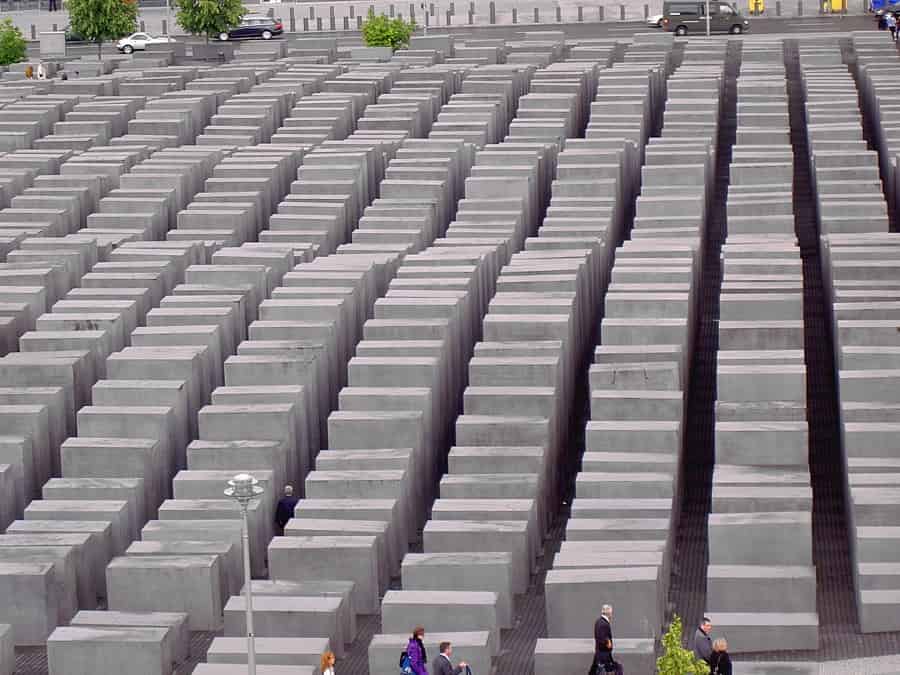
The ground throughout the memorial is uneven and rises and falls like a wave.
Other than the memorial’s name, there are no symbols, no names of victims, no names of concentration camps, and no mentions of Jews or Judaism.
The words Holocaust or Shoah (Sh-oh) don't appear anywhere as well.
Even the number of concrete slabs has no significance, it's just the number that could fit in the allotted space.
The abstractness and openness of the monument are by design.
The architect wanted to convey a sense of discomfort and confusion, order without reason.
The memorial has to be experienced by walking through it and dealing with the topic of the Holocaust in one's own personal way.
Under the surface of the memorial is the “Information Center”, a free museum that documents the persecution and extermination of the Jews of Europe.
You could spend as much time here as you need.
Brandenburg Gate
It’s a monumental neoclassical gate and is arguably the icon of Berlin.
In the 18th century, Berlin abandoned its medieval wall which had lost its defensive purpose.
And a new wall was built, this time for customs.
This new wall had many gates.
The gates were named after the cities the outgoing roads led to.
The Brandenburg Gate is named after the city of Brandenburg/Havel just west of Berlin.
The Brandenburg Gate is the only customs gate left.
It’s 26 meters high by 65 meters wide (or 85 by 215 feet), and is supported by 6 doric columns on both fronts.
The figure on top is a quadriga. Standing on the chariot is Victoria, the Roman goddess of victory. She holds the Iron Cross with an imperial eagle perched on top.
Just underneath the quadriga is a relief symbolically celebrating the victories of Prussia, with figures such as Nike, the goddess of victory, and Hercules, the god of strength.
Inside of the five passageways are reliefs on both sides of each wall for a total of 20 reliefs.
All reliefs depict scenes of Hercules and were designed to pay homage to Frederick the Great.
On both the southern and northern sides of the gate are columned porticos, where you will find 2 additional sculptural pieces, Mars, the god of war, and Minerva, the goddess of wisdom and protector of Berlin.
The small temple on the left once housed guards but is today a tourist office.
The one on the right once housed tax collectors but is today home to the Room of Silence.
Two things not to miss.
Check out the DZ Bank building to the southwest, where you will find a whale sculpture by Frank Gehry.
And roughly 80 meters to the west is a plaque near where the U.S. President Reagan called on the Soviets to tear down this wall.
NIGHT
That concludes our day. Now, it’s time to head to the hotel and freshen up for dinner.
We have a post listing the top German-Austrian restaurants in Berlin as recommended by members of our Berlin Travel Tips Facebook group.
There are dozens of options to choose from throughout the city, so there’s bound to be at least one convenient to you.
Reichstag
And for the nightcap, I recommend visiting the dome and terrace of the Reichstag Building.
Visiting the Reichstag Building is a must-do for every first-time visitor to Berlin.
Its glass dome affords a 360 view of the city as well as a unique bird’s eye view of the plenary chamber down below.
An audio tour, which takes roughly 20 min to complete will guide you to the very top of the dome and back down.
There is also an open-air rooftop terrace which also provides views of the city.
Tickets to the dome are required and are best booked well in advance from the Bundestag’s website, especially for peak travel dates.
You can even have dinner at Kafer, the restaurant located on the terrace next to the dome. Dinner reservations include tickets to the dome.
And that’s it folks, my one day, sightseeing heavy itinerary for visiting Berlin.
I hope that it provides you with some ideas of how to spend one day (or your first day in Berlin).
Be sure to like this video and share it with anyone that you think could benefit from it.
And subscribe to our channel and hit the bell notification if you would like to get more Berlin content.
And in this video, you can see my top 10 choices for getting a bird’s eye view of the city.
See you in the next video.
Tschuess!