


This self-guided tour of Copenhagen will cover some of the most notable landmarks in the city center, providing details about important locations such as Rosenborg Castle, Christiansborg Palace, Charlottenborg Palace, Amalienborg Palace, and more.
You may also want to consider an audio tour or a pay-what-you-want option, as both of these services are also either free or affordable.
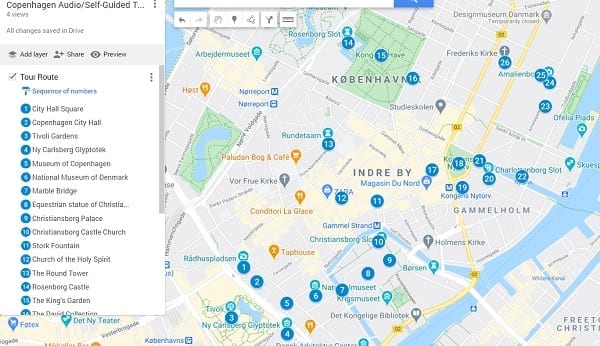
Click the map to enlarge it or to download it to a smartphone.
City Hall
This is the headquarters of the municipality and Lord mayor of Copenhagen, and the current building was first inaugurated in 1905.
The architectural style on display ii National Romantic, but it was also partially inspired by the Siena City Hall.
One of its most notable features is a gilded statue of Absalon above the balcony and clock tower.
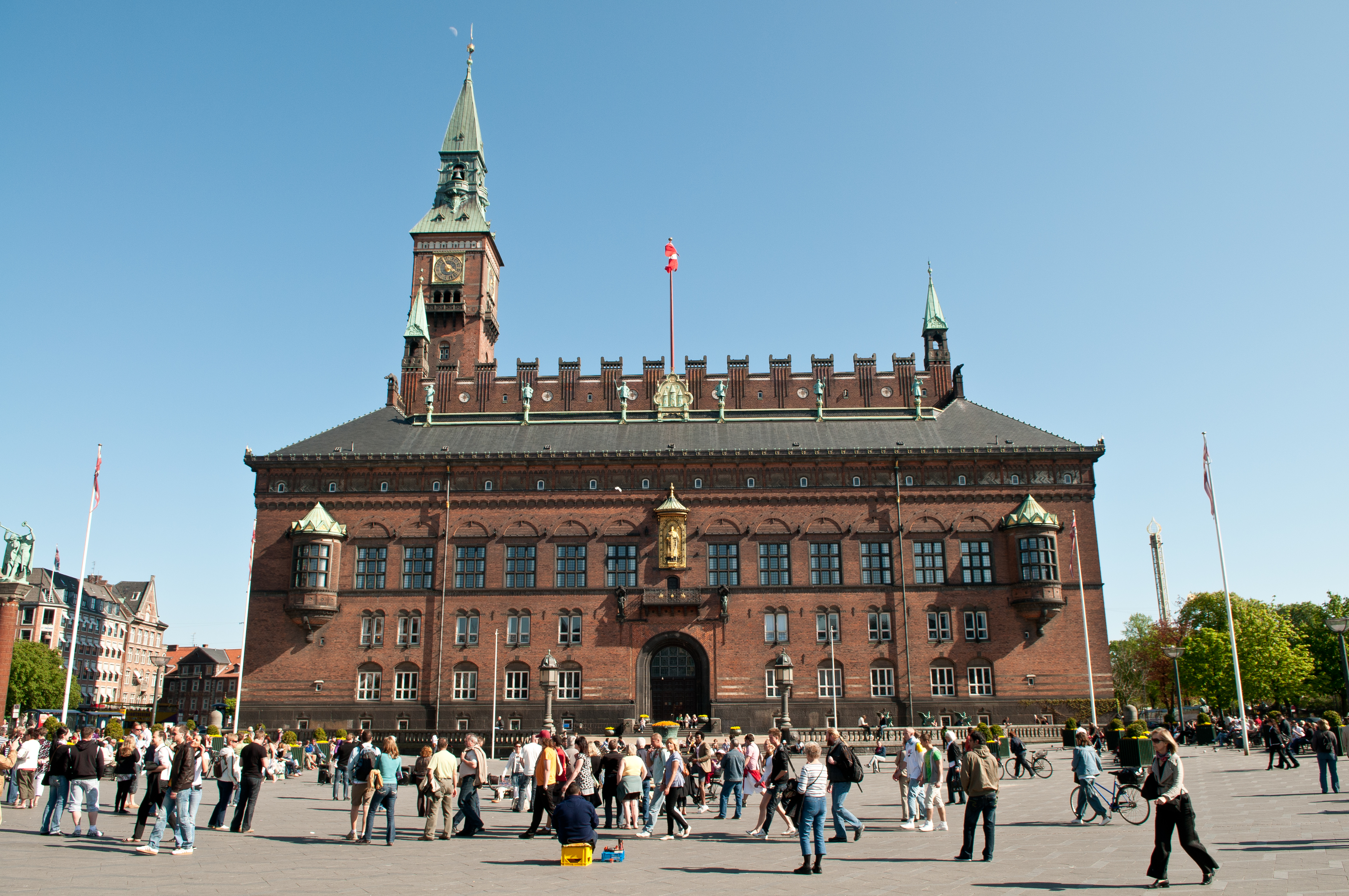
Speaking of which, the clock on display here is Jens Olsen’s World Clock, an astronomical clock that tracks both lunar and solar eclipses, the positions of stellar bodies, and a perpetual calendar in addition to telling the time.
In addition to serving as the home of the municipal council, City Hall Square is also a popular location for concerts and celebrations every year.
There are a few interesting things to see in this square, including the Dragon Fountain, a statue of Hans Christian Anderson, and the Lur Blowers bronze monument which towers to the left of City Hall.
Tivoli Gardens
This is the second oldest amusement park in the world that is still operating to this day, and it first opened in 1843.
In addition to being such a historic location, it’s also the second most popular seasonal theme park in the world.
The original founder of Tivoli was Georg Carstensen, and he received a charter to create the amusement park by convincing King Christian VIII that “when people are amusing themselves, they do not think about politics.”

The earliest attractions here included a theatre, flower gardens, bandstands, a scenic railway, and simplistic amusement rides like a merry-go-round.
Tivoli originally hired Hans Christian Lumbye to compose music for their park, and his music was inspired by the works of the Strauss family, which garnered him the title “Strauss of the North.”
They still play his music to this day.
Over the years, Tivoli has brought in several new amusement park rides including the Rutschebanen, one of the oldest wooden roller coasters in the world.
Christiansborg Palace
This is the seat of the Danish Parliament. The building also serves as the Danish Prime Minister's Office and the Supreme Court of Denmark.
Since it serves so many purposes, this is technically home to the three supreme powers of the Danish political system: the executive branch, the legislative branch, and the judicial branch.
This is the only building in the world to house all three branches of government.
The building before you today is actually the third of its name, with two others being constructed on this exact site since 1167.

As a result of the different palaces constructed here, there are three eras of Danish architecture on display including Baroque, Neoclassicism, and Neo-baroque.
The equestrian statue in front of Christiansborg Palace depicts Christian IX. It was designed by Anne Marie Carl-Nielsen, wife of composer Carl Nielsen.
If you’re interested in seeing the interior, there are tickets available for the various buildings comprising the palace.
Even if you don’t feel like spending any extra money, you can visit the Christiansborg Castle Church for free on your way toward our next stop.
It’s also worth noting that access to the viewing platform in the Tower is entirely free to access, and this is the tallest tower in the city, offering some of the best views of Copenhagen.
Rosenborg Castle
This is actually one of the newer castles in Copenhagen, built in 1606 as a country summerhouse.
It’s also one of the finest examples of the Dutch Renaissance style of architecture.
Rosenborg Castle was originally used as a royal residence until the early 1700s.
While it has been used for that purpose two other times since then, the last time was in 1801.

This castle now houses a museum that exhibits the Royal Collections, which are artifacts from throughout the history of royal Danish culture from the 16th - 19th century.
This is also where you’ll find the Crown Jewels and Danish Crown Regalia, the coronation chair, the coronation carpet, the throne, and many other notable items.
While it’s not free to enter Rosenborg Castle, it is free to enjoy arguably the best view of this historic building from the King’s Garden.
You can also spend some time walking around and enjoying the fountain, playground, and other areas.
King’s New Square
This public square is centrally located near many notable locations in Copenhagen, including our next three stops: the Royal Danish Theatre, the Charlottenborg Palace, and Nyhavn.
This is the largest public square in the city, and it was laid out by Christian V in 1670.
You'll find an equestrian statue in his honor at the center of King's New Square.

The foot of the plinth has four statues depicting Alexander the Great, Minerva, Herkules, and Artemisia.
These statues symbolize fortitude, prudence, strength, and honor.
At the time when this square was built, it was intended as part of a plan to expand the city, and the result was that the city center moved from the medieval area of Gammeltorv to this new location.
The old kiosk in this square was built in the Baroque Revival architectural style in 1913 and served as a telephone stand for some time before being transformed into a small cafe.
Royal Danish Theatre
Although this theatre was originally built in 1874, the theatrical company itself was founded in 1748, and it first served as the theatre of the king.
Today, this theater is open to the public and hosts a variety of performance art including opera, ballet, and orchestra.

This is the home of the Royal Danish Ballet and the Royal Danish Orchestra, the latter of which has existed in one form or another since 1448.
The Royal Danish Theatre can seat up to 1,600 people at a time, and ticket prices range from somewhat affordable to quite expensive.
Charlottenborg Palace
Built in 1677 in the Baroque architectural style, this was originally the home of Ulrik Frederik Glydenlove, an important general who led during the Scanian War.
Ulrik was the half-brother of Christian V, who donated the land to him.
This was the first building on New King's Square.
Eventually, when Ulrik became too old to take care of the house by himself, he sold it to Queen Charlotte Amalie in 1700, and that's where the palace earned its current name.

When Charlotte Amalie passed away in 1714, ownership of the palace was handed down to Christian VI, who would have a small theatre added to the residence.
Even before that, the Academy of Arts began using this palace for its activities in 1701, and the school would eventually be formally inaugurated in 1754.
Later on, in 1787, ownership of the palace was officially handed down to the Royal Danish Academy of Art, which still occupies the Charlottenborg Palace to this day.
Nyhavn
This district of Copenhagen is one of the most photographed locations in the world, as it is lined with bright and colorful 17th-18th century townhomes that make for an excellent photo opportunity.
Author Hans Christian Anderson lived here in Nyhavn for 18 years of his life.
Fans of his work should definitely take a moment to look around and take in the view that likely inspired the great writer for many years.
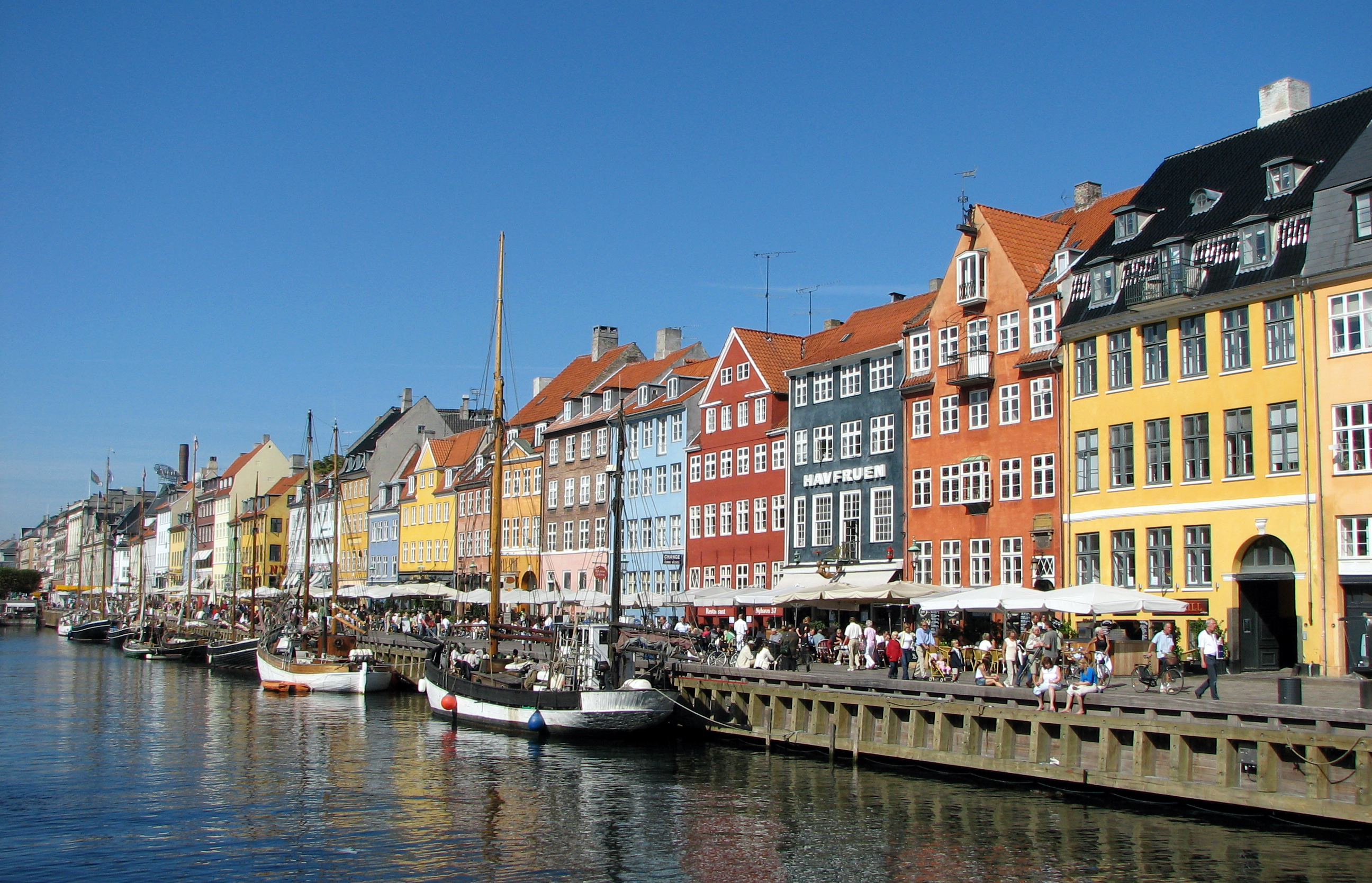
Due to its accessibility by boat, this area was also frequented by fishermen and ships carrying various cargo, making it a fairly important economic location.
Over the years, Nyhavn developed a reputation thanks to its many bars serving beer and drinks to sailors and prostitutes.
That said, as ocean-going ships got larger, fewer came to port in Nyhavn, and thus there weren't as many sailors, and the reputation of the area slowly faded.
Today, this area is mostly a popular tourist destination for anyone who wants to snap a picture of themselves with the perfect background imagery.
Amalienborg Palace
This is the home of the Danish royal family.
Although it was originally built in 1750 for four noble families, it would eventually be purchased by the royal family, who have resided here for over 200 years.
The design of Amalienborg follows the Rococo architectural style.
There is an equestrian statue of the founder of the palace buildings, King Frederick V, at the center of the square.
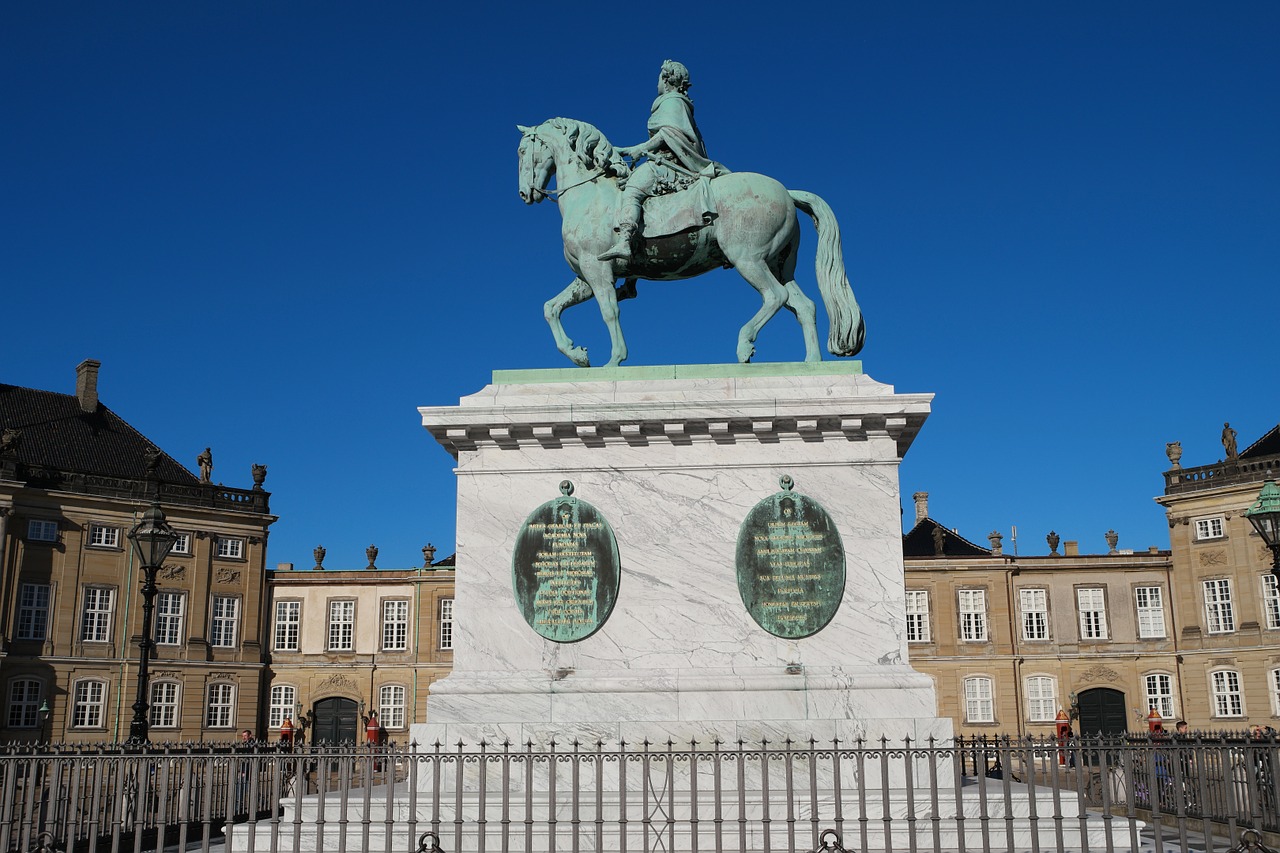
The four palaces that make up Amalienborg are named after some of its former residents: Christian VII's Palace, Christian VIII's Palace, Frederick VIII's Palace, and Christian IX's Palace.
Amalienborg is guarded 24/7 by the Royal Life Guards who march every day at 11:30 am from Rosenborg Castle to Amalienborg to perform the changing of the guard.
This is also the site of Amaliehaven, a two-level garden with several beautiful sculptures and a central fountain.