
Whether you are a casual Sunday jogger or a serious road warrior with many marathons behind you, Central Park is a runner’s paradise, although it's also a great place for a walking tour.
If you feel the urge to stretch your legs and get a run in during your trip to NYC, just head to the park.
I am an avid runner, and have done four full marathons and several half marathons.
I also live just 7 blocks north of Central Park!
Training for races in this park has given me the opportunity to run just about every inch of it.
So, I can safely say it has something to offer just about every runner.
Central Park offers several distance options and different types of terrain. No matter what your preference is, there is something for you!
Central Park Running Routes Map
Central Park Drive (the main road that goes around the park) can be broken down into different “loops,” so that you can customize your run for whatever distance you prefer.
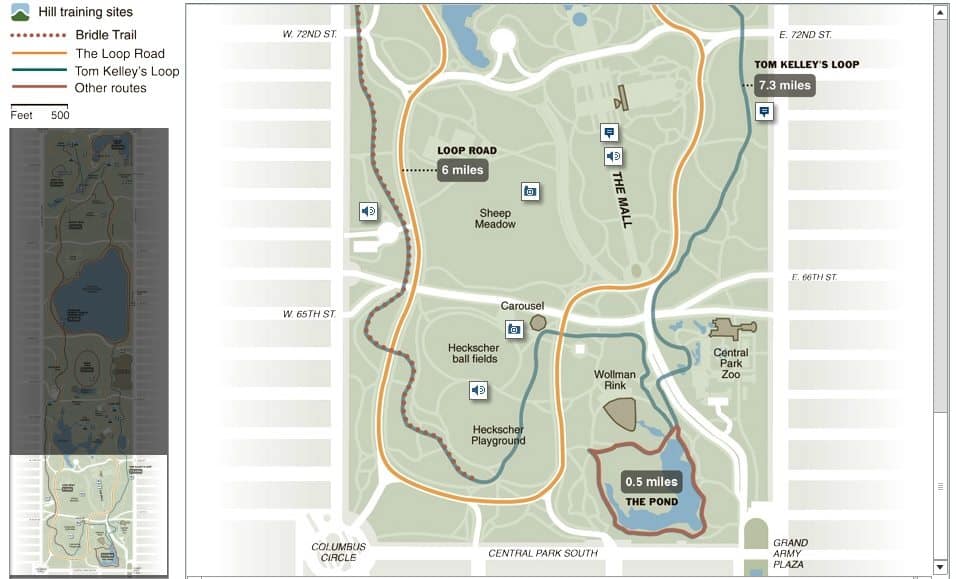
The map below is from the New York Times. Click here for a printable version of the full map
The distances can be altered by turning onto various “traverses,” or smaller roads that cut across the park.
Unless noted, assume all routes begin at the southeast entrance to Central Park, at 59th St and 5th Ave.
Full Loop
The distance of a full loop around the entirety of Central Park Drive is about 6.1 miles (10 km).
It is all on cement, and it ranges from flat (in the southern part of the park) to quite hilly (in the northern section of the park).
This is a great run for those used to distance running who want to see as much of the park as possible.
You can take the loop in either direction.
I have personally always preferred going counterclockwise. (Most races that take place in the park will go this direction.)
5 Mile Loop
You can choose to cut off some of the distance and make Central Park Drive a 5-mile loop (8 km).
This can be accomplished in two different ways.
If you want to keep it flatter, run Central Park Drive, but take the turn onto 102nd St.
Traverse rather than continuing north and doing the complete loop.
Make no mistake, you will still run hills with this option.
Everyone talks about the Harlem Hills, but there are hills throughout the park, including Cat Hill on the east side of the park at 75th street, and several good-sized rolling hills along the west side of the reservoir.
For a hilly challenge, start at the 72nd St Traverse and then run the loop of Central Park Drive all the way around and back to where you began.
You will run all of the hills I just mentioned, with the addition of the large Harlem Hills at the north end of the park.
4 Mile Loop
Sometimes called the “inner loop” or “middle loop” by local runners, this is great for those who want a shorter distance but still want to see a lot of the park.
This 4-mile (6.5 km) route also cuts out the challenging hills in the northern part of the park.
Start at the 72nd St Traverse and then run north.
Take the turn-off at the 102nd St Traverse and continue around back to the start.
This is one of my favorite routes in the park. Some nice rolling hills to work the legs, but nothing crazy.
You’ll see quite a bit of the park as well, even cutting off the north and south ends.
The run by Bethesda Terrace at 72nd is pretty beautiful and will definitely be picture-worthy.
If you are wanting to run either early in the morning or late at night, this part of the park will have a lot of people around and will be pretty well lit.

1.7 Mile Loop (2.7 km)
One of the shorter distances that you can do is on Central Park Drive.
For a quick but beautiful run, begin at either of the southern park entrances (east or west), and run to the 72nd St Traverse, where you will take the turn-off and then continue back around to your starting point.
Even though it is a short route, you will see some famous sites such as Tavern on the Green, Sheep Meadow, and Bethesda Terrace.
If you want to tack on another famous site and a quick hill challenge, this route takes you right by the entrance to Strawberry Fields - you could easily veer off to take a look!
Some visitors insist that this part of the park is pretty flat, but ask someone who has run the New York City Marathon.
This section of the park is where the famous marathon ends, and while it does not have the steep inclines of other parts of the park, anyone who has run it at the tail end of a 26.2 mile (42 km) race will tell you it is NOT, in fact, flat.
1.4 Miles with all hills!
For those who want a quick but challenging run- head uptown!
This 1.4 mile (2.3 km) route can be started from either of the northern entrances to the park on 110th St.
Begin on Central Park Drive and then take the turn-off at 102nd St. Traverse and continue back to where you began.
This is great for anyone who doesn’t have a lot of time, but wants a pretty intense workout and to get some solid hill work in.
Doing repeats of this loop is a popular workout for local runners training for hilly races.
Some Tips For Running on Central Park Drive
The best to run on Park Drive is when it is closed to vehicular traffic.
The park is closed to traffic Monday-Friday from 10 am - 3 pm and from 7 pm to 10 pm.
It is also closed to cars all weekend, starting on Friday at 7 pm and continuing through Monday morning at 6 am.
If you can’t run during any of the times listed, don’t fret! There is a designated runner’s lane.
It will be the innermost recreation lane on the road and will be designated by a painted symbol of a person walking on the pavement.
Leave the outside recreation lane for cyclists.
It is recommended, but not required that you run against the flow of traffic if you are running while the park is open to cars.
In any case, be aware of your surroundings. Watch out for cars and cyclists.
Even if the park is closed to vehicular traffic, pay attention to the traffic signals in the park.
Cyclists ride quickly in the park and are supposed to follow the traffic signals.
The park is for runners of all levels and speeds. If you need to pass someone, feel free!
But, if it is crowded (particularly when the park is open to traffic), give a verbal warning to your fellow runners.
I love to listen to music when I run, but if I am running Park Drive, I leave one earbud off so that I can be aware of other runners/cyclists/cars.
The best time to run on Park Drive is when it is closed to vehicular traffic.
The park is closed to traffic Monday-Friday from 10 am - 3 pm and from 7 pm to 10 pm.
It is also closed to cars all weekend, starting on Friday at 7 pm and continuing through Monday morning at 6 am.
The Reservoir Path
The path around the Jacqueline Kennedy Onassis Reservoir is quite possibly the most beautiful run in the entire park.
This is a dirt path (great for those with knee problems!) and it is relatively flat.
The distance of one loop around the Reservoir is about 1.6 miles, so it is perfect for anyone that wants a quick but stunning run.
The best way to get there is from the 86th St or 96th St entrances on either side of the park.
Some Tips for Running the Reservoir
- You must run counterclockwise. This is a one-way path.
- The path gets quite muddy after it rains, so plan ahead if it has rained in the past day or two.
- The path is on the narrow side and is used by people of all speeds, from those out for a casual stroll to those doing hardcore, track-style speed work. Be courteous to your fellow runners and be aware of those around you. It’s totally fine to pass someone, but give a verbal warning if you can and pass on the left.
- Besides being a great running path, the Reservoir offers some of the most spectacular skyline views of Manhattan. Because of this, it can get very crowded with tourists taking photos. (Particularly by the Engineer’s Gate on the east side of the Reservoir.) Either be prepared to pause your run for people to snap a picture or have your head be a blur in someone’s vacation photos. Again, we can all share this space. Just be mindful of your surroundings
- If you have a small, portable camera, try to bring it along! The views are pretty amazing. I have been running in Central Park for years, and the view of the skyline as the lights start coming on still takes my breath away. Even though most tourists take pictures by Engineer’s Gate, my favorite view is from the north side of the path looking down to midtown.
- If it is a hot, sunny day, there isn’t as much shade cover on this path. If you are looking for shade, you are better off checking out The Bridle Path. You can still pop up to the Reservoir Path periodically to check out the views and take pictures!
The Bridle Path
There are two loops of this dirt path.
There is one that goes around the outer edge of the Reservoir (1.7 miles) and one that continues a bit further north into the park (2.5 miles).
To take the longer route, start by the southern end of the Reservoir and then continue past the Reservoir towards the North Ball Fields and the 102nd St Traverse.
Continue around the Bridle Path and back to where you started.
If you are loving the feel of the Bridle Path, there is actually an option for an even longer route.
The Bridle Path has a “tail” that extends from the southwest part of the loop, and goes all the way down to the southwest corner of Central Park.
The entire larger loop plus the tail of the Bridle Path is 4.2 miles (6.8 km).
The best way to do this is to start the larger Bridle Path Loop at the southwest end, go all the way around, and then take the tail path down.
It will finish up near Columbus Circle.
The Bridle Path is my absolute favorite place to run in Central Park.
The dirt path is gentle on my legs, there are just enough rocks and roots to keep it varied, and it isn’t nearly as crowded as the Park Drive routes.
Some Things to Know
- The Bridle Path is not quite as flat as the Reservoir track. It has a few small rolling hills. But it is generally flat compared with the rest of Central Park.
- There are a lot of rocks and roots on the path. If you are not an experienced trail runner be careful and watch where your feet are going.
- It won’t happen often, but the Bridle Path was designed for horses. Should you come across one, horses have the right of way on this path! (It has only happened to me once in more than a decade running in this park.)
- The Bridle Path, like the Reservoir Path, gets quite muddy when it rains. Right after a heavy shower you might be better off sticking with the paved roads. If you decide to go for it anyway, be prepared to hop some puddles and have muddy shoes at the end!
- Unlike the Reservoir, you can run either clockwise or counterclockwise on this route.
- If you are visiting in the spring, definitely run this path. There are some beautiful cherry blossoms on the part of the Bridle Path west of the Reservoir.
- If it is a hot, sunny day, this path is one of the shadiest places to run in the park. Definitely my go-to spot in the summer!
General Tips for Running In Central Park
- The park opens at 6 am every morning and closes at 1 am
- Central Park is very safe and quite busy at most times, but always be aware of your surroundings. I am asked about safety all the time. I can say, as a woman who runs solo in Central Park most of the time, I have never felt unsafe. I have run at 6am right when the park opens and I have gone out at 9 or 10pm. Just pay attention and stick to where there are other runners.
- If you are nervous about running in the park alone for any reason, consider joining a group run! Most groups running in the park are official membership groups, but there is a group called the Central Park Running Club that offers free guided group runs every Tuesday and Thursday morning. They meet at the Loeb Boathouse at 6:30am and welcome all levels.
- There are bathrooms located throughout the park. Most are open year-round, so you should never be too far from one. Many of them are not located right off of the main loop, however, so be prepared to veer off course a bit. My go-to spots are The Arsenal Building in the Central Park Zoo (south end of the park), Bethesda Terrace (72nd), right by the Delacorte Theater (about 81st St.), and the North Meadow Recreation Center (97th St.)
- All of the routes detailed are in well-traveled areas of the park. There are several smaller trails that cut through the park, but if you aren’t familiar with Central Park you might get a bit turned around. It is best for a newcomer to stick with the main paths.
- Most parts of the park are well-lit at night, but some areas (like the Bridle Path) can be dark in spots.
- There are many water fountains in the park, but they are shut off during the winter. If you are visiting during that time make sure to bring water with you. (Or bring a few dollars to buy some from a vendor.)
- It is recommended that runners carry an ID and emergency contact number with them.
- If you need to call emergency services for any reason, lamp posts in Central Park are all numbered. This can give a precise location for anyone trying to find you.
- Enjoy the scenery!! Central Park is a beautiful place to run. You can combine your workout with some sightseeing!
For The Ultimate New York Running Experience…
If you enjoy racing, see what is going on during your visit.
There are dozens of races run in Central Park all year long, so get out there are run with the locals.
New York Road Runners sponsors many races, so check out www.nyrr.org to see what might work for you!
Many of their races will follow the routes that we have outlined here, so you will be able to check and see if the upcoming race is one that may be something you are interested in.
The New York City running community is very large and very welcoming, so this could be a great way to make some local friends during your visit!
Like what you see on your run?
Take one of our Central Park walking tours to learn more about this beautiful urban oasis. Check out the calendar for dates/times.