
As a tour guide in NYC for Tours by Foot, I love traveling abroad and discovering all the wonderful things to see and do about the city I’m visiting.
It’s an added pleasure to be able to pass on what I’ve learned to my tour guests who plan to go to cities I have been to.
Having been to Rome twice, I’ve explored many neighborhoods that make Rome so wonderful, including the Jewish Ghetto.
This article is a self-guided tour of the Jewish Ghetto including notable archeological and cultural sites.
The walk is approximately 1 km (just over 1/2 a mile) and should take about an hour if you don’t stay too long at any location.
I recommend that you listen to Rick Steves's excellent audio tour as a companion to this tour.
There is also a free guided walk that usually occurs on Fridays and Saturdays at 12:30 pm.
I’m a big fan of free walking tours, not just leading them but taking them.
They are easy on the wallet and loaded with information. They are also fun!
We have 4 other self-guided tours that we hope you will consider.
We also offer free guided tours of Rome.
SELF-GUIDED TOUR OF ROME'S JEWISH GHETTO
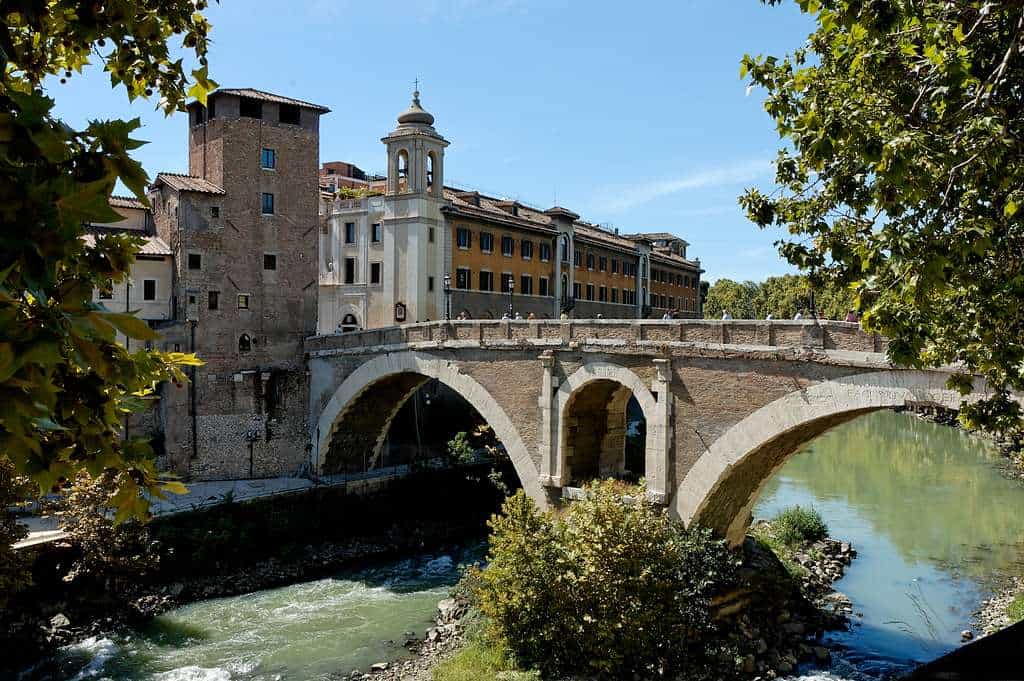
The tour begins at the Ponte Fabricio, a bridge over the Tiber River (map).
It's within walking distance of other must-see sites in Rome.
It's 10 minutes from the Capitole museums, 10 minutes to the Basilica di Santa Cecilia in the neighborhood of Trastervere, and 20 minutes to the Forum and Colosseum.
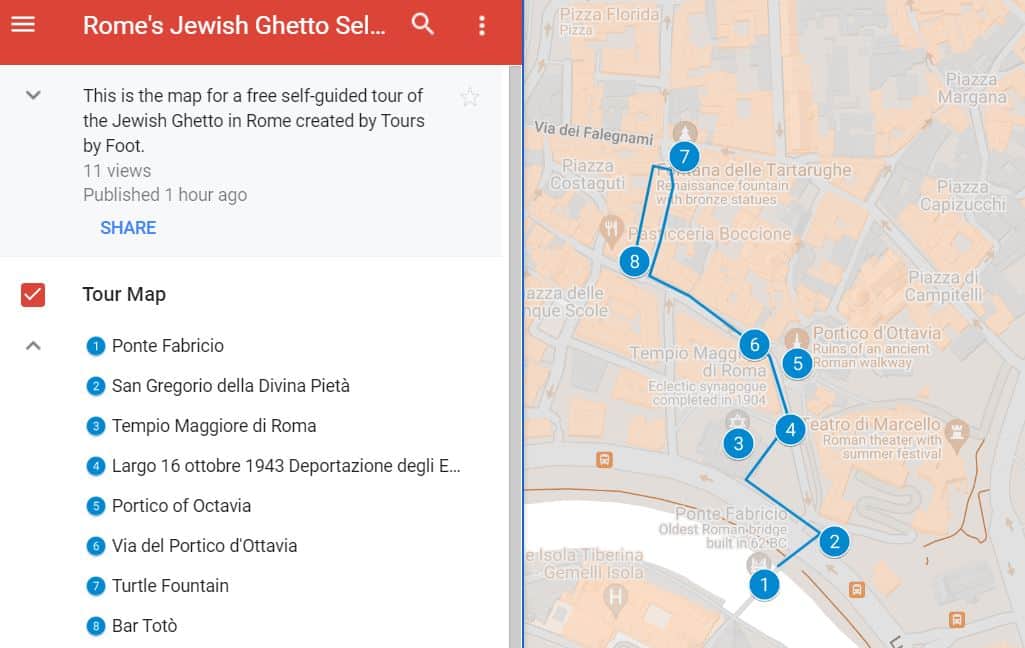
Click on the map to enlarge it or to download it to a smartphone.
What is the Jewish Ghetto in Rome?
Now I know that the word ghetto doesn’t imply a neighborhood one wants to explore.
But this is one of the most popular neighborhoods to spend time in for both travelers and locals.
This Jewish neighborhood in Rome is charming, filled with bars and restaurants, some serving Roman-Jewish cuisine with recipes dating back to the early centuries.
So, what’s up with the name?
I love history, but I will not go into too many details of how the Jewish Ghetto came to be. But I do need to offer some history of the Roman Jews who lived here for more than 2,000 years.
The locations in this self-guided tour need context especially since some are from ruins from ancient times.
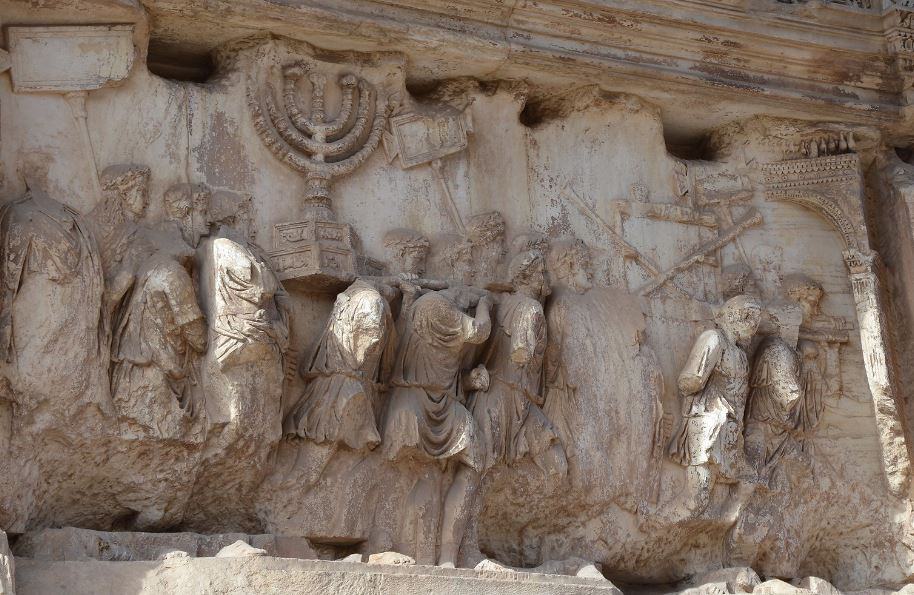
As far back as 161 BC, Jews from the region then known as Judea (Israel and Palestine) moved to Rome.
Jews in Ancient Rome were initially welcomed, but attitudes changed in the mid-1st century BC through the 2nd century AD.
Many Jews were enslaved. The Jewish community was exiled. Decades later they were welcomed back.
Attitudes swung back and forth, but when Christianity became the religion of the Holy Roman Empire in 326 AD, Jews were less and less tolerated.
Over the following centuries, anti-semitism grew in what is modern-day Europe.
In 1555, Pope Paul IV revoked the rights of all Jews living in Rome.
Most Jews lived in an enclave (as people of the same culture and religion often do).
The Pope had walls built around the area with just two gates. This area became known as the “Jewish Quarter”, and eventually the “Jewish Ghetto.”
Today, ghetto and quarter are interchangeable.
Whatever you call it, it is a must-see part of Rome.
1. Ponte Fabricio
Rome is known for its ancient bridges spanning the Tiber River.
While Ponte Fabricio is not the prettiest bridge (that would be Ponte Sant’Angelo), it is the oldest.
It dates back to 62 BC, making the bridge well over two thousand years ago.
The bridge connects Tiber Island and the Jewish Ghetto and is in surprisingly good condition and is in use to this day.
In the Middle Ages, it was known as the Jew’s Bridge because it connected the neighborhood of Trastevere (another Jewish section in Rome) to the Jewish Ghetto, by way of Tiber Island.
Seeing ancient structures is fascinating to me. But what I enjoy the most is bringing these old places back to life in a way.
We do that through historical facts, stories, and names related to these sites. So let’s bring this ancient bridge to life. Here's how.
Find a spot on either Tiber Island or on the Jewish Ghetto side of the bridge where you can see its arches.
You’ll see a Latin inscription saying “Lucius Fabricius, Son of Gaius, Superintendent of the roads, took care and likewise approved that it be built”.
Now we know how the bridge got its name! Fabricio…Fabricius.
Either one, he did a pretty good job!
2. Chiesa di San Gregorio della Divina Pietà
This small chiesa (church) is to the right as you come off the Ponte Fabricio, at 9 Monte Savello Square.
One aspect of Rome that makes it such an interesting city to me is that it is a city of layers.
So many buildings were built on top of older buildings that were no longer wanted, were damaged, or, as in the case of ancient structures, in total ruin.
This church has many layers. The date it was built is unknown, but a reference to it dates to the 15th century.
It is said to have been built on the site where St. Gregory the Great (San Gregorio) was born or lived around the mid-6th century.
Before that, there are hints that an important family in the Roman Empire lived here in the early 1st century.
In the early 18th century, Pope Benedict XIII Orsini di Gravina commissioned a restoration. Then in 1858, it underwent a second restoration.
At that time an inscription in Latin and Hebrew above the entrance.
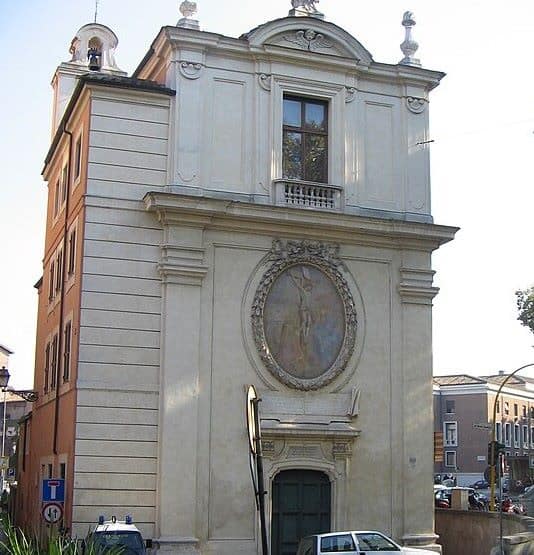
When I first saw the church I was intrigued as to why Hebrew writing was on a church.
At the time of the second restoration, the Pope required Jews in the ghetto to attend Catholic sermons on the Sabbath at the church.
Naturally, the Jews resisted this forced worship of a religion not their own.
The inscription is a passage from the Old Testament from the Book of the Jewish Prophet Isaiah in which God complains about the stubbornness of the Jews.
The church had flipped this passage on its head by implying that God was angry that the Jews in the ghetto refused to participate in Catholic worship.
3. il Tempio Maggiore (Great Synagogue)
Just a few streets from the church is the Great Synagogue of Rome, completed in 1904.
Just 50 years earlier Jews were confined to the ghetto and compelled to worship Christ at the nearby church.
What happened in the time between the addition of that inscription and the construction of the magnificent synagogue?
After the unification of Italy in 1870, Jews were granted equal civil rights and Jews were free to worship as they wanted.
The Jews decided to demolish the building that housed the five ancient synagogues and build the most impressive synagogue in Rome.
They succeeded and it’s the city’s largest and grandest synagogue with an active congregation.
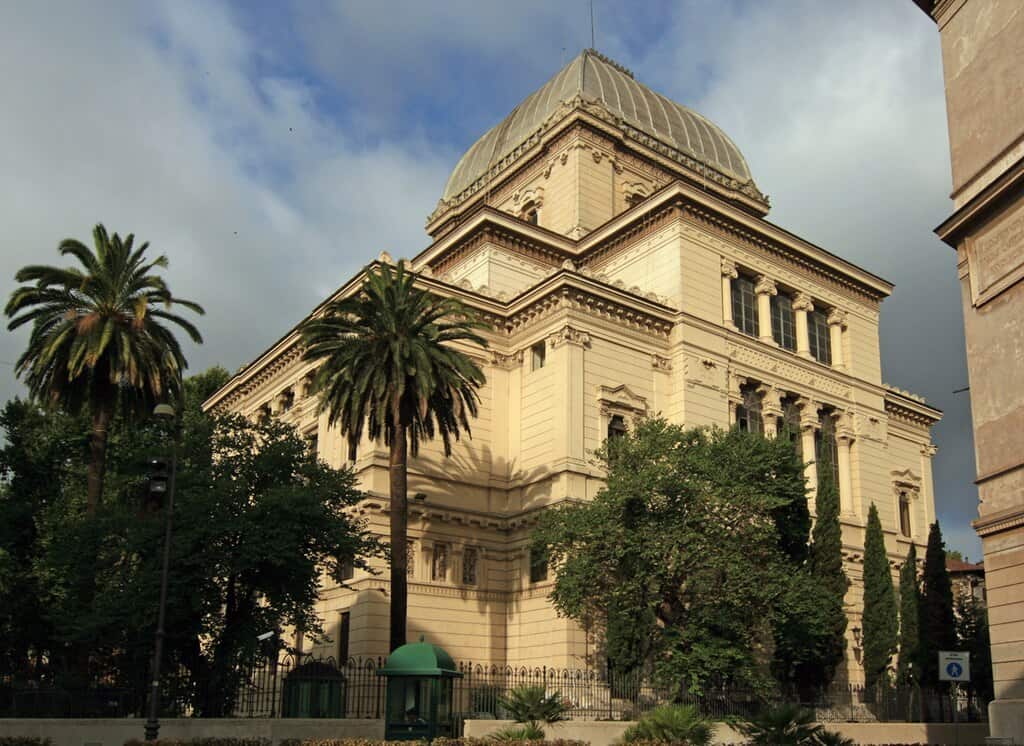
The synagogue is home to the Jewish Museum of Rome and it is one of the best places to learn about Judaism in Rome.
Tickets include a guided tour of the synagogue and entry to the museum with an audio guide in several languages.
Tickets cost €11 for general admission, €5 for students and free for children under 10. Other concession prices are offered.
You can get a reduced price of €8 with the Roma Pass, which saves you money on admission to many other top attractions in Rome.
The museum offers a discount for anyone who has already visited either the MAXXI Museum or the Conservatory of Santa Cecilia.
TIP: While the MAXXI Museum isn’t at the top of most lists for the best museums in Rome, I think it is worth a visit if you have the time or are interested in modern exhibitions and innovative performances.
4. Largo 16 Ottobre 1943
Largo 16 Ottobre 1943 (October 16 1943 Square) is a public square that memorializes the date that more than 2,000 Jews of the ghetto were rounded up by the German Gestapo and deported to the death camp of Auschwitz.
Only 16 of them survived.
Despite this horrific outcome, I found I was touched when I visited the square because of what I learned about the Italian treatment of Jews during the German occupation of Italy in World War II.
At the time of the occupation, it is estimated that 35,000 Jews lived in Italy. I was surprised to learn that some non-Jewish Italians, including government officials, shielded Jews from Nazi persecution.
Some Jews were interned in labor camps, but other Jews didn't obey orders to go.
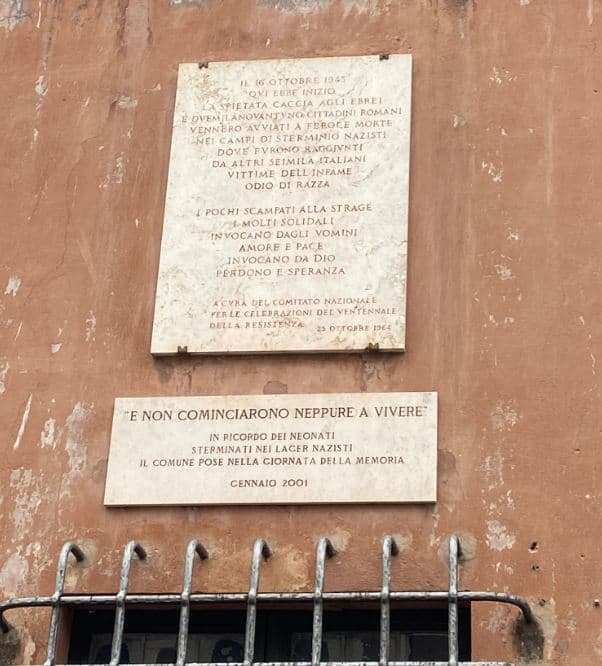
Though 8,000 Italian Jews perished in the Holocaust, this is considerably fewer people than in the rest of Europe.
Approximately 80% of Italy’s Jews survived the war. Today there are just under 28, 000 Jews in Italy.
On April 13, 1986, the first-ever recorded papal visit to a synagogue took place when Pope John Paul II stepped into the Great Synagogue.
He spoke about the kinship between Catholics and Jews saying, “You are our favorite brothers, our older brothers.”
Fourteen years later, he acknowledged for the first time Catholic involvement in the persecution of the Jews.
He spoke of the “burden of guilt” Christians bore “for the murder of the Jewish people” at any time in history, including the Holocaust.
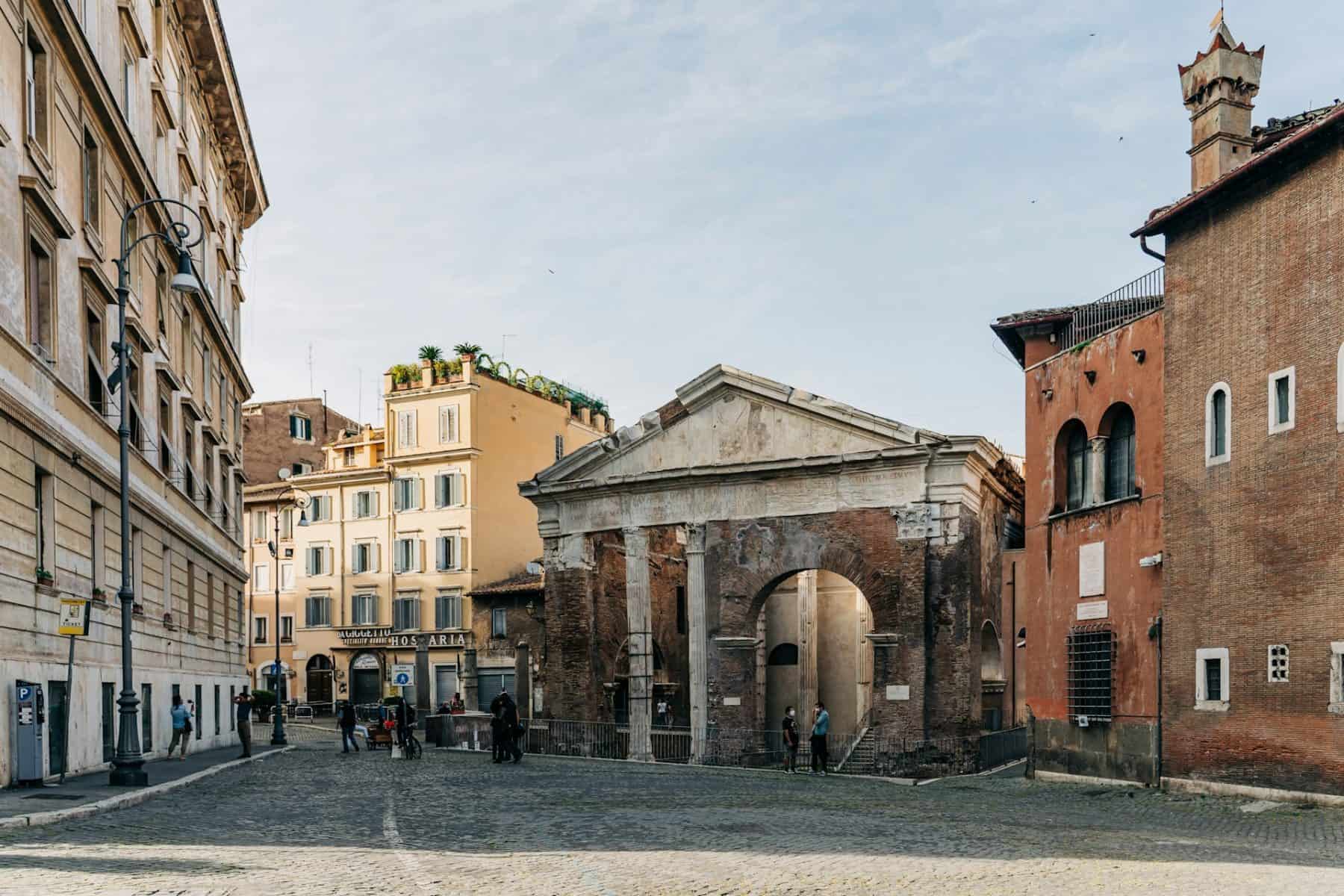
6. Portico d’Ottavia
A portico in Ancient Rome was the front of a building and the Portico d’Ottavia is a fine example of the architectural features found in such buildings.
While not the most monumental ruin in Rome, I like that it is a small remnant from ancient times sitting amidst the vibrant surroundings. I also like that it is another site that reveals Rome’s layers of history.
The initial portico was built in the 2nd century BC by a wealthy Roman named Cecilius Metellus.
It was rebuilt by Emperor Augustus, at some point after he came in 27 BC, following the assassination of his great uncle Julius Caesar. He named it after his sister Octavia.
The portico once had two temples (one to Jupiter and the other to Juno). Octavia added a library.
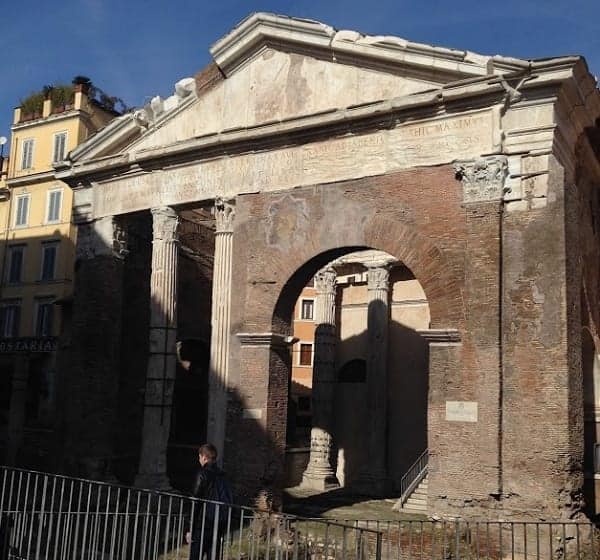
In the Medieval era, the structure was used as a fish market and in the 8th century, a small church was built. It was named Sant'Angelo in Pescheria (in Pescheria translates to ‘in the fish market’.
Walk through the portico, which you can and should -- it’s free) to do so.
I like to imagine people praying to Roman gods, then later individuals buying fish and then others attending a service in a small church.
It's amazing how one small site can transport you through more than 2,000 years of Roman society.
7. Via del Portico d’Ottavia
This avenue, about a block in length, is the main street of this Jewish section of Rome.
Via del Portico d’Ottavia is lined with kosher and kosher-style restaurants and a few shops selling Judaica, items representative of the Jewish religion, like prayer books and candelabra.
As you walk along Via del Portico d’Ottavia, stop at the intersection of Piazza Costaguti and stand facing the pastry shop, Pasticceria Boccione.

Here you can see a telling juxtaposition of old and new.
The left side of this photo above has modern buildings while to the right is Via del Portico d’Ottavia with some of the only remaining ghetto buildings.
TIP: If you are hungry, I highly recommend you grab pastries here at the wonderful Pasticceria Biccione.
Try the torta ricotta e visciole, a cake filled with sour cherries and sweet ricotta cheese using a 50-year-old recipe.
Expect a line but it's worth the wait!
8. Fontana delle Tartarughe (Fountain of the Turtles)
One of my favorite spots in this Jewish section of Rome is the small Piazza Mattei, home to the small but elegant Fontana delle Tartarughe.
It was built between 1581 and 1588 on a project by Giacomo Della Porta for the wealthy noble Mattei family who gave the square its name.
The fountain’s name is for the bronze turtles added in 1658 by Gian Lorenzo Bernini, master sculptor and architect.
This fountain wasn’t built solely for its beautification of the square. It supplied the area with fresh water.
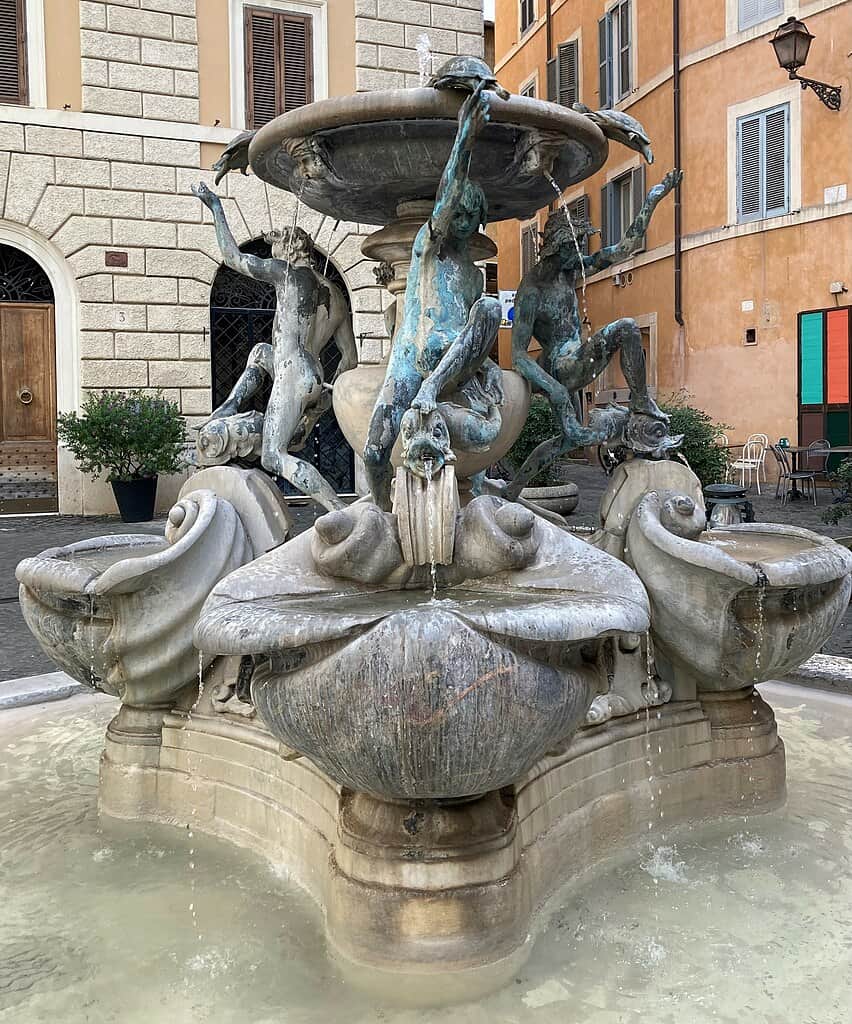
This playful fountain has a dark side though, as so many sites in the Jewish Ghetto do.
The fountain was just outside the gates of the ghetto that closed from sundown to sunrise.
This denied the residents of the ghetto access to fresh water. It wasn't until 300 years later when the Jewish ghetto was torn down that the residents could finally get fresh water at any time.
On a side note, the fountain has appeared in two movies.
In "The Talented Mr. Ripley" (1999) Tom (Matt Damon) drags Freddie (Jude Law) out of his apartment on the piazza. On Tom’s way back home, you can catch a glimpse of the fountain.
The fountain also appears in Woody Allen’s 2012 movie “To Rome with Love”.
9. Bar Toto & More
This old bar is known mostly for its facade which features ancient marble plaques and statues.
This old-style bar‘s facade is a window into Rome’s history.
Above the doorway, you'll see fragments of ancient marble plaques on the left and the heads of statues to the right.
These remnants are decorative as they were not here in ancient Roman times.
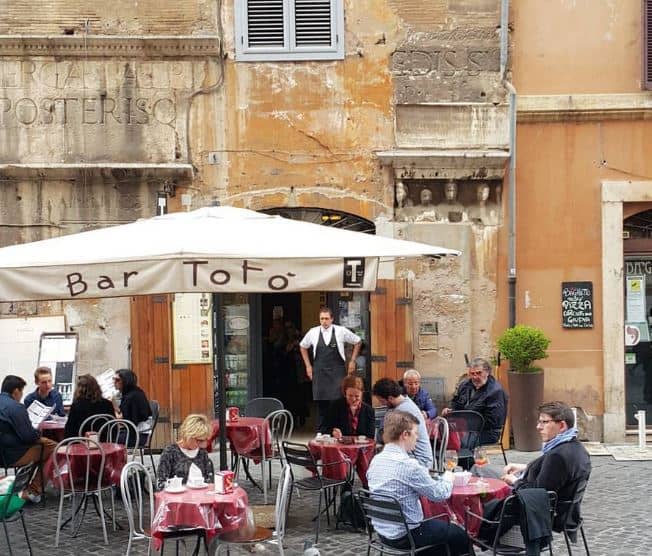
They were taken from ancient Roman ruins and used to construct this building from the Renaissance.
At that time, ruins were not considered valuable archeological sites but were regarded as quarries that provided construction materials.
To the side of Bar Toto’s door is a small slot in the wall, a charity donation box for the orphans who lived in the ghetto.
These are just a few of the sites to see in the Jewish Ghetto, but there is so much culture on display here that we recommend taking an audio tour to learn even more.
Be sure to check out our other self-guided walks of Rome, including Central Rome, Vatican City, the Colosseum and the Roman Forum.
We also offer free guided tours of Rome.
Related Posts
