

Boston's subway system, known as the T, is one of the easiest ways for visitors to get around the city.
The T connects many of Boston's most popular neighborhoods and attractions, including Boston Common, the Freedom Trail, Faneuil Hall, the North End, Fenway Park, Back Bay, Cambridge, and the waterfront. It can also help you get to and from Logan International Airport.
If you're visiting Boston for the first time, figuring out which line to take, where to buy a ticket, and how much the ride will cost can seem confusing at first. But once you understand the color-coded lines and a few basic rules, using the Boston T is relatively simple.
This guide explains how to use the Boston subway, including the subway map, T lines, fares, CharlieCards, contactless payment, subway stops for tourists, and tips for riding the T like a local.
- Boston Subway Map
- Boston Subway Lines
- Boston Subway Fares & Tickets
- Boston Subway Stops for Tourists
- How to Use the T Like a Local
- Boston T FAQs
- Subway vs. Hop-On-Hop-Off Bus
- Boston Discount Passes
- Things to Do in Boston
Boston Subway Map
The Boston subway system is operated by the Massachusetts Bay Transportation Authority (MBTA) and is commonly called the T.
The subway is organized into color-coded lines, making it relatively easy to determine which train you need.
View the current MBTA subway map before your trip. The MBTA updates its maps and service information, so it's a good idea to check the official map rather than relying on an older printed version.
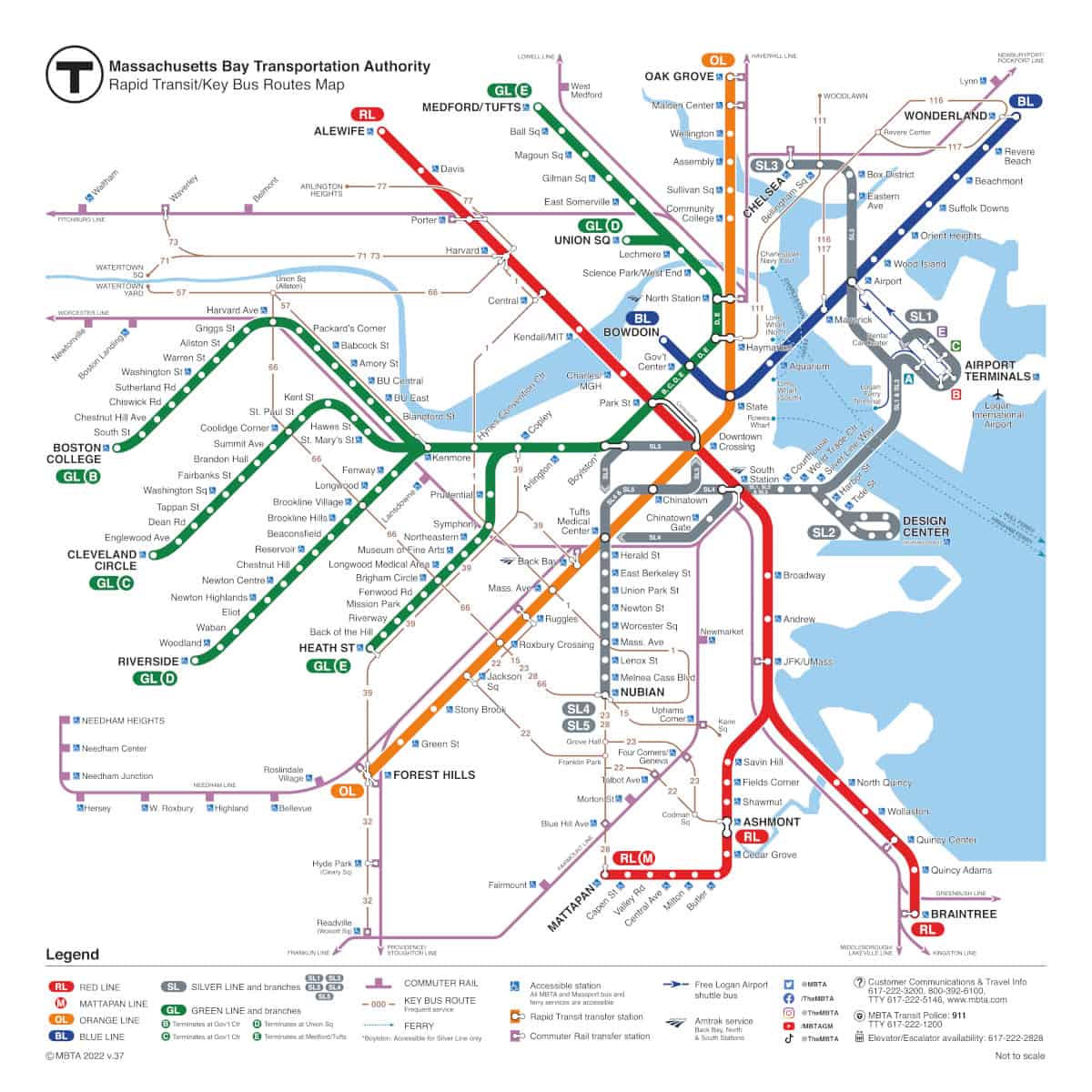
Boston T Lines
The Boston subway system includes the Red, Orange, Blue, and Green Lines, as well as the Mattapan Trolley.
Each line serves different parts of Boston and the surrounding area.
Blue Line
The Blue Line connects downtown Boston with East Boston, Logan International Airport, and Wonderland.
For visitors, some of the most useful stops include:
- Aquarium – New England Aquarium and Boston Harbor
- State – Old State House and downtown attractions
- Airport – Logan International Airport connection
The Blue Line is particularly useful if you're traveling between downtown and Logan Airport.
Green Line
The Green Line serves several neighborhoods and destinations in Boston, including Back Bay, Fenway, Kenmore Square, the Museum of Fine Arts, and parts of Cambridge and Somerville.
The Green Line is made up of several branches, so pay attention to the destination displayed on the train.
Useful stops for visitors include:
- Park Street – Boston Common and the Freedom Trail
- Boylston – Boston Common and Boston Public Garden
- Copley – Copley Square and the Boston Public Library
- Kenmore – Fenway Park
- Museum of Fine Arts – Museum of Fine Arts
Orange Line
The Orange Line runs through several important parts of Boston and is particularly useful for visitors exploring downtown and Back Bay.
Popular stops include:
- State – Old State House and downtown
- Haymarket – North End and Faneuil Hall area
- North Station – TD Garden
- Back Bay – Back Bay neighborhood
- Chinatown – Chinatown and the Theatre District
Red Line
The Red Line is especially useful for visitors heading to Cambridge and some of Boston's major cultural and historic attractions.
Popular stops include:
- Park Street – Boston Common
- Downtown Crossing – downtown Boston
- South Station – transportation hub
- Harvard – Harvard University
- Kendall/MIT – MIT
- JFK/UMass – connection to the John F. Kennedy Presidential Library area
Mattapan Trolley
The Mattapan Trolley is an extension of the Red Line system that runs between Ashmont and Mattapan.
It is primarily useful for reaching neighborhoods south of Boston rather than the major tourist attractions in the downtown area.
How Do You Know Which Train to Take?
Look at the destination displayed on the front and side of the train.
The color of the line tells you which route you're on, but the destination tells you which direction the train is traveling.
When in doubt, check the station signs and the MBTA map before boarding.

Boston Subway Fares & Tickets
One of the easiest ways to pay for the Boston T is with contactless payment.
The MBTA's new Charlie fare system is being rolled out in stages and supports contactless payment options. Riders can use a contactless credit or debit card, mobile device, or wearable to pay for eligible trips.
Standard CharlieCards are also still available and can be loaded with stored value or passes.
How Do You Pay for the T?
Visitors have several options, depending on the type of trip and service they're using.
You can generally pay using:
- A contactless credit or debit card
- A mobile wallet or compatible wearable
- A CharlieCard
- A CharlieTicket
- Other MBTA fare products for applicable services
For the most current fares and payment options, check the MBTA website.
Contactless Payment on the Boston T
If you have a contactless credit or debit card, paying for a subway ride can be particularly easy.
Simply tap your card or compatible mobile device at the fare gate when entering the subway.
Tip: If you're using a physical contactless card, use the same card throughout your trip rather than switching between a physical card and a mobile wallet. This helps ensure your trips are properly associated with the same payment method.
CharlieCards
A CharlieCard is a reusable fare card that can be loaded with value or eligible passes.
Standard CharlieCards are available at fare vending machines, retail locations, and other designated locations throughout Greater Boston.
The MBTA is transitioning to its new Charlie fare system, so visitors may see both the existing CharlieCard system and newer contactless payment equipment while the transition continues.
What About the Commuter Rail?
The Commuter Rail is different from the subway.
The T's subway lines are designed primarily for getting around Boston and nearby communities. The Commuter Rail connects Boston with communities farther outside the city.
Commuter Rail fares are based on zones and are separate from standard subway fares.
If you're taking a day trip outside central Boston, check the fare requirements for your specific Commuter Rail destination.
Boston Subway Stops for Tourists
You don't need to memorize the entire Boston subway system to get around.
If you're visiting Boston, these are some of the most useful T stops for major tourist attractions.

Boston Common
Park Street
Served by the Red and Green Lines.
Boston Common is one of the best starting points for exploring downtown Boston and the Freedom Trail.
Faneuil Hall and Quincy Market
State
Served by the Blue and Orange Lines.
This is also a convenient stop for exploring downtown and connecting with other parts of the T.
Paul Revere House and Old North Church
Haymarket
Served by the Orange and Green Lines.
From Haymarket, it's a short walk into Boston's historic North End.
New England Aquarium
Aquarium
Served by the Blue Line.
This station is particularly convenient if you're visiting the aquarium or exploring Boston Harbor.
Chinatown and the Theatre District
Chinatown
Served by the Orange Line.
Downtown Crossing is also nearby and provides connections to several destinations.
Bunker Hill Monument and USS Constitution
Community College
Served by the Orange Line.
You'll have a longer walk from the station to Charlestown's historic sites, but the T can still be useful for reaching the neighborhood.
Harvard University
Harvard
Served by the Red Line.
This is the most convenient T stop for exploring Harvard Square and Harvard University.
Museum of Fine Arts
Museum of Fine Arts
Served by the Green Line.
This station is convenient for the Museum of Fine Arts and nearby attractions.
How to Use the Boston T Like a Local
Boston's subway system isn't difficult to use, but a few simple tips will make your trip easier.
Let passengers exit before you board
When a train arrives, stand to the side of the doors and allow passengers to get off before you enter.
It sounds obvious, but blocking the doors is one of the easiest ways to identify yourself as a visitor.
Check the destination before boarding
Don't just look for the color of the line.
Check the destination displayed on the train and make sure you're traveling in the direction you want.
This is especially important on the Green Line, which has multiple branches.
Keep your fare ready
If you're using contactless payment, have your card or phone ready before you reach the fare gate.
If you're using a CharlieCard, make sure it has sufficient value or the appropriate pass loaded before you travel.
Be aware of rush hour
Boston's T can become crowded during weekday commuting hours.
If your sightseeing schedule is flexible, traveling outside the busiest periods can make your trip considerably more comfortable.
Give up priority seats when needed
Some seats are designated for passengers with disabilities or other accessibility needs.
If someone who needs the seat boards, offer it to them.
Don't block the doors
If you're not getting off at the next stop, move away from the doors when possible.
This gives other passengers room to enter and exit.
Keep an eye on service alerts
The MBTA provides current service alerts and other information for riders. Check for disruptions before heading out, especially if you have a timed attraction or tour reservation.
Does the Boston Subway Have Tap-to-Pay?
Yes. You can use a contactless credit or debit card to pay for many MBTA trips.
The MBTA's new Charlie fare system introduced contactless payment options at subway stations and on eligible MBTA services, making it much easier for visitors to get around Boston without purchasing a separate transit card.
If your credit or debit card has the contactless symbol, you can simply tap it at the fare gate or payment reader when boarding.
You can also use a compatible mobile wallet or wearable device.
For visitors, this is often the easiest option because you may not need to purchase a CharlieCard before riding the T.
Tip: Use the same payment method throughout your trip. For example, if you start by tapping your physical credit card, continue using that same card rather than switching between the physical card and your phone. This helps make sure your trips are properly associated with the same payment method.
For the latest information about contactless payment and the Charlie system, check the MBTA's official Charlie website.
CharlieCards and Boston T Passes
If you're staying in Boston for several days or expect to use public transportation frequently, you may want to consider a transit pass instead of paying for individual rides.
The MBTA offers several fare options, including CharlieCards, CharlieTickets, and unlimited travel passes.
CharlieCards
A CharlieCard is a reusable transit card that can be loaded with stored value or eligible passes.
CharlieCards can be useful if you expect to use the T frequently during your visit. They can also be reloaded when you need additional value.
However, you don't necessarily need a CharlieCard if you're comfortable using contactless payment with your credit card or mobile device.
Is a Boston T Pass Worth It?
For visitors, the answer depends on how much you'll use public transportation.
If you're planning to walk between many of Boston's attractions and only use the T occasionally, paying for individual rides may be the simplest option.
If you're staying several days and expect to use the subway and buses frequently, an unlimited pass may save you money and make getting around easier.
The MBTA offers daily, weekly, and monthly pass options. Check the current fares before purchasing, since prices and fare rules can change.
You can purchase eligible passes and fare products at MBTA fare vending machines and other designated locations.
Can You Share a CharlieCard or Pass?
Be careful about sharing transit passes with another person.
Some passes have restrictions on how quickly they can be used again after being tapped. If you're traveling with a group, it's better to understand the current fare rules before trying to use one pass for multiple people.
For current fare prices, pass options, and payment rules, check the MBTA's official fare information.
What Is a CharlieCard?
A CharlieCard is a reusable transit card used to pay for rides on Boston's MBTA public transportation system, including the subway and buses.
CharlieCards were introduced in 2006 as part of an upgrade to Boston's fare system, replacing the old system of tokens and monthly subway passes. Today, you can load money onto a CharlieCard or use it with eligible MBTA passes.
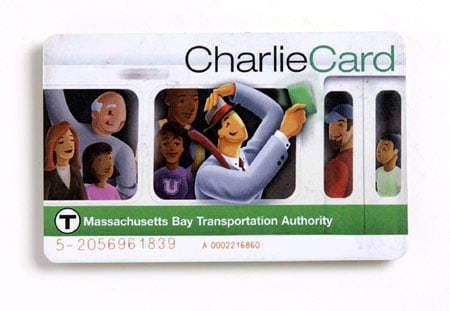
The name CharlieCard comes from the Kingston Trio's 1959 song “Charlie on the MTA,” which tells the story of a passenger who gets stuck on Boston's subway because he doesn't have enough money to pay another fare.
The Charlie Card was introduced in 2006 and previously it was just called a Subway Pass for monthly holders and tokens were purchased for daily riders.
When the system was upgraded, the tokens were removed from the system and all fares had to be purchased with either a card (that can be reloaded) or a paper ticket.
When deciding on a new name for the Card, a few of the rejected names included:
The Fare Cod, making a joke about the way Bostonians pronounce the word card and the fish that is associated with Boston, as well as the T Go Card; which let’s face it, is a boring name.
The name for the Charlie Card was taken from the Kingston Trio Band's song Charlie on the MBTA.
Where Can You Get a CharlieCard?
CharlieCards are available at select MBTA stations, customer service locations, and participating retail locations. Availability can change, so check the MBTA website for the most current information before your trip.
Do you need a CharlieCard? Not necessarily. For many visitors, using a contactless credit or debit card, smartphone, or wearable device is the easiest way to pay for individual T rides.
If you're planning to use public transportation frequently during your visit, however, a CharlieCard or unlimited travel pass may be worth considering.
Boston T Fun Fact: Look for the Art
Boston's transit system is more than a way to get around. The MBTA has one of the country's oldest public art programs, with artwork displayed throughout its stations.
As you travel around Boston, keep an eye out for murals, sculptures, mosaics, and other artwork created by professional artists and Boston-area students. It's an easy way to experience a little more of the city while you're getting from one attraction to another.
Boston T FAQs
What is the Boston subway called?
Boston's subway system is commonly called the T.
The official agency is the Massachusetts Bay Transportation Authority, or MBTA.
Does Boston have a subway?
Yes. Boston has a subway system that is part of the MBTA.
The system includes the Red, Orange, Blue, and Green Lines, along with the Mattapan Trolley.
Can I use a credit card on the Boston T?
Yes. The MBTA's new Charlie fare system supports contactless payment, allowing riders to use compatible contactless credit or debit cards and mobile devices.
Do I need a CharlieCard to ride the Boston subway?
No. You don't necessarily need a physical CharlieCard.
Contactless payment is available through the MBTA's Charlie system, while standard CharlieCards remain available for riders who prefer to use one.
Can children ride the T for free?
Children age 11 and younger can ride MBTA services for free.
Other riders, including seniors and people with disabilities, may qualify for reduced fares.
Can I get from Boston to Logan Airport by subway?
Yes.
The Blue Line connects downtown Boston with the Logan Airport area. From the Airport station, travelers can use the airport shuttle connection to reach their terminal.
Is the Commuter Rail the same as the T?
No.
The subway, commonly called the T, primarily serves Boston and nearby communities. The Commuter Rail is a separate regional rail system designed to connect Boston with communities farther away.
Why is the Boston subway called the T?
The letter T is used as the symbol for the MBTA's rapid transit system.
You'll see the T symbol on station signs, maps, and other transit information throughout Boston.
What are peak hours on the Boston T?
Peak travel periods generally occur during weekday morning and afternoon commuting times.
If you're sightseeing, traveling outside the busiest commuting periods can make the subway more comfortable.
Can I bring a bicycle on the T?
Bicycle rules vary by service, time, and location. Check current MBTA bicycle policies before bringing a bike onto the subway.
Tips From Reddit
Sometimes the best public transportation advice comes from people who actually use the system.
We found a Reddit discussion from a visitor asking locals for advice about using the T, including how to pay, navigating the Green and Blue Lines, and getting to attractions such as the New England Aquarium. Boston-area riders responded with practical tips for first-time visitors.
If you're new to Boston's public transportation system, it's worth taking a look at the discussion for additional perspectives from people who use the T regularly.
Remember: Reddit is useful for personal experiences and practical tips, but always check the MBTA for current fares, schedules, service changes, and closures.
Boston Subway vs. Hop-On-Hop-Off Bus
The T and a hop-on-hop-off sightseeing bus serve very different purposes.
The T is public transportation. It's primarily designed to get you efficiently from one part of Boston to another.
A hop-on-hop-off bus is a sightseeing experience. You pay more, but you get transportation combined with commentary and stops near major attractions.
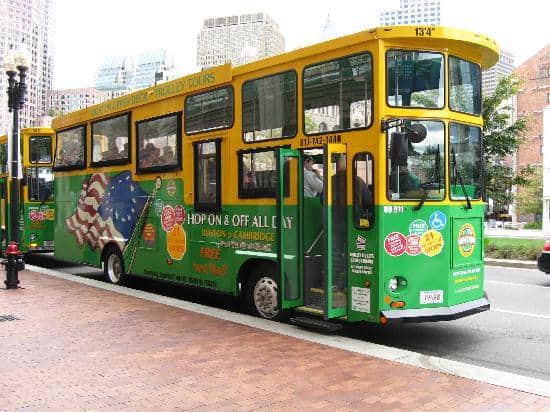
This photo of Boston Upper Deck Trolley Tours is courtesy of TripAdvisor
Advantages of a Hop-On-Hop-Off Bus
- Convenient stops near major tourist attractions
- Live commentary during the ride
- A sightseeing experience as well as transportation
- Easy option for visitors who don't want to navigate the T
- Useful for seeing several parts of Boston in a short period
Disadvantages of a Hop-On-Hop-Off Bus
- More expensive than public transportation
- Traffic can slow the buses down
- Wait times can vary
- Buses can become crowded during busy travel periods
Advantages of the Boston T
- Affordable
- Useful throughout the city
- Frequent service on many routes
- Avoids much of Boston's street traffic
- A good choice for getting between neighborhoods and attractions
- Lets you travel around Boston the way many locals do
Disadvantages of the Boston T
- Some stations are not fully accessible
- Service disruptions and delays can occur
- Trains can become crowded
- There is no sightseeing commentary
- Navigating unfamiliar stations can take some practice
If your main goal is getting somewhere, the T is often the better choice.
If your goal is seeing Boston while someone else handles the navigation, a sightseeing bus may be a better fit.
You can also combine the two: use the T for transportation and take a sightseeing bus when you want a guided overview of the city.
Boston Public Transportation for Tourists
For most visitors, you don't need to understand every part of the MBTA system.
Learn the major T lines, identify the closest station to your destination, and check the direction of the train before boarding.
Boston is also a very walkable city. Many major attractions are close enough together that you may find yourself using the T for only a few trips during your visit.
For example, you could take the T to Park Street, explore Boston Common and the Freedom Trail on foot, continue through downtown and the North End, and then use the T again when you're ready to return to your hotel.
That's one of the best things about visiting Boston: the subway gets you where you're going, and then you can explore the city on foot.
And if you want to explore Boston with a local guide, check out our Boston walking tours. Our tours start and end within walking distance of T stations, making it easy to combine a tour with public transportation.