

Part of understanding New Orleans’ past is to learn about the city’s historic cemeteries. There are 42 of them!
Unless you are a historian, I can't imagine you want to devote too much time to seeing the city’s cemeteries when New Orleans is bursting with life!
As a local tour guide, I’ve led thousands of guests over the years through NOLA’s famous cemeteries and those that are lesser-known but still worth a visit.
When I give a cemetery tour, there are always a few of my tour guests who want to know which others to visit on their own.
Well, I could recommend at least a dozen. Each has a unique character and history. No two are alike which is why they are so special.
When writing this guide to New Orleans Cemeteries, my fellow tour guides and I settled on 8 cemeteries to see.
But if that’s too many (and I can see what that would be!), we narrowed down our list to 5 must-see cemeteries.
Below you’ll find detailed descriptions so you can choose which to see as well as some basics of New Orleans cemeteries in general.
Also included are tips for your visit and a list of guided tours (including our own).
In the video below, my fellow tour guide Andrew takes you on a tour of Metairie Cemetery.
- Why Above-Ground Buials?
- Types of Tombs
- St. Louis Cemetery #1
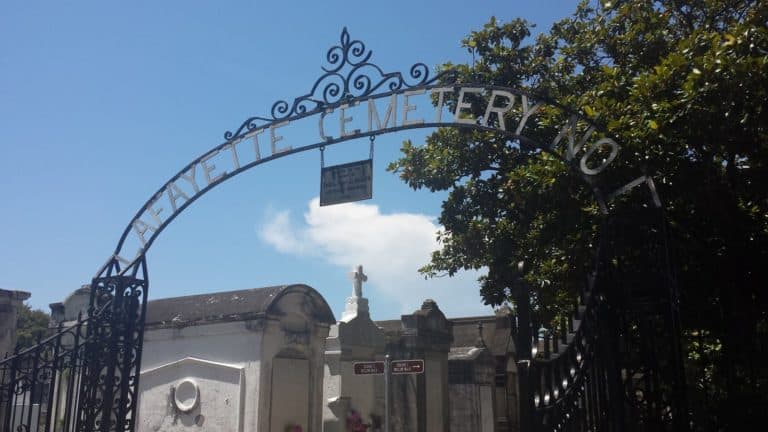
- Lafayette Cemetery #1
- St. Louis Cemetery #3
- Other Cemeteries
- Tips for Visiting Cemeteries
- Guided Tours
WHY ARE PEOPLE BURIED ABOVE GROUND IN NEW ORLEANS
New Orleans was founded by the French in 1718 as a tiny outpost situated on a bend in the Mississippi River and surrounded by cypress swamps.
Usually, the early settlers would bury residents in the highest ground in the area, the levee.
However, this was problematic in a city that still tended to flood every few years.
Bodies or caskets would be revealed when the water came and washed away the soil around their final resting places.
In 1722, an official cemetery, the St. Peter Cemetery, was built on the outskirts of the tiny village.
Back then, there were burials, but problems associated with our high water table and flooding continued.
In 1788, a new cemetery, St. Louis Cemetery (today's St. Louis #1) was built, St. Peter Cemetery was deconsecrated, and the lots were sold for building residences.
The bodies of the dead are buried in graves the old cemetery remained and are occasionally unearthed during renovations on that block.
Around 1800, New Orleans began the current custom of above-ground interment, inspired by the cemeteries in European cities.
This custom, so practical in New Orleans, soon became standard practice and continues today.
TYPES OF TOMBS AND INTERMENTS IN NOLA
The tombs in the cemeteries of New Orleans are works of art, and as such, there is no limit to the styles one will find.
The question I hear the most from guests on my cemetery tours is why so many tombs look different in style and size.
Here’s the answer. Tomb styles are related to who is buried there and their status.
The four most common types are family tombs, society tombs, wall vaults and coping tombs.
Family Tombs
These are the most common types of tombs.
These mausoleums usually feature 2-3 chambers stacked upon each other but can hold 40-50 deceased family members.
When all of the chambers are occupied and a new corpse needs to move in, the one that has been in the longest is taken out.
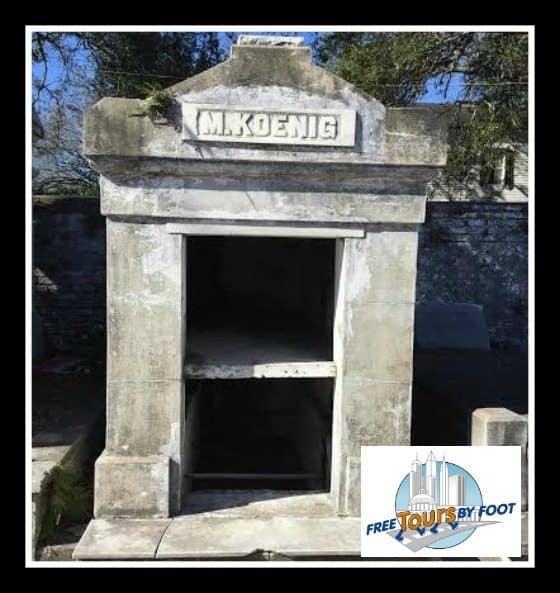
The remains are bagged, labeled, and placed in a below-ground box called a caveau.
The new occupant is put in the chamber, the chamber opening is bricked up, and the closure tablet is screwed in place.
This process is repeated every time the tomb is needed.
Society Tombs
These are large tombs that can hold the remains of hundreds of dead.
They belong to benevolent associations, religious orders, workers' unions, immigrant groups, or charitable organizations.
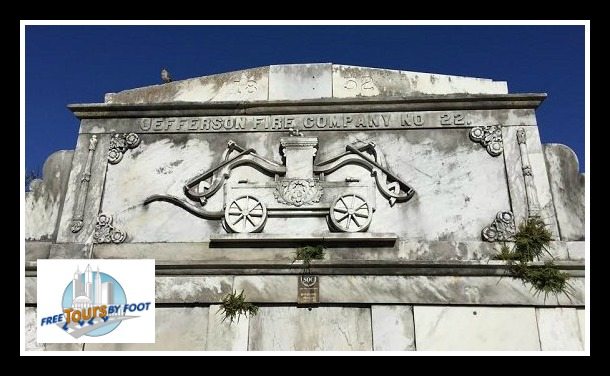
In life, members paid dues to the society, and in death were allowed to be buried in the society tomb.
They range from simple rows of tombs to elaborate structures such as Jefferson Fire Company #22 (image below).
Wall Vaults
Often, the walls of the cemeteries are made of burial chambers.
These are sometimes called “oven vaults” because they resemble old-style ovens.
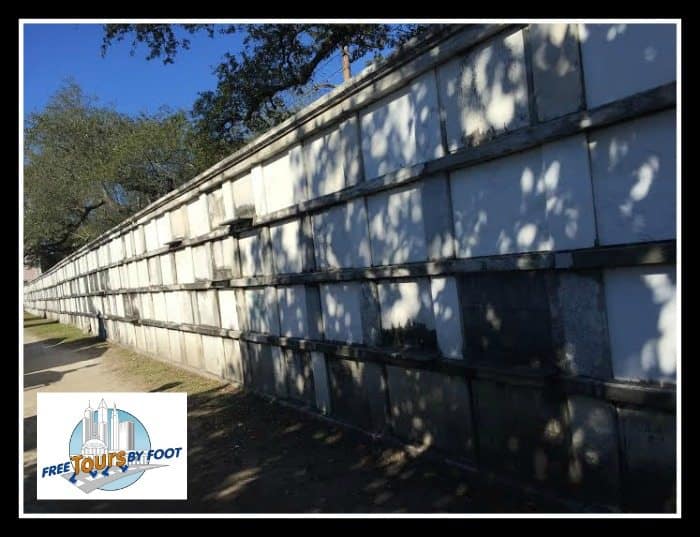
Wall vaults are a less expensive alternative to building a family tomb, but only 6-8 occupants can fit inside.
Wall vaults line the inside of exterior cemetery walls.
Coping Tombs
Coping Tombs are used when, for religious or personal reasons, the deceased wished to be buried in the earth but died in New Orleans.
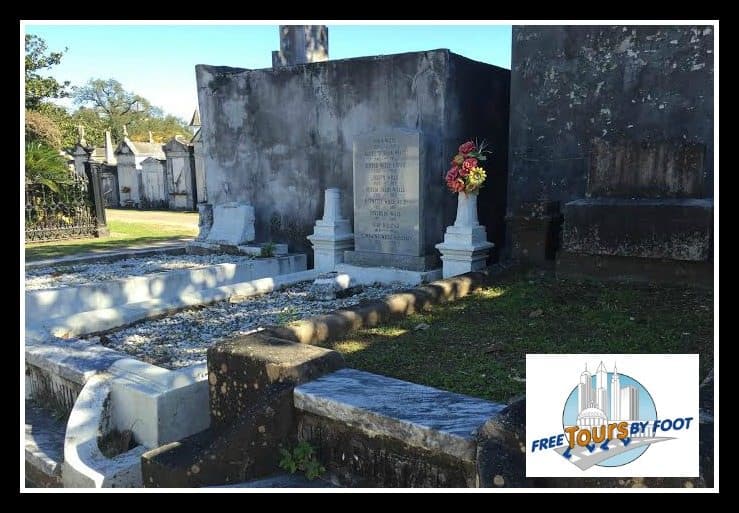
A wall is built which reaches three feet underground and 2-3 feet above ground level.
The casket is placed within the wall, and then the area around it is filled in with soil.
WHICH CEMETERY TO VISIT?
Now that you know a little about New Orleans cemeteries, you will want to visit one. But which one?
In nearly every neighborhood you’re likely to visit, there is a cemetery worth seeing.
Here are a few of our favorites:
Click here for a larger interactive map
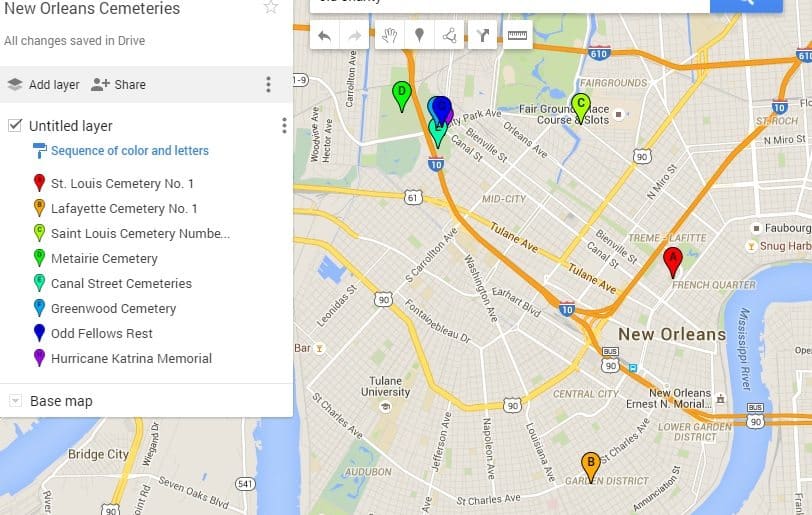
A - St. Louis Cemetery #1
(edge of French Quarter): (map)
The city's oldest cemetery is listed on the National Register of Historic Places and its tombs are splendid, many with incredible creative artistry.
After an extensive restoration, the cemetery has limited visitors to those who are on the list of families who own tombs or if they are on an official tour.
The one tour offered runs daily, every 15 minutes, from 9:00 am until 3:45 pm. It leaves from Basin Street Station.
Tickets are $25 and the tour is 45 minutes long. Reservations are required. Learn more or book this tour here.
To get a glimpse of some things you will see on the tour, watch our video below.
Here is a video of St. Louis Cemetery #1 shot from a drone
In our post, 10 Reasons to Visit St. Louis Cemetery #1, read why I think this is a must-see New Orleans cemetery.
Here are a few tidbits:
Notable personalities resting here include Voodoo Queen Marie Laveau and Homer Plessy of the landmark civil rights case Plessy v. Ferguson.
There's a society tomb just for musicians. It's the New Orleans Musicians’ Tomb.
Oddly, there is a white pyramid tomb of still-living Nicolas Cage, the Hollywood actor. He's booked a spot in advance!
In 1969, the counter-culture, rather 'unorthodox' movie Easy Rider (starring a young Jack Nicholson) was filmed here.
After that, the Archdiocese forbade any commercial filming in any Catholic cemeteries in the city.
The movie was wildly successful, however!
B - Lafayette Cemetery #1
(Garden District): 1416-1498 Washington Ave, New Orleans (map).
A city-owned cemetery established in 1832 in the heart of the district famed for its enormous antebellum mansions and lovely fenced yards, this cemetery is one of the most visited in the city.
Lafayette Cemetery #1 is listed on the National Registry of Historic Places.
The cemetery was closed to visitors in 2019 for repairs and improvements and it's estimated that the cemetery will reopen to the public in late 2025/early 2026.
I'm hoping it will reopen soon because I love to bring friends who visit me here.
Our daily pay-what-you-wish guided tour of the Garden District stops at the cemetery and though it isn't open to the public now, we still discuss the graveyard as you look in through the gates.
Lafayette Cemetery #1 is a favorite filming spot. You can spot it in Interview With a Vampire, Double Jeopardy, NCIS: New Orleans, American Horror Story, Dracula 2000, The Originals, and numerous music videos.
It has also been the burial ground for many of Anne Rice's fictional characters, such as the Mayfair Witches.
Read my post about what makes Lafayette Cemetery #1 worth visiting.
We also have a GPS-enabled audio tour for when it reopens. Fingers crossed!
C - St. Louis Cemetery #3
(City Park/Bayou St. John): (map)
This is a spectacular cemetery as you can see from the video with my fellow tour guide Andrew.
There's even a three-story mausoleum that, if you climb to the top-floor balcony, you will be rewarded with an impressive view of the neighborhood.
On our tours of this cemetery, you'll see some amazing things and learn some fascinating history.
Built on the site of a former leper colony, this cemetery sits on a natural high ridge along Bayou St. John and is a great place to get photographs of angel statues.
If you are thinking of taking a bus tour of New Orleans, most companies stop at the end of Esplanade Avenue near the entrance to the cemetery.
Feel free to use our self-guided tour of Esplanade Avenue and Bayou St. John neighborhoods.
D - Metairie Cemetery
(Old Metairie, though actually, it is in New Orleans): (map)
A stunning 65-acre cemetery built on a former horse-racing track!
When it was dedicated in 1872, the trend in cemeteries in the Eastern United States was toward rural memorial parks with landscaped grounds, lakes, and pathways.
This aesthetic, combined with New Orleans flair for ornamented, above-ground tombs, makes this cemetery one that could easily spend a day here admiring.
I think it is fabulous for taking artsy photographs in black and white.
Metairie Cemetery is the final resting place of several Civil War generals, New Orleans mayors, Louisiana governors, artists, and writers.
It also contains the remains of Al Copeland, the founder of Popeyes Fried Chicken, and famed musician Louis Prima, whose epitaph is inscribed with the lyrics of one of his most famous songs, “Just a Gigolo”.
Many people visit the Morales tomb, which was originally built for famed Storyville madam Josie Arlington and features a young girl knocking at the door of the tomb.
E - Canal Street Cemeteries
(Mid-City): Various addresses (map)
This is a cluster of different cemeteries within close proximity to each other.
They include the Cypress Grove Cemetery, Greenwood Cemetery, Old Charity Hospital - Hurricane Katrina Memorial Cemetery, and Odd Fellows Rest (not open to the public currently).
You can reach these cemeteries by taking the red Canal Street Streetcar, that says CEMETERIES on the front. It doesn't get any easier!
For a fun twist on your excursion, you can take this very popular Night Cemetery and Ghost Bus Tour that visits some of these cemeteries.
Old Charity Hospital Cemetery was established in 1848 as a burial place for unidentified people. Therefore, there are no markers at all in this cemetery.
After Hurricane Katrina in 2005, 83 victims of the storm and its aftermath remained unidentified and were interred here at the Hurricane Katrina Memorial.
Cypress Grove Cemetery contains several interesting tombs, including the Soon on Tong tomb, erected in 1904 as a temporary resting place for Chinese people who died in New Orleans, before their remains were shipped to China.
Greenwood, one of the city’s largest cemeteries at 150 acres, boasts at its entrance the impressive Elks tomb and Firemen’s Monument.
You will also see many cast-iron tombs in Greenwood.
TIPS FOR VISITING CEMETERIES
I often hear from my tour guests that there are some things they wish they had known in advance before visiting a cemetery.
Here are some tips to help you avoid any issues.
The cemeteries in this guide are safe to visit; some others are not.
New Orleans is a city with some neighborhoods that are less safe than others.
All of the cemeteries we are recommending are considered safe, but always use common sense and be aware of your surroundings.
Most cemeteries are closed at night and it's not recommended to visit them on your own.
Several tour operators offer night-time cemetery tours that visit the cemeteries from the outside.
The cemeteries are still active.
All of the cemeteries mentioned in this guide are still active cemeteries.
Families are still burying their dead regularly.
If you see a funeral procession or workers preparing a tomb, respectfully stay away from that area.
Most importantly, do not take photographs of the procession.
Marking tombs is vandalism.
There are tombs in some of the older cemeteries that have been marked, usually with three Xs.
Some people believe that this is a voodoo tradition and that the person interred within will grant your wish if you make the Xs and say some magic words.
This probably is not true.
Unless your wish is to pay a fine for the destruction of property, never make a mark on a tomb. It is disrespectful and illegal.
Leave nothing but footprints.
This is a biggie. Please do not litter in the cemeteries. I am always surprised when I see trash on the ground.
The maintenance workers work hard to keep these sacred places accessible and as pleasant as possible to everyone.
Take LOTS of pictures.
Photography is allowed in all the cemeteries and everyone loves to see pictures of these special places.
Take close-ups of statues’ faces, inscriptions, and people’s names.
Get creative. Try black and white photos.
NEW ORLEANS CEMETERY TOURS
Just about every tour company in New Orleans offers some type of cemetery tour.
Most are focused on the history and burial practices of each cemetery, but others combine elements such as ghost stories and Voodoo practices (see the section below).
We offer the best tours at the best value (you pay whatever you like or can afford).
But don't just take our word for it, see what people have said in the past on TripAdvisor, Yelp, and Google.
While St. Louis Cemetery #1 can only be visited with a guided tour, we have created a self-guided version for you to get a sense of what you will see.
Save Our Cemeteries
Save Our Cemeteries is a not-for-profit organization dedicated to cemetery preservation in New Orleans.
They are the only tour organization in New Orleans solely dedicated to cemeteries.
They are also the only company to regularly offer tours that include St. Louis Cemetery #2, a slightly younger neighbor of St. Louis #1, itself full of lesser-known but still fascinating local history.
Sporadically, they’ll offer tours of Metairie Cemetery, one of the largest and most ostentatious in the city.
Their tours in Lafayette Cemetery #1, unlike those offered by most companies, cover only the cemetery – not the surrounding neighborhood.
We have a self-guided, GPS-enabled audio tour of Lafayette #1.
Reviews: Save Our Cemeteries is consistently rated 4.5 out of 5 stars across TripAdvisor, Yelp, and Google.
Reviewers offer high praise for the organization’s mission and for the guides’ knowledge.
TOUR INFORMATION
Reservations: Reservations are not required, however, recommended.
Schedule and Pricing: Prices listed below are for online reservations; walk-up prices, when space is available, are an additional $5/person.
A portion of every ticket price is dedicated to the organization’s work of cemetery preservation and restoration.
Tours are advertised as lasting 90 minutes, possibly extending to as many as two hours.
NIGHT TOURS THAT VISIT A CEMETERY
Here are two night bus tours I think are excellent: Dead of Night Ghosts & Cemetery Bus Tour and Night Cemetery and Ghost Bus Tour.
Most bust tours available are daytime tours and include a stop at a cemetery and provide the opportunity to walk around the area.
Read about these companies on our bus tour comparison page.
Some companies offer longer tours than others, but you can expect to spend between 15-20 minutes in a historic cemetery looking around and learning.
TIP: Want to save money? Who doesn't?
CitySightseeing, the hop-on-hop-off bus service offers a free, 1-hour walking tour of Lafayette Cemetery #1 when you purchase a 3-day bus pass.
Also, a walking tour is included for free with the purchase of the Sightseeing Pass.

RELATED POSTS