
Lower Manhattan is where New York City’s history, government, finance, and culture come together. From Wall Street and the New York Stock Exchange to the 9/11 Memorial and One World Trade Center, this part of New York is filled with landmarks that tell the story of the city and the nation.
Our Lower Manhattan walking tours take you through the historic streets of the Financial District and surrounding neighborhoods. Along the way, you'll hear stories about New Amsterdam, the American Revolution, Wall Street, immigration, the World Trade Center, and the people and events that shaped New York City.
Whether you're interested in American history, architecture, Wall Street, or New York City history, exploring Lower Manhattan with a local guide is a great way to discover the stories behind the city's most important landmarks.
Lower Manhattan Walking Tour
Our Lower Manhattan Walking Tour is a 2-hour guided walking tour through the historic heart of Downtown Manhattan and the Financial District. You'll see famous landmarks, discover hidden details, and hear the stories that shaped New York City and the United States
What You'll See on Our Lower Manhattan Walking Tour:
- Wall Street and the New York Stock Exchange
- Federal Hall, where George Washington was inaugurated
- Trinity Church and the grave of Alexander Hamilton
- Historic streets of the Financial District
- Charging Bull
- Bowling Green and the former site of Fort Amsterdam
- Battery Park
- 9/11 Memorial area
- One World Trade Center
- Other historic buildings and landmarks throughout Lower Manhattan
More Ways to Explore Lower Manhattan
Our guided Lower Manhattan Walking Tour isn't the only way to explore this historic part of New York City.
Lower Manhattan Audio Tour
Prefer to explore at your own pace? Our Lower Manhattan audio tour lets you discover the neighborhood independently while listening to stories about its history, architecture, landmarks, and famous figures.
Here's a sample from our audio tour.
NYC in One Day Private Tour
Want to see more of Downtown Manhattan in a single day? Our NYC in One Day Private Tour combines several of Manhattan's most fascinating neighborhoods and landmarks into one private experience.
The tour includes the Financial District, Chinatown, Little Italy, SoHo, Greenwich Village, and part of the High Line, giving you a broad introduction to Downtown Manhattan in one day.
This private tour is a great option for visitors who want to see more of New York City with their own guide and make the most of their time in Manhattan.
Self-Guided Lower Manhattan Walking Tour
Want to explore Lower Manhattan on your own? We've created this free self-guided walking tour to help you discover some of the neighborhood's most important historic sites and landmarks.
Written by one of our local NYC tour guides, the guide takes you through Lower Manhattan from Battery Park and the Financial District to the World Trade Center area and beyond. You'll find historical information, interesting stories, tips, and suggestions for what to see along the way.
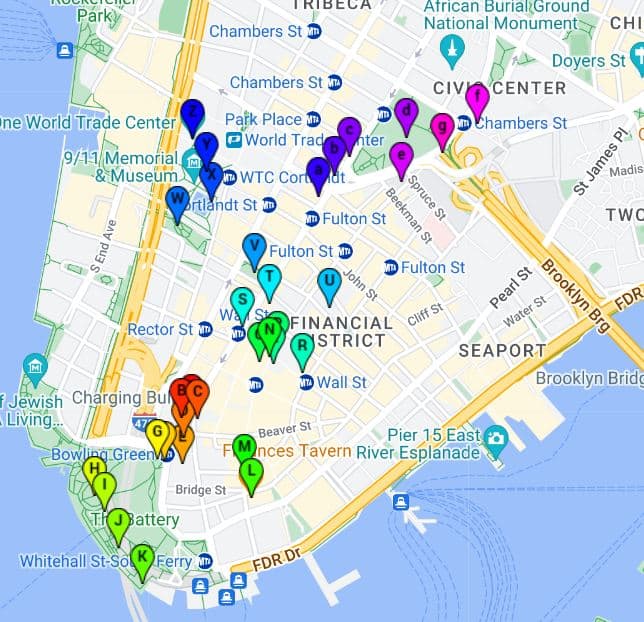
Click on the map to be taken to an interactive version.
A) Charging Bull
Broadway and Morris Street
We’ll start this self-guided tour at Broadway just below Morris Street.
This 7,000-pound bronze bull is one of the most photographed (and touched) sculptures in New York City.
The bull appeared mysteriously on a December night in 1989, in front of the New York Stock Exchange.
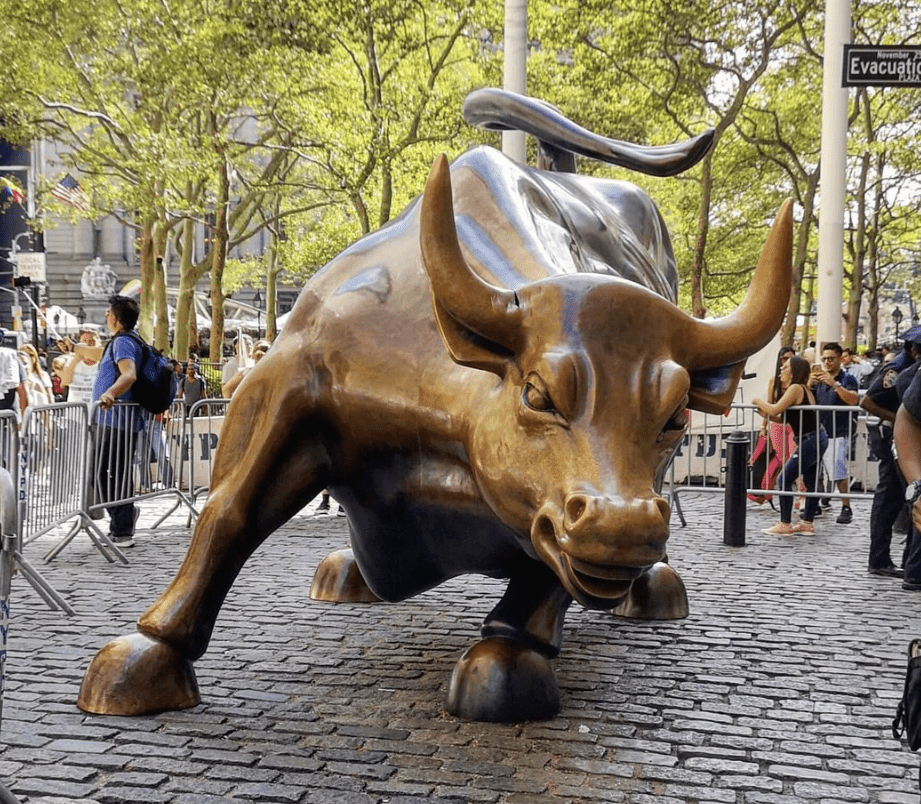
The sculpture was a gift to NYC from Italian sculptor Arturo Di Modica in response to the 1987 stock market crash.
The bull is a symbol of a bull market when economies grow strong.
You’ll likely want a picture with the bull and his snarling nostrils, you can expect a line of people waiting.
TIP: You can save some time if you pose by the bull’s anatomically correct behind!
B) Cunard Building
25 Broadway | Built in 1919
At the turn of the 20th century, New York's shipping industry was booming so, logically, the Cunard shipping line chose to locate its shipping and ticket offices near the port.
The friezes along the exterior of this Italian Renaissance-inspired limestone building are playful as they incorporate symbols of the ocean, such as Nautilus shells, Titans, and compasses.
If you are interested in small architectural details like I am, you might want to cross the street for a moment to get a close-up look. I think it is just lovely.
C) Standard Oil Building
26 Broadway | Built in 1922
In 1885, John D. Rockefeller's Standard Oil Company commissioned its first New York headquarters building to be built.
It was a ten-story, 86-foot-wide office building. The building curves follow the natural curve of Broadway, which was an unusual architectural feature at the time.
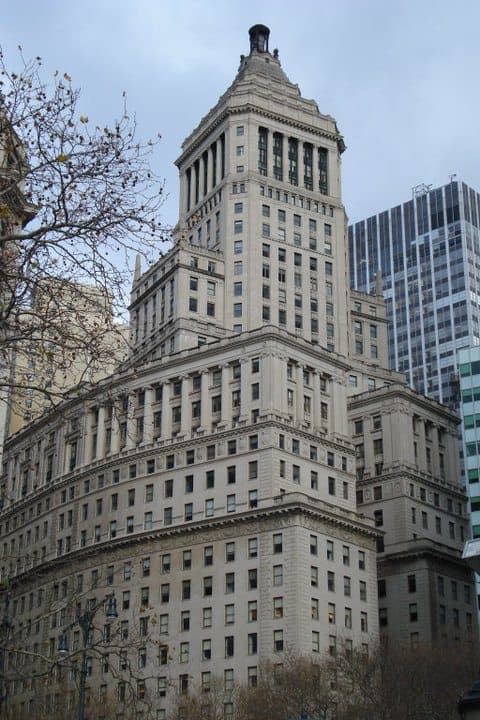
Over the next decades, the building was expanded by an additional six floors and a 27-foot-wide extension.
Atop the building is a 480-foot pyramidal tower with a metal brazier that resembles a giant oil lamp, symbolic of Standard Oil's power.
D) Bowling Green Park
The history of this small park dates to the 1630s, when Dutch settlers held an annual market here. In 1733, English colonists used the park for the popular sport of bowling (also known as boules).
The park was encircled by a cast iron fence that still exists today. Inside the park was a 4,000-pound gilded lead statue of King George III.
On July 9, 1776, the first public reading of the Declaration of Independence in the colony of New York occurred here and a mob of anti-English colonists toppled the statue.
The park by the way is a nice place to sit and have a bite to eat from one of the many takeout food places nearby or the food vendors just outside the park.
E) Alexander Hamilton U.S. Custom House
1 Bowling Green | Built in 1907
Across from Bowling Green Park is a stunning Beaux-Arts building designed by Cass Gilbert.
It was built as New York City’s customs house but it now houses the National Museum of the American Indian.
I love showing this building to my tour guests to point out the symbolism of the four huge sculptures of female figures that flank the building.
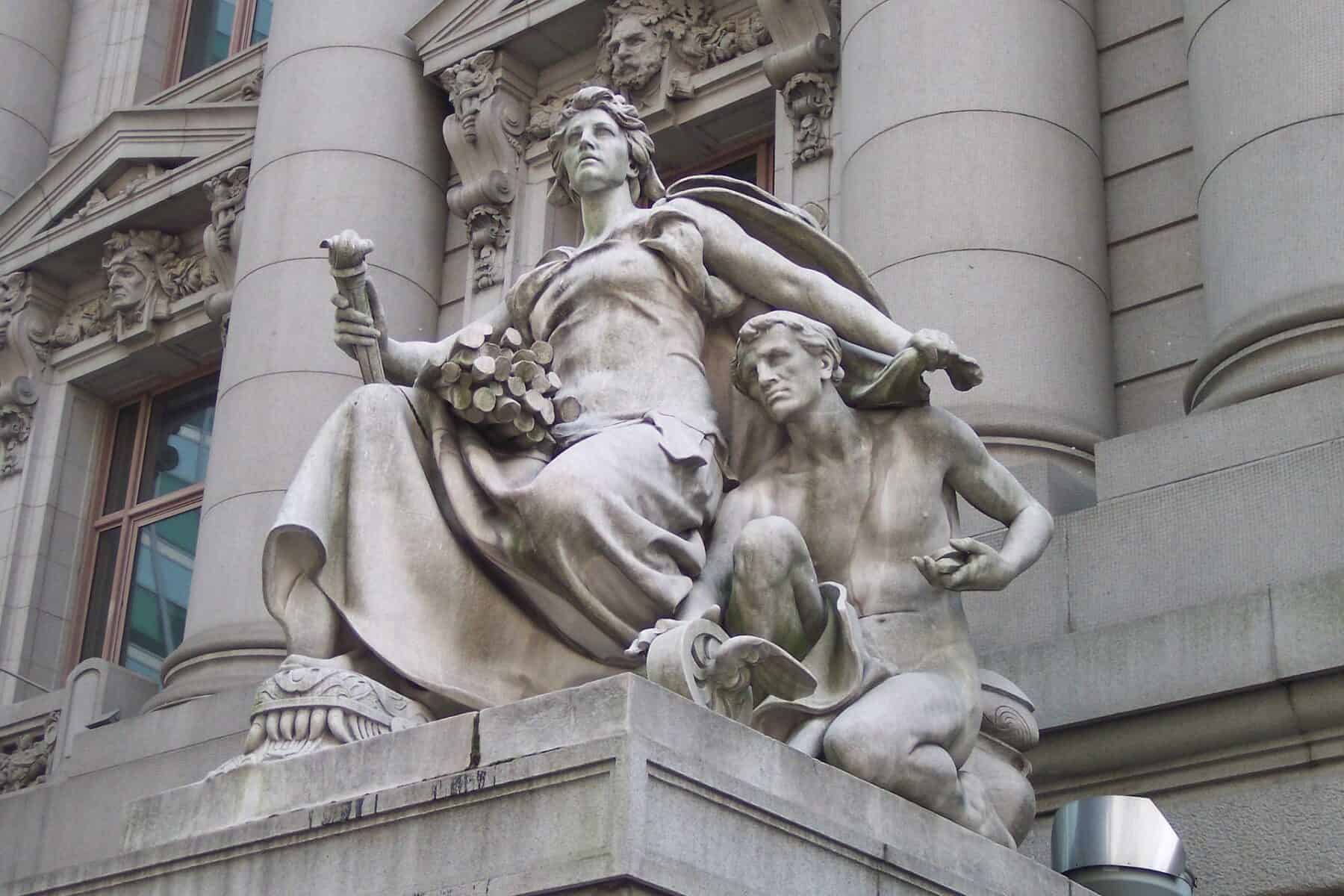
They symbolize four continents: Asia, America, Europe and Africa.
The highly-detailed statues include references to the culture of each of those continents.
Look at the statues from all sides to see if you spot the objects these female figures hold.
I find this to be one of the most beautiful buildings in New York City and also one worth spending time admiring its intricate facade.
Read more about this gorgeous building here.
F) Battery Park
In Dutch times, the southern shoreline of Manhattan Island was just slightly below Bowling Green but over the decades, Manhattan was expanded by the placement of landfill around its shores.
Thus, Battery Park is located on almost entirely all landfill. The park is named for the battery of artillery installed here, first by the Dutch, then the British and finally the Americans.
It’s a nice shady place to sit and have lunch or read a book.
For those of you who haven't seen a squirrel before, Battery Park is filled with them!
My tour guests from Australia are thrilled to see these creatures so many of them have never seen before as they are very rare on the continent.
See our Guide to Battery Park to find out what else you can see here.
G) Netherlands Memorial
Built in 1926
Located near the northern border of the park, across the street from the National Museum of the American Indian, is a monument to the Netherlands, the first European colony to settle in New York City.
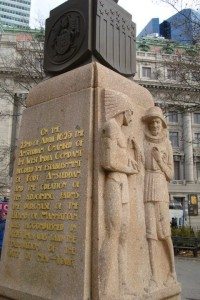
The monument is a flagpole with an inscription in both English and Dutch commemorating the official date that the Dutch colony of New Amsterdam was founded in 1625.
H) Castle Clinton
Built in 1812
This is one of the Lower Manhattan sites that is always fun to tell my tour guests about!
Though it doesn't look particularly special, this brown round structure has a very unusual history.
In 1811, the relatively new American government feared that Great Britain was going to return to take back what it lost 3 decades earlier.
They built a fort at the tip of Manhattan to defend against an attack by the British Navy -- that never arrived.
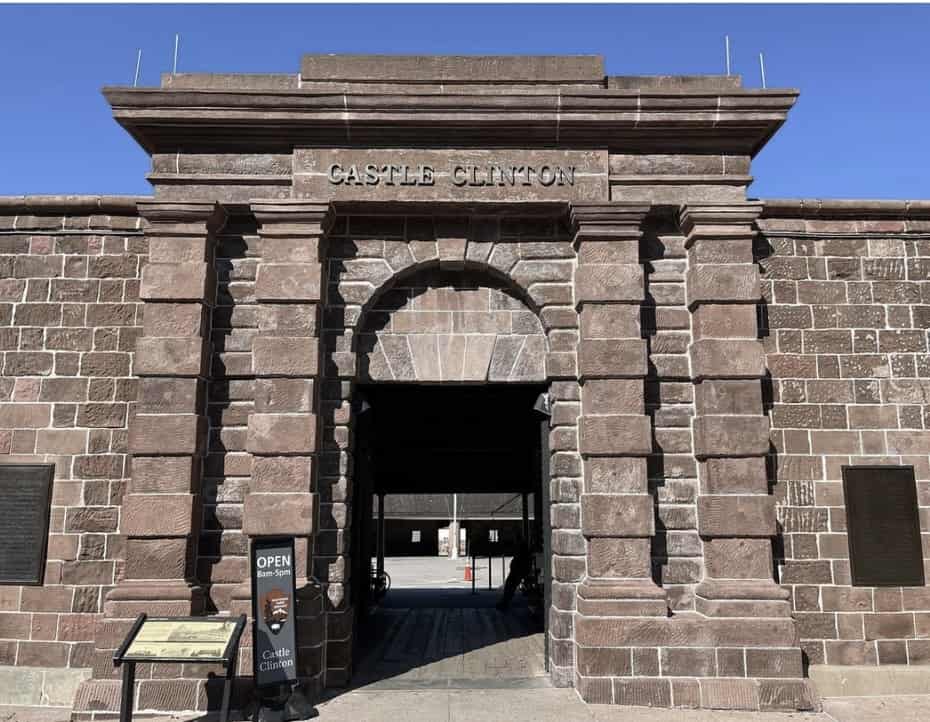
Since 1813, Castle Clinton has served many purposes. First, it was a beer garden, then a theater.
From 1855 to 1890, Castle Clinton was the immigration arrival center for the East Coast until Ellis Island opened in 1892.
From 1896 to 1941, it was the site of the New York City Aquarium! (That’s now in Coney Island and worth a visit, especially if you are traveling with kids).
There’s a free small museum inside that I think is worth a quick peek. It has drawings and photographs tracing the fort’s history.
You may find yourself at Castle Clinton without deliberately going to see it as it is the location of the ticket office for all Statue of Liberty and Ellis Island tours.
I) The Immigrants
Created in 1983
There are several sculptures in Battery Park, but none as fitting as these depict immigrants arriving in America.
In their faces and pictures, You can sense both their plight and hope as they take their first steps toward building a new life in America.
J) East Coast Memorial
Dedicated in 1963
This commanding memorial commemorates 4,609 U.S. servicemen and women who died at the hands of the Germans in World War 2 in the coastal waters of the western Atlantic Ocean protecting America,
K) Statue of Liberty and Ellis Island Vista Point
Statue of Liberty
At this vista point at the tip of Manhattan, you can get a decent picture of the Statue of Liberty.
The statue stands 93 meters tall from the base of the pedestal to the tip of the torch. It is made of thin copper sheeting over an inner metal frame. The copper is just 2.4 millimeters thick.
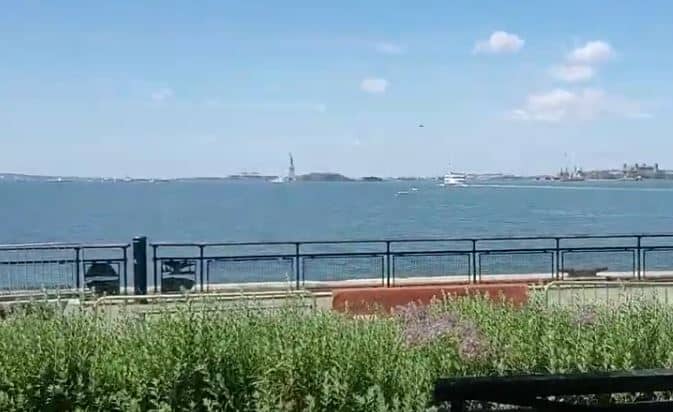
The history of the statue is too long to go over here, so here are a few tidbits.
The statue was a gift to America from the people of France. The idea was conceived in 1865, and it took two decades to complete.
The statue was built in France and shipped to New York while the pedestal was being built.
If a visit isn't on your NYC to-do list I encourage you to think about going. Take a look at our Guide to visiting the Statue of Liberty and Ellis Island.
The island to the right of Liberty Island is Ellis Island.
Ellis Island
As the granddaughter of immigrants, I have a personal relationship with Ellis Island and have visited twice to research my family’s lineage and also to learn about immigration generally.
Ellis Island was the gateway to America from 1892 to 1954, processing over 12 million immigrants.
Between 1905 and 1914, an average of one million immigrants per year passed through Ellis Island.
Whether or not you have immigrant roots, you will likely enjoy visiting Ellis Island. It’s part of the ticket to the Statue of Liberty so why not take a look?
L) Fraunces Tavern and Museum
54 Pearl Street
The first building on the site was constructed in 1671 as a home for Colonial New York's Mayor van Cortlandt. In 1762, Samuel Fraunces became the owner and opened up the Queen's Head tavern.
In the years leading up to the Revolutionary War, the Sons of Liberty secretly met to plan the fight for independence.
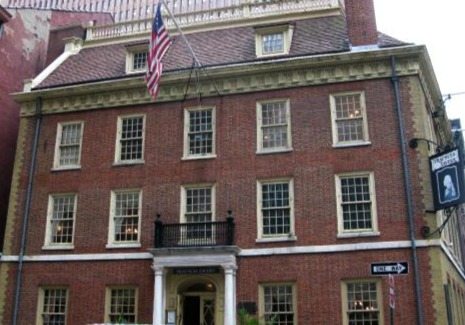
After the war was won, General George Washington hosted a dinner in 1783, in the third-floor Long Room where he bid farewell to his officers before going on to become the country’s first president.
The building fell into disrepair but was saved from destruction in 1904. A restoration was completed in 1907 and the Museum opened the 124th anniversary of Washington’s farewell.
TIP: It’s a nice place to have dinner if you like classic American cuisine. I like the cozy Whiskey Bar for a drink.
Read more about Fraunces Tavern and Museum.
M) Stone Street
In the 1650s, when New York was still Dutch New Amsterdam this street was 'Brouwer Sraet', one of the earliest streets to be paved with cobblestone, hence its renaming to Stone Street.
Stores sprung up along the street but the Great Fire of 1835 destroyed most remnants from the Dutch era New Amsterdam.
After decades of neglect the Landmarks Commission, the Alliance for Downtown New York and Stone Street owners joined forces to restore the eastern portion of the street.
The street is now a charming pedestrian mall with several restaurants and bars and outdoor dining in good weather.
TIP: If you do want to eat on the street, I suggest you avoid lunchtime (12 noon - 2 pm) and happy hour (5 pm- 7 pm). These times are when the street is packed with local workers!
N) Wall Street
There really was a wall here, built here in 1652 by the Dutch settlers of New Amsterdam as a buffer between them and the Native Americans, the first inhabitants of what they called Manna-hata.
The wall served its purpose well -- until the British arrived, forced the Dutch out, and renamed the city New York.
By the late 1700s, New York had become a prosperous city with lively commercial activity.
Speculators would meet by a buttonwood tree at the foot of Wall Street to trade, thus planting the seed of modern-day Wall Street.
TIP: We have a self-guided tour of Wall Street for a deep dive.
O) New York Stock Exchange
11 Wall Street | Completed in 1903
Every day, billions of dollars in stock are traded inside this building. The history of trading on Wall Street dates back to the Dutch colonial era.
It took place on the street or in coffee houses. In 1792, 24 brokers created the Buttonwood Agreement, which was the basis for the creation of the New York Stock & Exchange.
The name of the agreement was a reference to a buttonwood tree on Wall Street that was a popular spot for traders to gather.
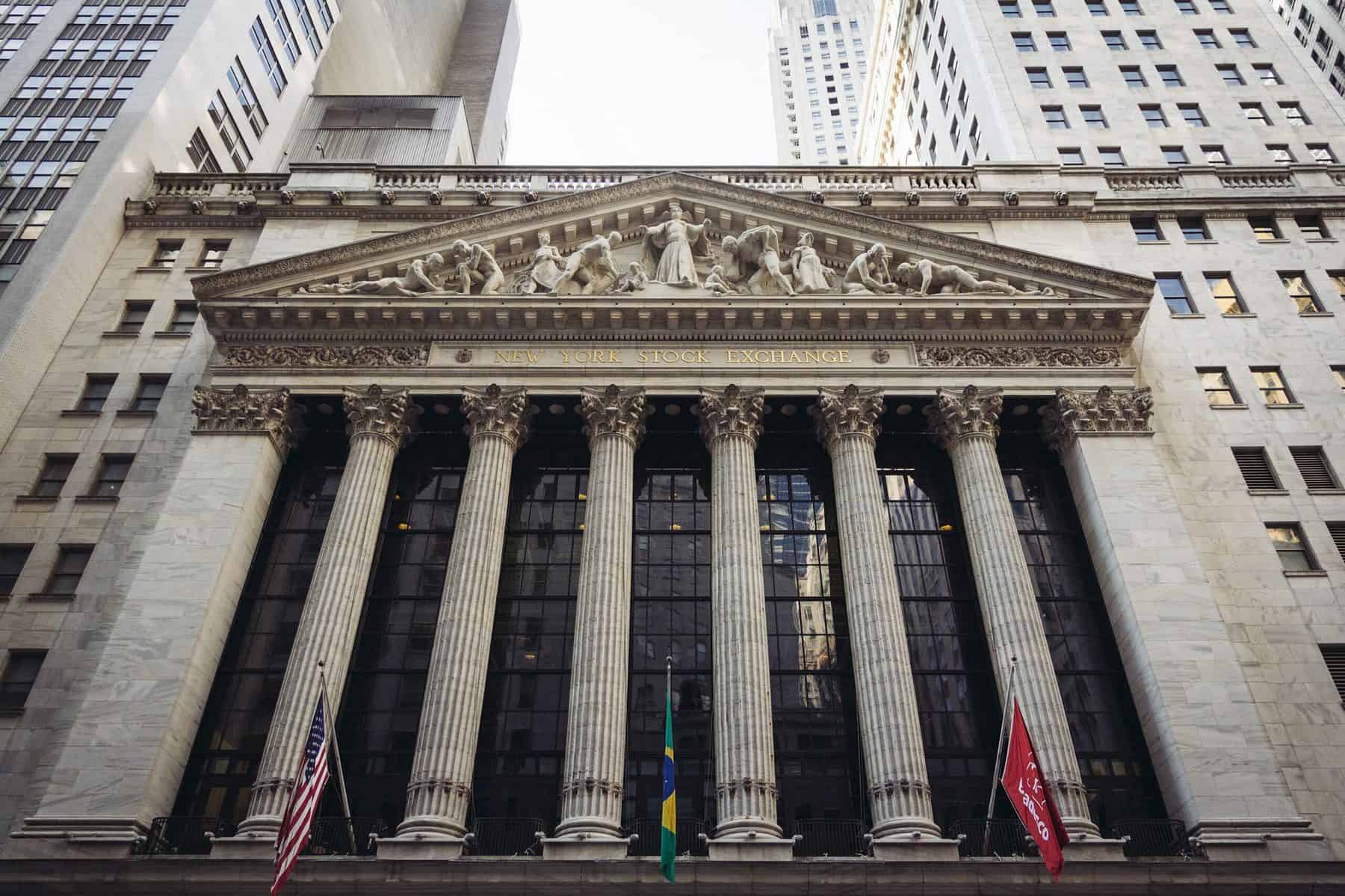
The new stock exchange rented a room at 40 Wall Street and moved to its current location in 1865 and the building that you see today was completed in 1903.
You can hear a much more detailed history about the NYSE on one of our walking tours, our audio tour or Wall Street tours offered by other vendors.
P) Federal Hall National Memorial
26 Wall Street | Built in 1842
This impressive Greek Revival-style building was preceded by a smaller and less formidable one and served as colonial New York's City Hall.
History was made on the balcony of that first building when George Washington was sworn in as president on April 30, 1789.
Washington's larger-than-life statue depicts the scene. All that is missing is the bible upon which he laid his hand while being sworn in.
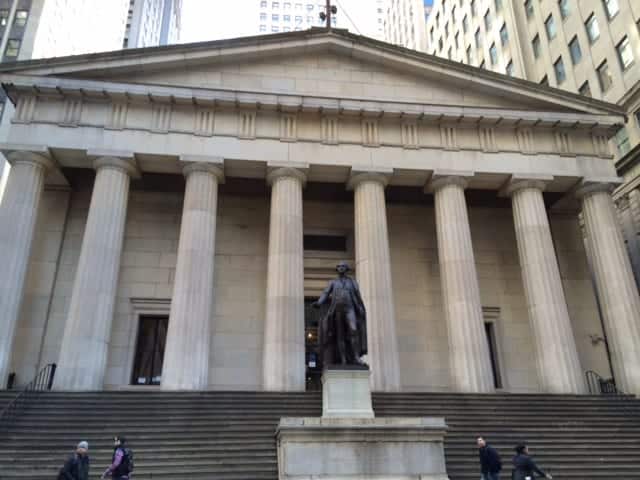
You can see that bible inside along with artifacts about Lower Manhattan's role in the nation's early history.
It’s a small, free museum with what I think is one of the coolest artifacts in all of America -- a piece of the balcony that George Washington stood on for his first inauguration.
Read here about what other treasures are inside this nifty museum. I really do think it is worth a few minutes of your time to take a look inside.
TIP: There are public bathrooms which are rare in NYC. Take advantage!
Q) Morgan Guaranty Trust Building
23 Wall Street | Built in 1913
J. Pierpont Morgan, one of the richest men in the world at the turn of the 20th century, had this building constructed as his headquarters.
On September 16, 1920, a horse-drawn buggy loaded with 100 pounds of dynamite and 500 pounds of cast-iron slugs exploded across the street from the building.
The blast killed 39 people and injured hundreds more. The culprits’ identities remain a mystery to this day.
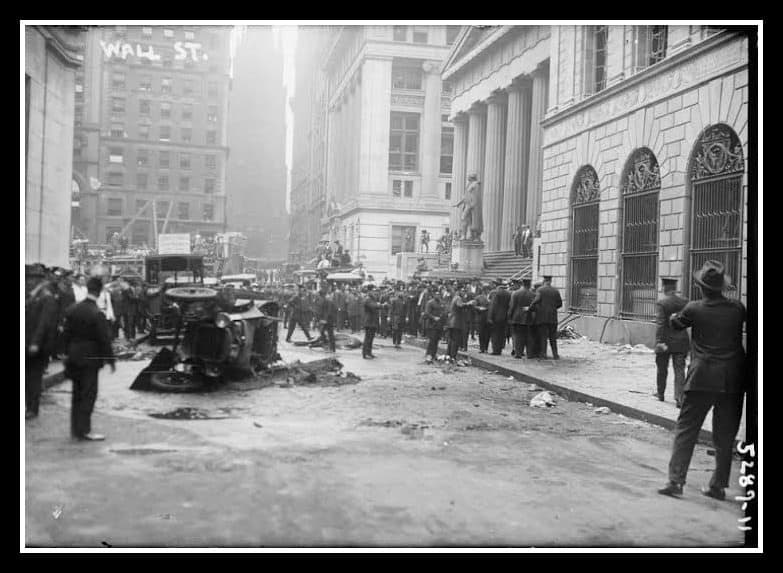
If you look closely at the building’s Wall Street facade at approximately eye level, you'll see pockmarks in the limestone façade. These were caused by shrapnel from the bomb.
As someone who loves New York City history, down to the smallest detail, I am always gratified when I show these pockmarks to my tour guests and my friends who would otherwise walk right past them.
Such small holes for such a big moment in the city’s history.
R) The Manhattan Company Building / Trump Building
40 Wall Street | Completed in 1930
Designed by architect H. Craig Severance, 40 Wall Street was completed in just 11 months, in an effort to win the race to construct the tallest building in the world.
The rivalry was between 40 Wall Street and the Chrysler Building. During construction, both buildings continually (and secretly) altered their design to win the race.
When 40 Wall Street was completed in April of 1930, it was the tallest building in the world.
But less than a month later, the Chrysler Building hoisted a secret 125-foot-tall stainless steel spire atop the building, thus becoming the tallest building in the world.
A year later none of this mattered when the Empire State Building was finished and dwarfed every other building around.
In 1995, Donald Trump bought the building, hence its current name.
S) Trinity Church
89 Broadway | Completed in 1846
An Anglican parish and church were first established on this site in 1697 and there have been three church buildings on this site.
The first Trinity Church was built in 1697 and was the tallest structure in colonial New York. It was destroyed in the Great Fire of 1776.
The second church was built in 1788 but was torn down just a few decades later as it was architecturally unsound.
The current church was built in 1846 and designed by the father of the neo-gothic movement in America, Richard Upjohn.
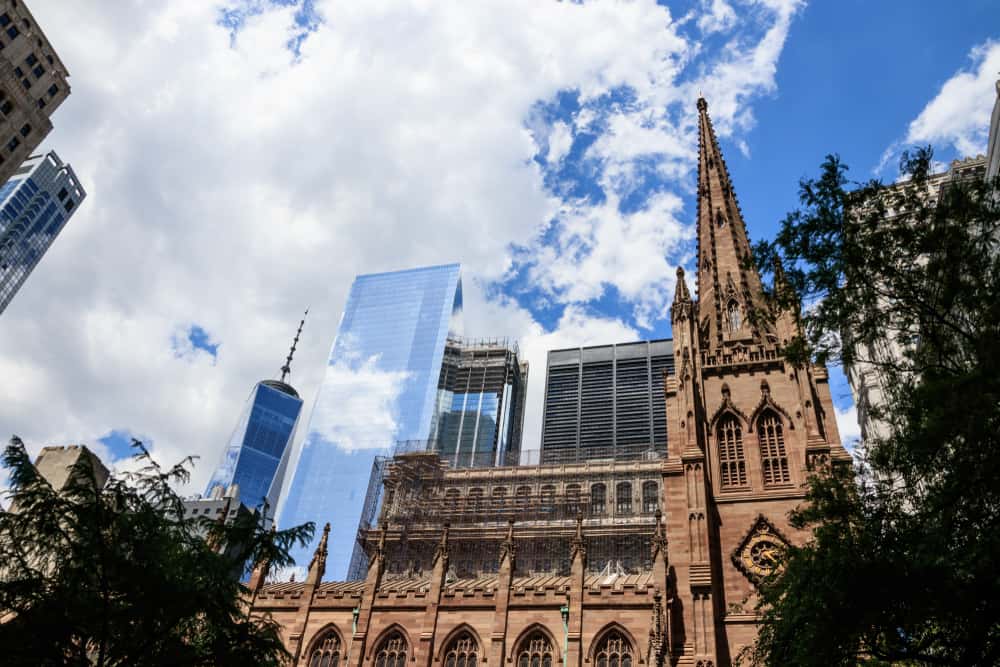
As extraordinary as the exterior of the church is, the interior is every bit as awe-inspiring with some of America's oldest and most beautiful stained glass.
Take a stroll in the small cemetery, with tombstones dating from the early 1700s.
The large pyramid-shaped tomb is the resting place of Alexander Hamilton, first Secretary of the U.S. Treasury, and now the subject of a hit Broadway show!
I can tell you the show is a lot more fun than seeing his tomb!
As someone who loves the juxtapositions of old and new in the city, Trinity Church is perfect for photos like the one above.
T) Equitable Building
120 Broadway | Completed in 1915
At the time of its completion, this was the largest office building in the world, standing 538 feet (164m) tall and spanning a full city block, with 1.8 million square feet of space.
Although the Equitable was hailed by some as an architectural wonder, the public was outraged because the building cast a 7-acre shadow across Lower Manhattan.
In response, New York City passed the 1916 Zoning Resolution, often referred to as the "set-back" law.
This law requires that buildings of a certain height and bulk have set-backs to not constrict sunlight and air flow to the surrounding smaller buildings.
A well-known example of the set-back style is the Empire State Building is a perfect example of a set-back building.
The set-backs on buildings look like staircases. I like to think of them as tiers of a wedding cake!
U) Federal Reserve Bank of New York
33 Liberty Street | Completed in 1924
At 33 Liberty Street is the largest depository for monetary gold in the United States.
As of 2025, the vault, located five stories below street level and sealed with an immense steel door weighing 90 tons, housed approximately 507,000 gold bars, with a combined weight of 6,331 metric tons.
The building is modeled on an Italian Palace and designed by the venerable architectural firm of York & Sawyer whose buildings can be found around the U.S.
But none are as valuable as this one!
V) Zuccotti Park
Zuccotti Park has become synonymous with the Occupy Wall Street movement, whose stated mission is to achieve social and economic equality.
On September 17, 2011, the Occupy Wall Street movement organized a mass protest and chose Zuccotti Park due to its location in the heart of the Financial District.
Interestingly, the site the park is built on has a history of protest. It was the location of colonial New York's first coffeehouse (and no, it was not a Starbucks).
On November 5, 1773, a huge crowd assembled outside the coffeehouse to denounce the oppressive Tea Act imposing taxes on the colonies for imported tea.
TIP: If you do want to grab a Starbucks, there is one two blocks up at 22 Dey Street, next to one of my favorite discount shopping stores, Century 21.
W) The Sphere
165 Liberty Street
For three decades this 25-foot tall bronze sculpture stood in the middle of the World Trade Center Plaza.
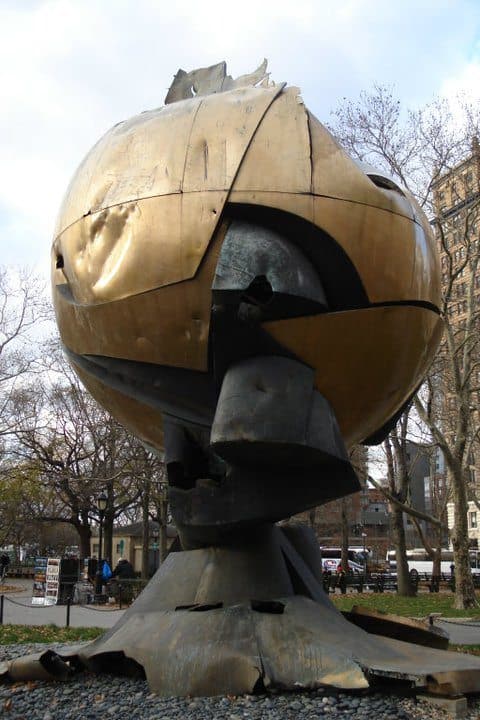
It was salvaged from the wreckage of the WTC after 9/11, pulled from under mountains of rubble, but amazingly sustaining minimal damage. The Sphere is a symbol of resilience.
X) National 9/11 Memorial Plaza
The designers of the plaza created a public space and memorial worthy of those who lost their lives on 9/11.
While one may think that it would be a depressing space, I find the large plaza airy and peaceful, where one can find a quiet spot to contemplate.
The memorial’s main feature is the two enormous reflecting pools with cascading water set within the footprints of the Twin Towers.
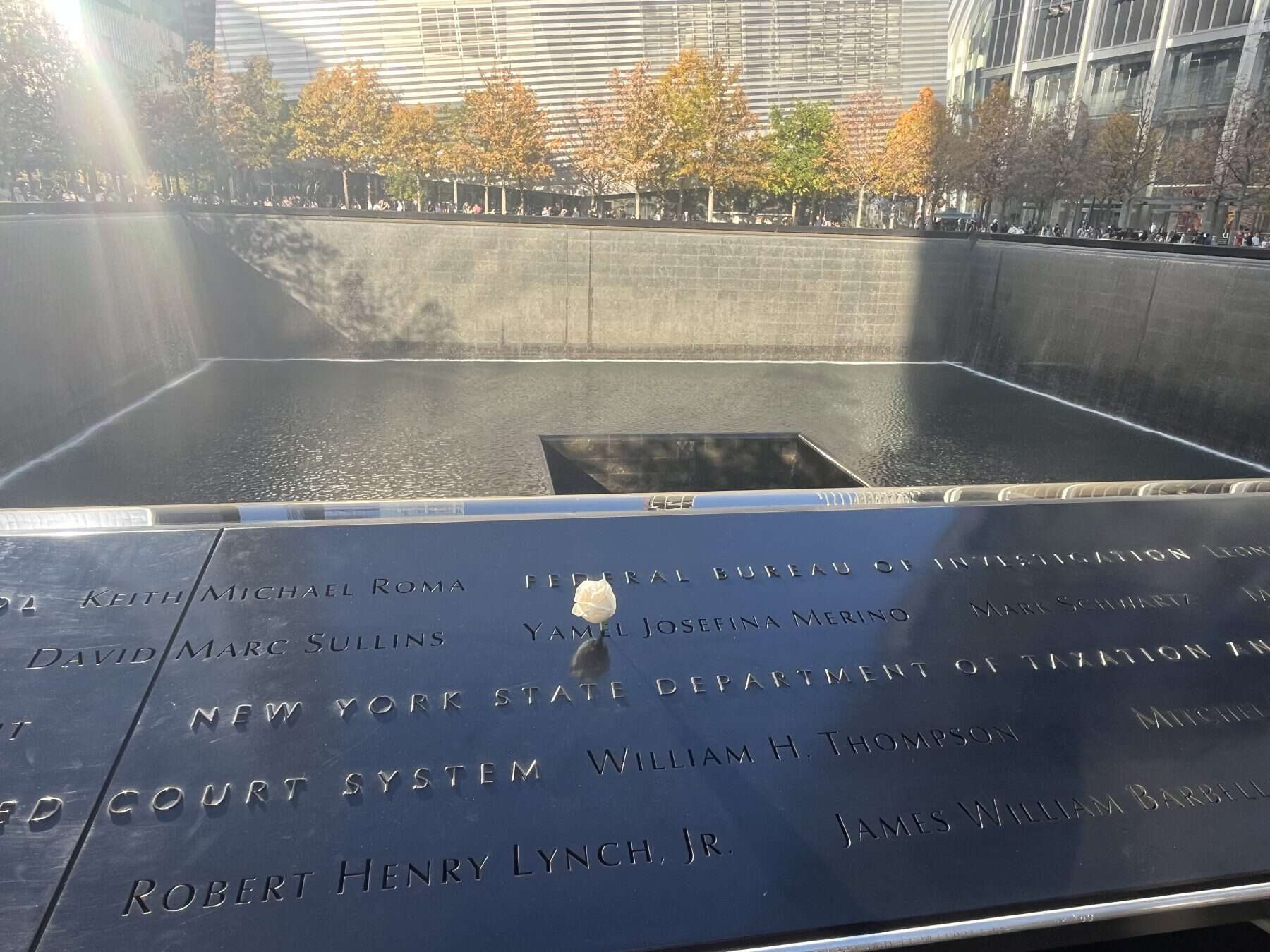
The pools are bordered by 76 bronze panels attached to the parapet walls that form the edges of the pools.
The panels are inscribed with the names of 2,977 victims killed on September 11 as well as the names of six victims who were killed in the 1993 World Trade Center bombing.
We have a self-guided tour about the plaza, its history and creation and more.
Y) 9/11 Memorial Museum
Through interactive technology, archives, narratives, and a collection of artifacts, the museum recounts the events of 9/11.
I was surprised by the amount I learned about 9/11 despite having been in New York City on that day.
I was also surprised by how moved I was. Before you plan a visit, you should consider if the somber experience is right for you and others traveling with you.
Z) One World Trade Center
Nicknamed the Freedom Tower, this is the tallest building in the Western Hemisphere at 1,776 feet tall or 541.3 meters.
The 1,776 feet chosen as its final height was to commemorate the year the United States declared independence.
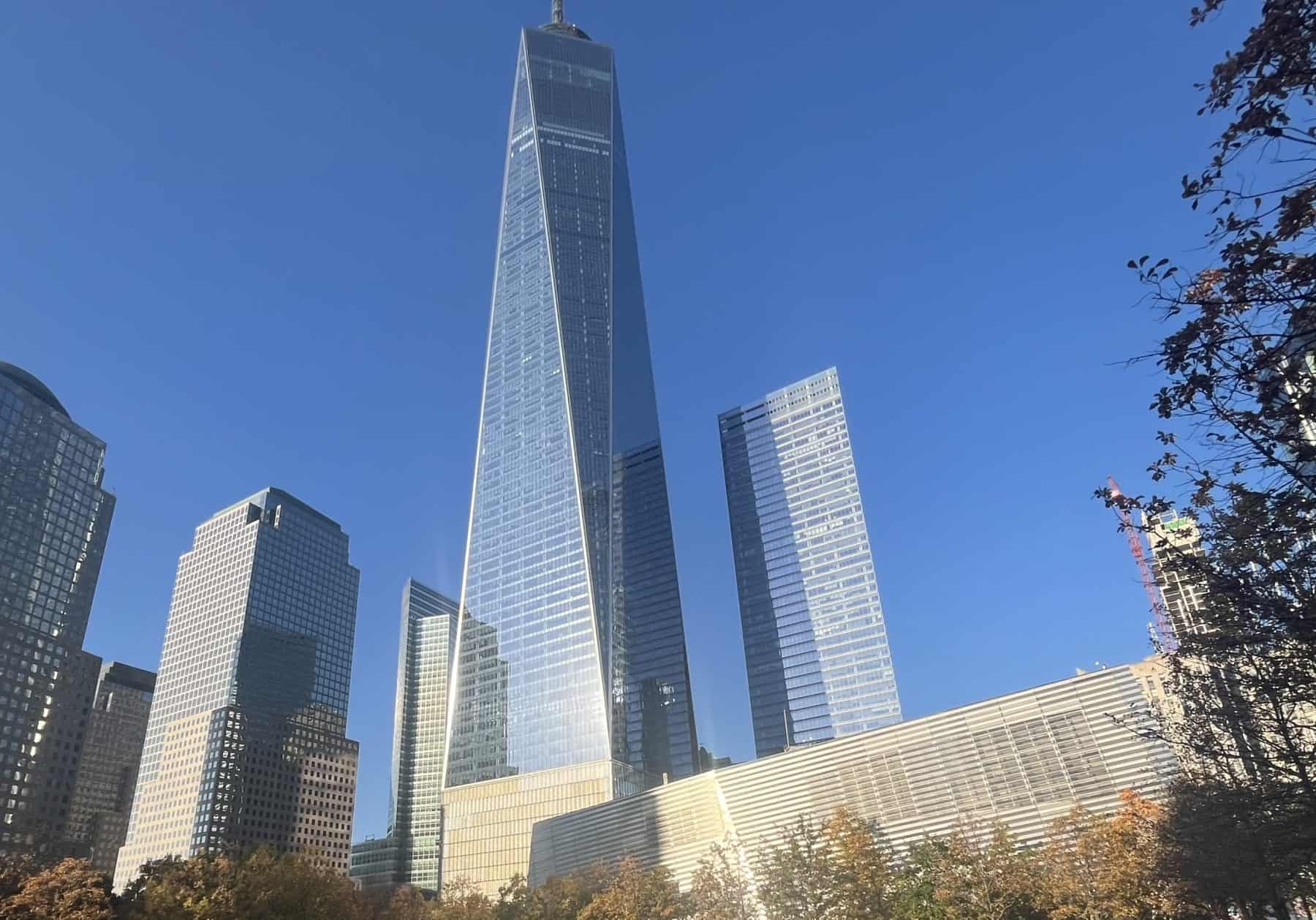
Atop the building is the One World Observatory, one of five observation decks in New York City.
I’ve been here twice, once during the day and once at night. The views are breathtaking!
a) St. Paul's Chapel
Broadway and Fulton Street | Built in 1766
This is the only colonial-era house of worship still standing in New York City and it is also the oldest public building that has been in continuous use since it was built.
It served as an extension of Trinity Church located a few blocks south and included in this tour. St. Paul's has a sacred and inspirational place in history.
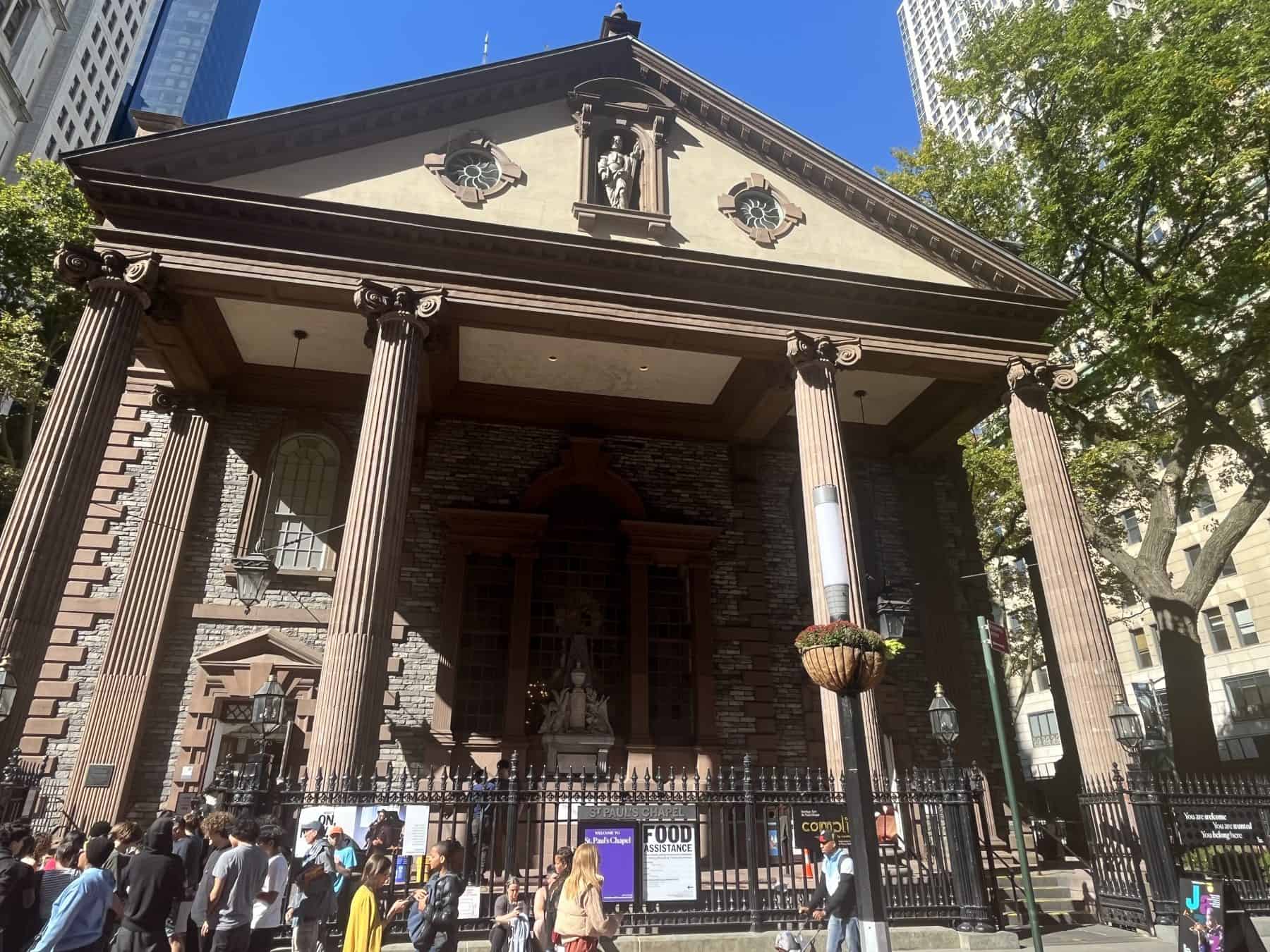
George Washington prayed here after his presidential inauguration at the nearby Federal Hall in 1789.
St. Paul's also served as a place of comfort and solace for the rescue workers at the World Trade Center in the days following 9/11.
b) Canyon of Heroes
As you walked up Broadway during this tour, you may have noticed the granite strips inlaid on the sidewalk bearing the names of heads of state, pioneers of air and space travel, soldiers, sailors, and more.
The stretch of Broadway from City Hall to Battery Park is known as the "Canyon of Heroes” and is where ticker-tape parades were born.
If you didn't notice, you can look for the commemorative granite strips down when you leave St. Paul's.
As you walk to the next location on this tour, look down along Broadway between Vesey Street and Barclay Street.
Among the strips, you'll come across three of the many New York Yankees strips along the Canyon of Heros for winning the World Series.
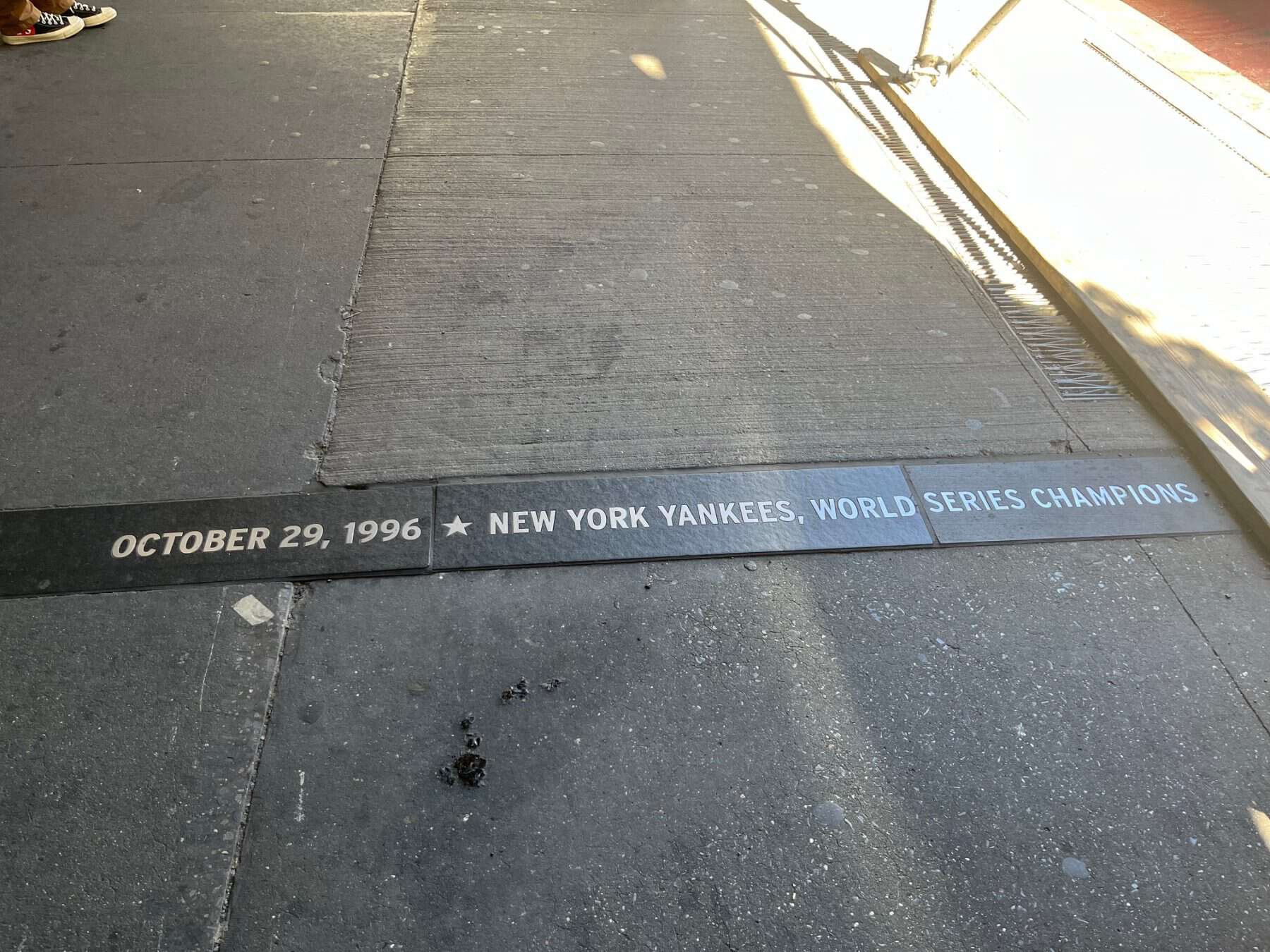
More than 200 parades have taken place. The first was in 1886 when the Statue of Liberty was unveiled.
In 2021, a parade was held to honor essential workers and first responders for their response to the COVID-19 pandemic.
Last year, a ticker tape parade was held to celebrate the Women’s National Basketball Association (WNBA) champions, the New York Liberty!
c) Woolworth Building
233 Broadway | Completed in 1913
At more than 790 feet tall, with 57 floors, this building held the title of the world’s tallest building until the completion of 40 Wall Street in 1930.
The building is a modified neo-gothic style, a modern skyscraper decked out with gargoyles, spires and flying buttresses like those found in a church.
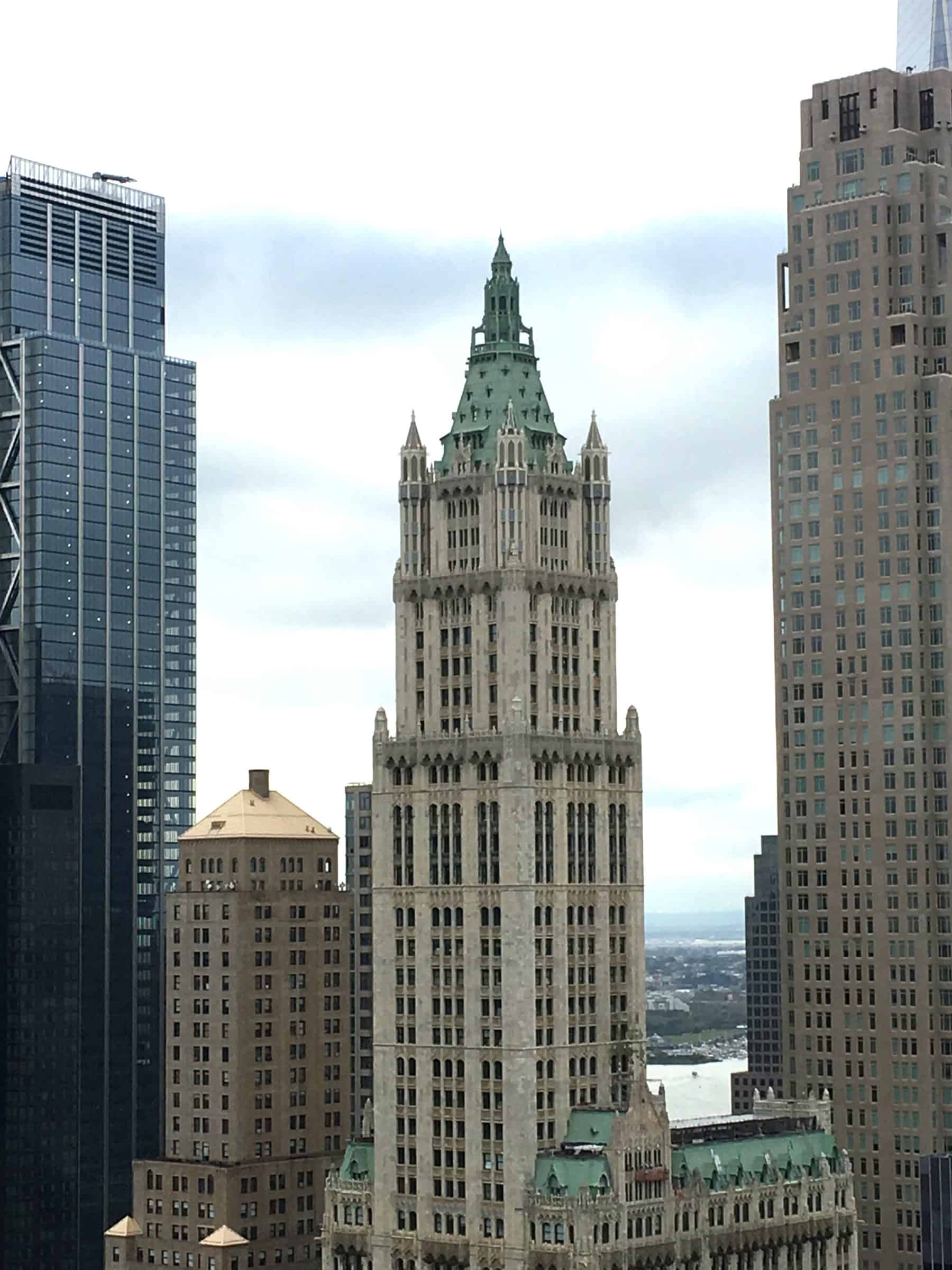
In 2014, a property developer purchased the top 30 floors and is converting them into private luxury apartments.
The building is no longer open to the public but you can take a peek into the lobby from the building's doors.
d) New York City Hall
City Hall Park | Completed in 1812
New York’s City Hall is one of the oldest continuously used city halls in America. At the time of its completion, City Hall was one of the three tallest buildings in the city.
It was so large that it not only housed the three branches of local government (the Mayor, the City Council and the courts) but also a chapel, small jails and a wine and beer cellar!
Today, this building houses both the Mayor’s offices and the New York City Council.
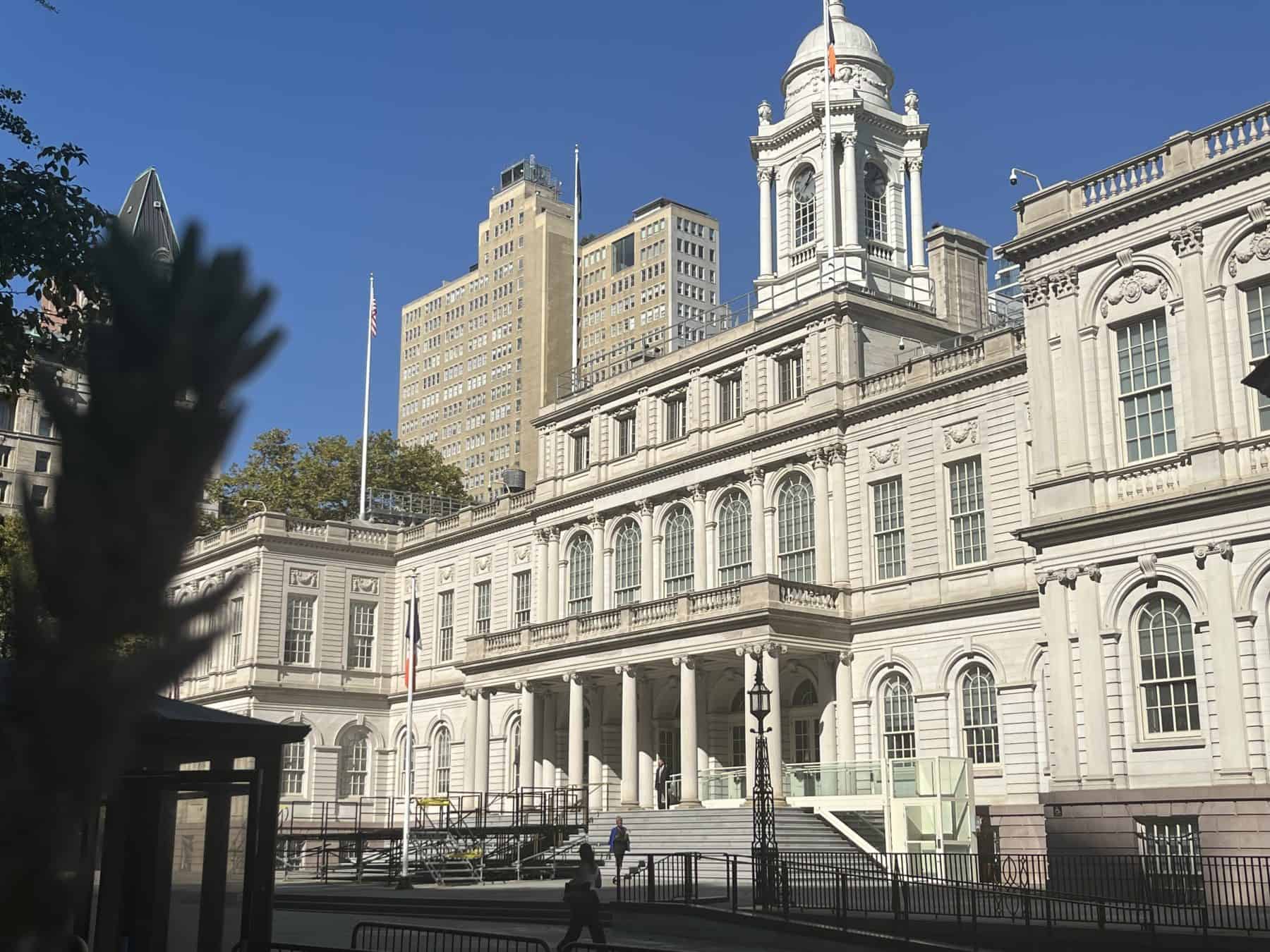
In front of City Hall is City Hall Park, a cozy park that is a wonderful place to relax on a bench and have lunch or just people-watch.
The site of the park has a colorful and contrasting past having been used as a pasture, a prison, a parade ground, a public execution site, an almshouse, an art museum, and a post office.
If you still have the energy, walk over the Brooklyn Bridge whose entryway is just across from the park.
e) Newspaper Row
Running south of City Hall and diagonally to Broadway is Park Row. Only two blocks long, this short street was a hub of power from the late 1800s to the early 1900s.
Here the major newspapers of the day built their headquarters including The New York Times, The New York Tribune, The New York Journal and The New York World.
The sole survivor is the original New York Times building located at 41 Park Row (1889). In 1903, the New York Times moved to Longacre Square, which was then renamed Times Square.
Since 1951 Pace University has occupied the building.
At 38 Park Row, where a Starbucks is located on street level, is the sumptuous terra cotta Potter Building (1886).
The building replaced a former headquarters of the New York World, which was built in 1857 and burned down in February 1882. The building was converted into apartments from 1979 to 1981.
This is the kind of building that makes me encourage my tour guests to remember to look up at older buildings to see these structure’s full glory.
You may want to do the same -- but please do so safely!
Don’t do so in the middle of the sidewalk, as you may get run down by rushing pedestrians, but also not in the street so you don't get hit by a car!
f) Manhattan Municipal Building
1 Centre Street | Completed in 1915
At the intersection of Centre and Chambers Streets stands one of New York City’s most enchanting buildings and certainly one of my all-time favorites -- and there are so many to choose from!
It is the headquarters of many of the city’s administrative agencies, filling up 40 floors of the building with bureaucracy.
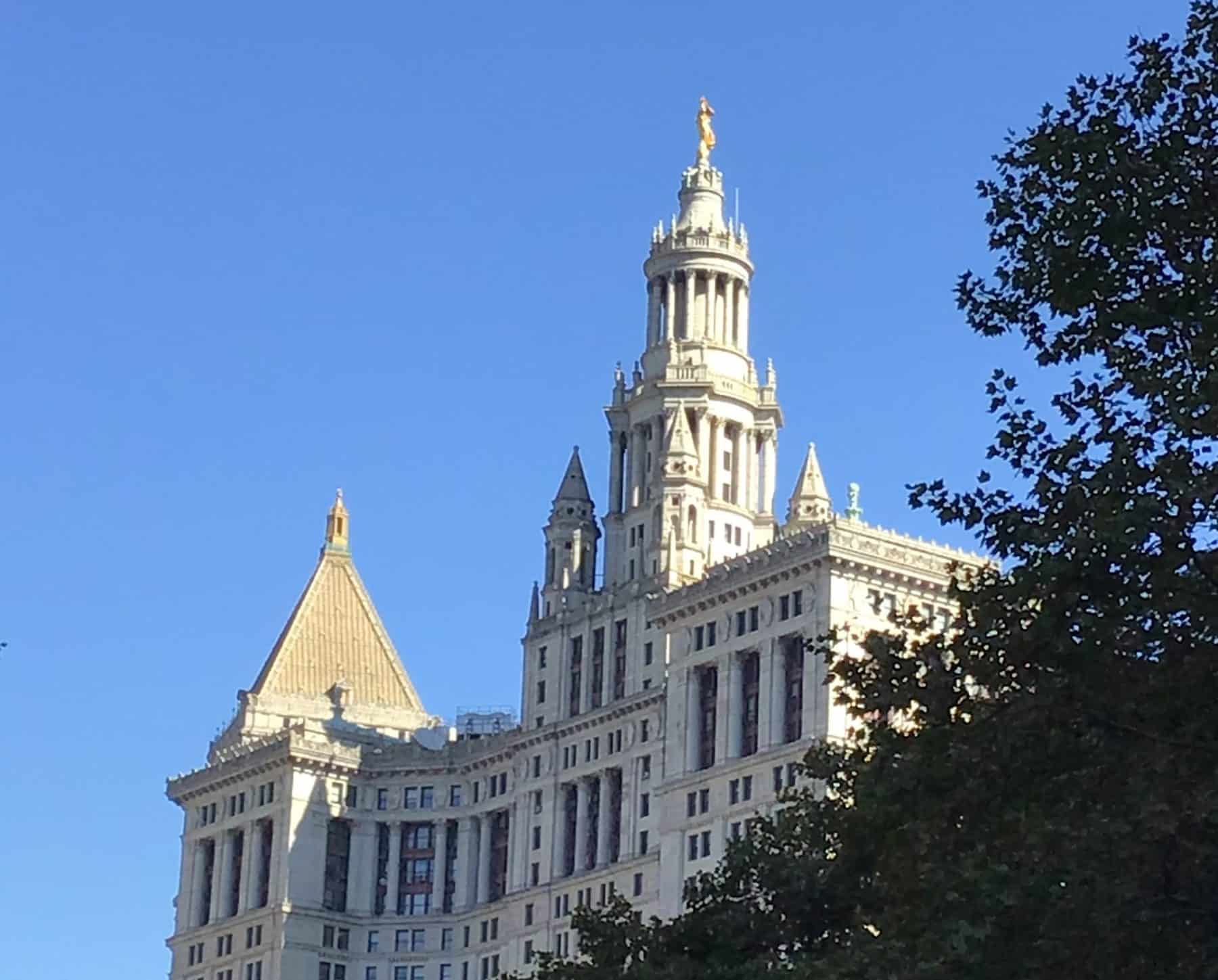
The building does have a romantic side. The expression “getting married at City Hall” really means coming to this building for a simple civil service and to pickup your marriage certificate.
It’s quite fitting that the building bears a resemblance to an elaborate wedding cake.
g) Brooklyn Bridge entrance
Since you are right next to the entrance to the pedestrian walkway of the Brooklyn Bridge, it makes sense to walk over it.
I understand you may have weary legs by now, but rest a bit in City Hall Park, then cross the bridge.
It is one of the absolute best experiences you can have in New York City.
Our tour, Across the Brooklyn Bridge Tour to DUMB, begins right here so consider joining us!