

Hi, I’m Steve, a tour guide with Tours by Foot.
And, in this post, I’m going to take you on a walk through the Nikolaiviertel, a part of Berlin’s medieval core.
When people think of Berlin, they usually are thinking about 20th-century history.
But, settlement in this area dates back to somewhere around the late 1100s.
Nikolaiviertel was located inside of Berlin’s city wall, which was erected sometime in the early 13th century.
It was roughly 2.5 km in length and circled what was then the twin cities of Berlin and Coelln.
You can still make out the border of the early settlements on today’s Berlin map.
The Nikolaiviertel is marked in red in the photo on your screen.
Berlin developed as a waypoint along an overland trade route right at the crossing point of this route with the River Spree, and Nikolaiviertel was the area closest to the action.
And, although Allied bombs leveled much of the area, some traces of its earliest days still exist.
Today, a rather worthy GDR-era reconstruction of the area surrounding the Nikolaikirche (the Church of St. Nikolas) is what draws visitors like you to this little enclave.
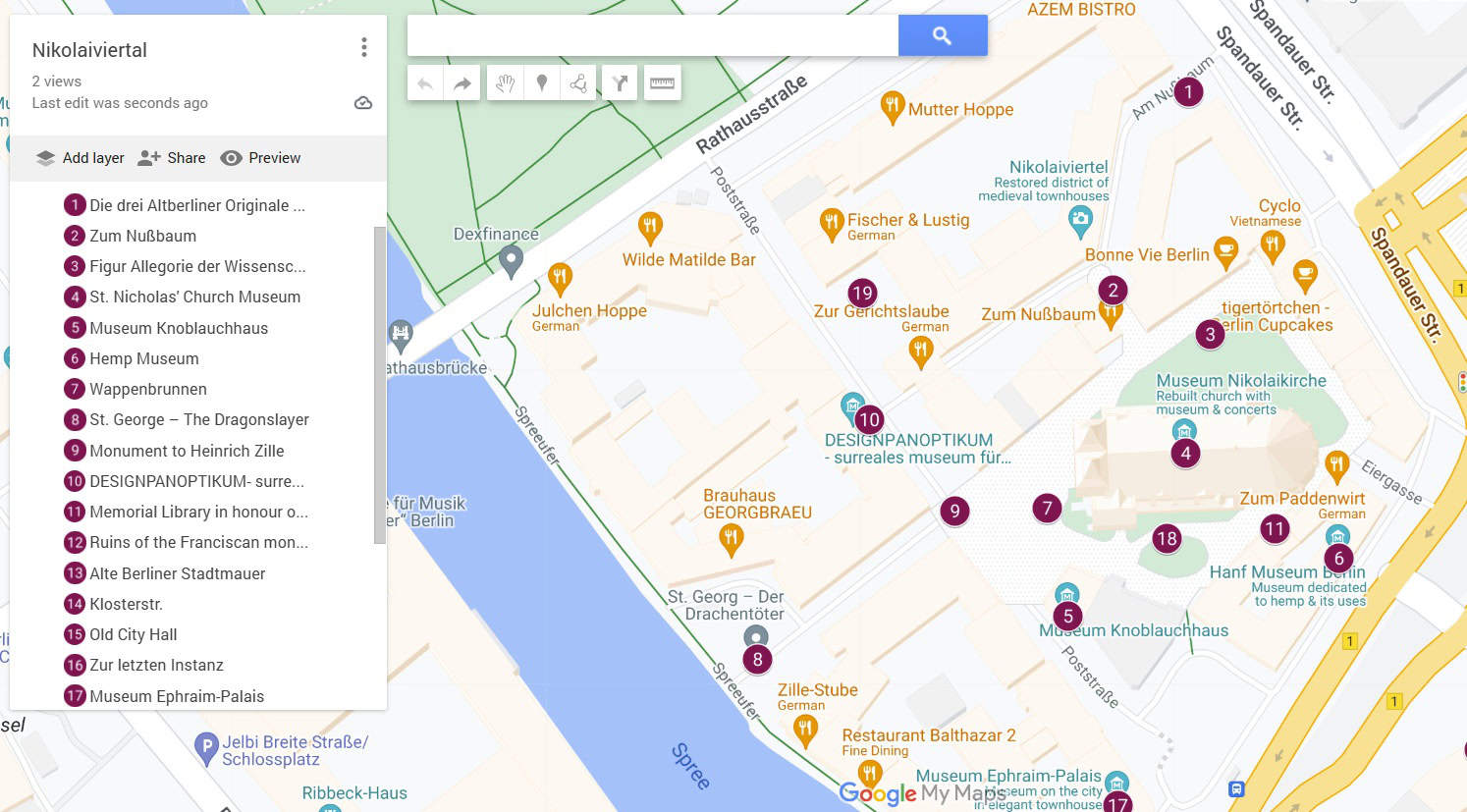
And, I’m going to follow the general route of the 19-stop self-guided walking tour that is listed on boards, like this one, that you will find throughout the neighborhood.
And you can do the same thing when you visit.
All right, let’s get started. Oh, and you could watch the video version of this walking tour here.
KAUFHAUS ISRAEL
Well, it turns out that the pull of Berlin’s recent memories is hard to avoid.
We find ourselves on Spandaurstrasse, just in front of a mixed-use building.
This used to be the location of Kaufhaus Israel (image),
Nathan Israel was a descendant of one of the original Jewish families invited to Berlin by Prussian King Frederick the Great and settled in the nearby Jewish enclave along Judenstrasse (just to the south of where we are standing).
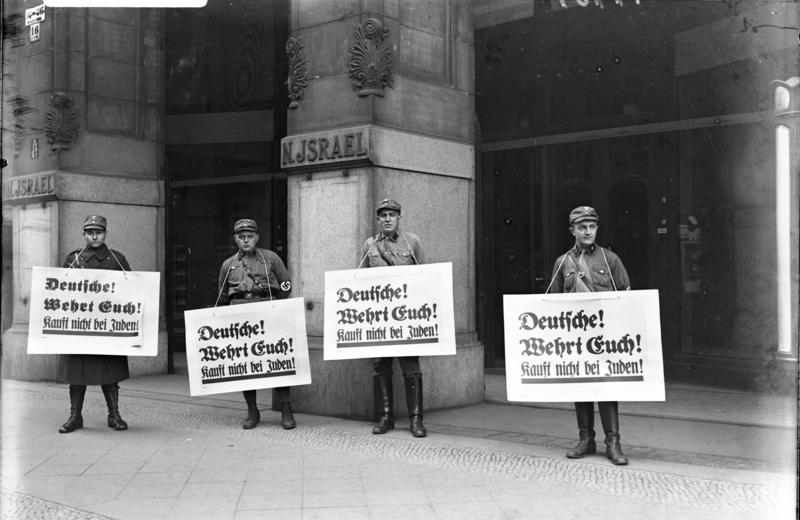
From relatively meager means, the Israel family built one of Berlin’s largest department store chains.
But their luck would run out when the Nazi’s came to power, as their store along with others owned by Jews throughout Germany would be boycotted.
And it’s this image that I remember seeing as a kid anytime the boycott was mentioned in books or in documentaries.
This is a topic for a future video. For now, we need to move on.
Die drei Altberliner Originale
This sculpture is called Die Drei Altberliner (or-eeg-gen-al), or the 3 Old Berlin Originals.
The 3 are Heinrich Zille, Otto Nagel, and Claire Waldoff, all who either lived in or spent time here around Nikolaiviertel.
The works of Nagel, a painter, and Waldoff, an actress, were deemed degenerate by the Nazis.
Nagel would even be imprisoned at Sachsenhausen Concentration Camp.
We’ll talk more about Zille later, but all three’s work was associated with the working class one way or the other, and well, this was the GDR in charge of Nikolaiviertel’s reconstruction.
All right, moving on.
The reconstruction of Nikolaiviertel was initiated in preparation of the 750th anniversary of Berlin’s founding.
It’s GDR socialism meets historical preservation, as evident by these prefabricated concrete slabs (that are prevalent throughout Berlin, especially East Berlin).
Less evident are the accommodations for roughly 2000 people. At the time of the GDR, these were special housing units for the well-connected, but still mostly .
The aim was not a 1:1 reconstruction; rather, modern building styles were to call upon historic architecture through the ages.
Zum Nussbaum
Here is an interesting addition to the ensemble. This is Zum Nussbaum, or at the tree.
This is a reconstruction of the original gabled-front restaurant built in 1571, which was also destroyed in Allied bombing raids.
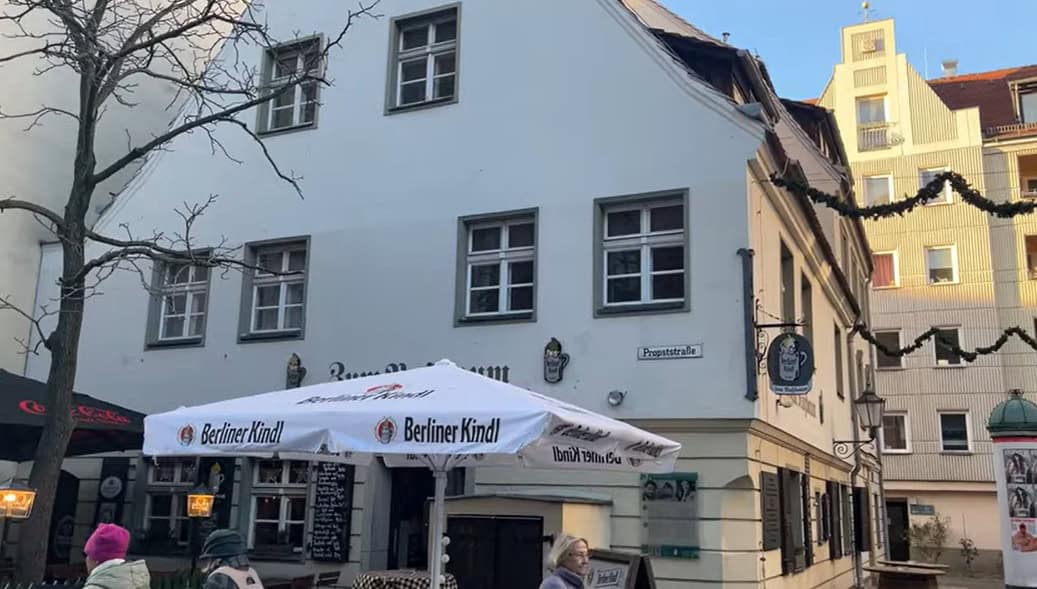
The original, however, was not located here.
It was located on the other side of the Spree, on Fisher Island in Coelln.
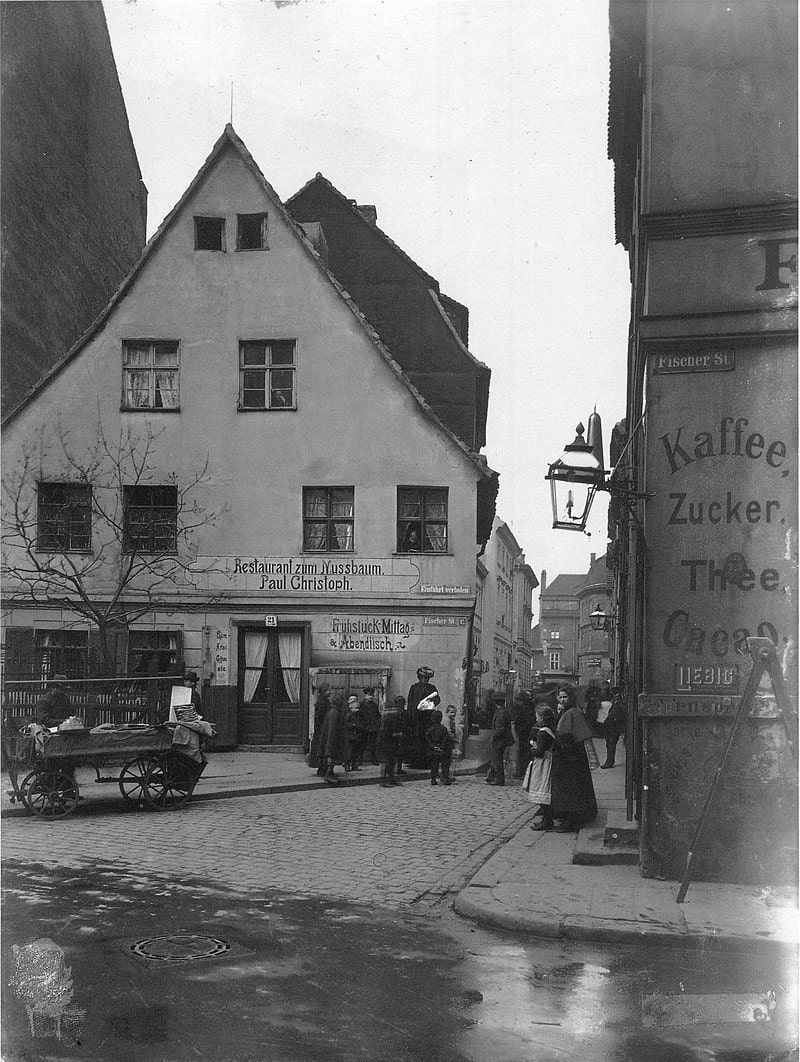
And this isn't the only historical icon of Berlin history to relocate here to Nikolaiviertel, which was part of the plan, in a way, a survey of architecture and symbols over the years in Berlin’s historic quarters.
The name of the restaurant derives from a walnut tree, which was planted next to the origina restaurant. The new version of the restaurant naturally comes with its own.
The restaurant specializes in Berlin cuisine, meaning lots of heavy meats and potatoes.
Allegory of Science
This statue is called the Allegory of Science. It depicts a man holding a book in one hand and a globe in the other.
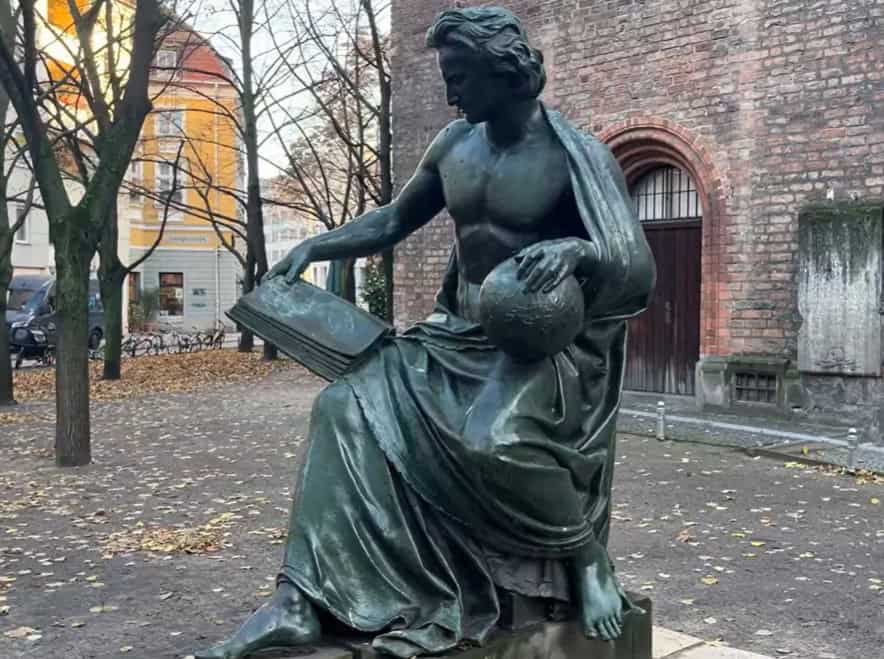
This figure was salvaged from a statue of Prussian King and German Emperor Friedrich Wilhelm III, which was located in the Lustgarden on Museum Island but was mostly destroyed by allied bombs.
At the time of filming, I’m not quite sure why it ended up here, other than it was available and looking for a new home.
Sundial
Moving on. Here we have stop #4 on the official self-guided tour.
The plaque says that “this sundial was installed here to commemorate another sundial located in the Krögel, a run-down area once located just south of here and demolished in the mid-1930s.
The sundial bore the Latin inscription ‘Death is certain, the hour is uncertain’, which was playfully transformed by the locals into ‘It’s dead certain that the clock is imprecise!’”.
Tigertortchen
If this walk makes you hungry, be aware that the Nikolaiviertel is a good place to find a bite to eat, whatever your appetite.
There are restaurants, fast food shops, cafes, bars, and dessert shops.
And speaking of desert shops, here is one of my favorites, Tigertortchen.
Tortchen is the diminutive to Torte, which in English is tart.

And that’s what they serve: mini tart cakes, which I think are really just mini cupcakes.
It’s a bit on the expensive side, but well worth it, if you ask me.
If you are here, you are probably on holiday after all.
But just don’t expect to use the bathrooms here. You’ll need to find go elsewhere for that.

Zum Paddenwirt
Here’s one of the quarter’s best-reviewed restaurants, and it’s got a strange name. The name is low-German and in English means server of the toads.
The story is that the Spree once came much closer to the restaurant than it does today, and the former proprietor of the inn used to fetch barrels of ale by boat.
One evening, as the story goes, he was too lazy to unload them.
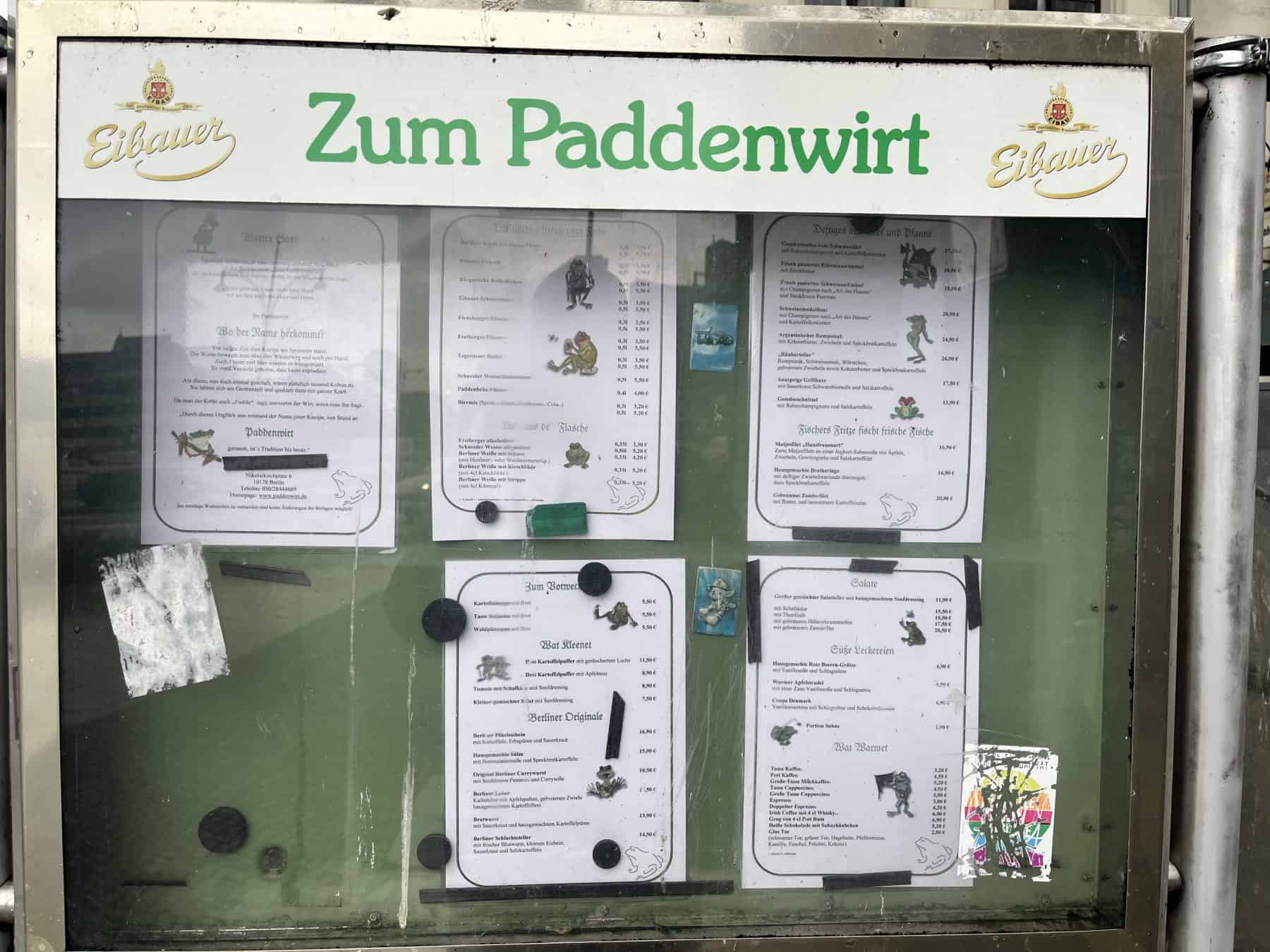
When he returned to his boat the next morning, hundreds of drunken frogs (Padden) croaked at him—a leaky barrel had lured the amphibians into the boat, who apparently took a liking to the drink.
The croaking attracted a crowd of onlookers, who promptly gave the innkeeper his new nickname.
I’ve been here once with my wife for a snack.
I can recommend the Gulash, but the restaurant serves the standard Berlin classics, such as leg of pork, grilled sausages, schnitzel, and more.
Molkenmarkt
Mullendambruecke is the name of the river crossing that connected Old Berlin and Coelln.
Even before it became a city, this was an ancient crossroads of water and land routes and was a trading center.
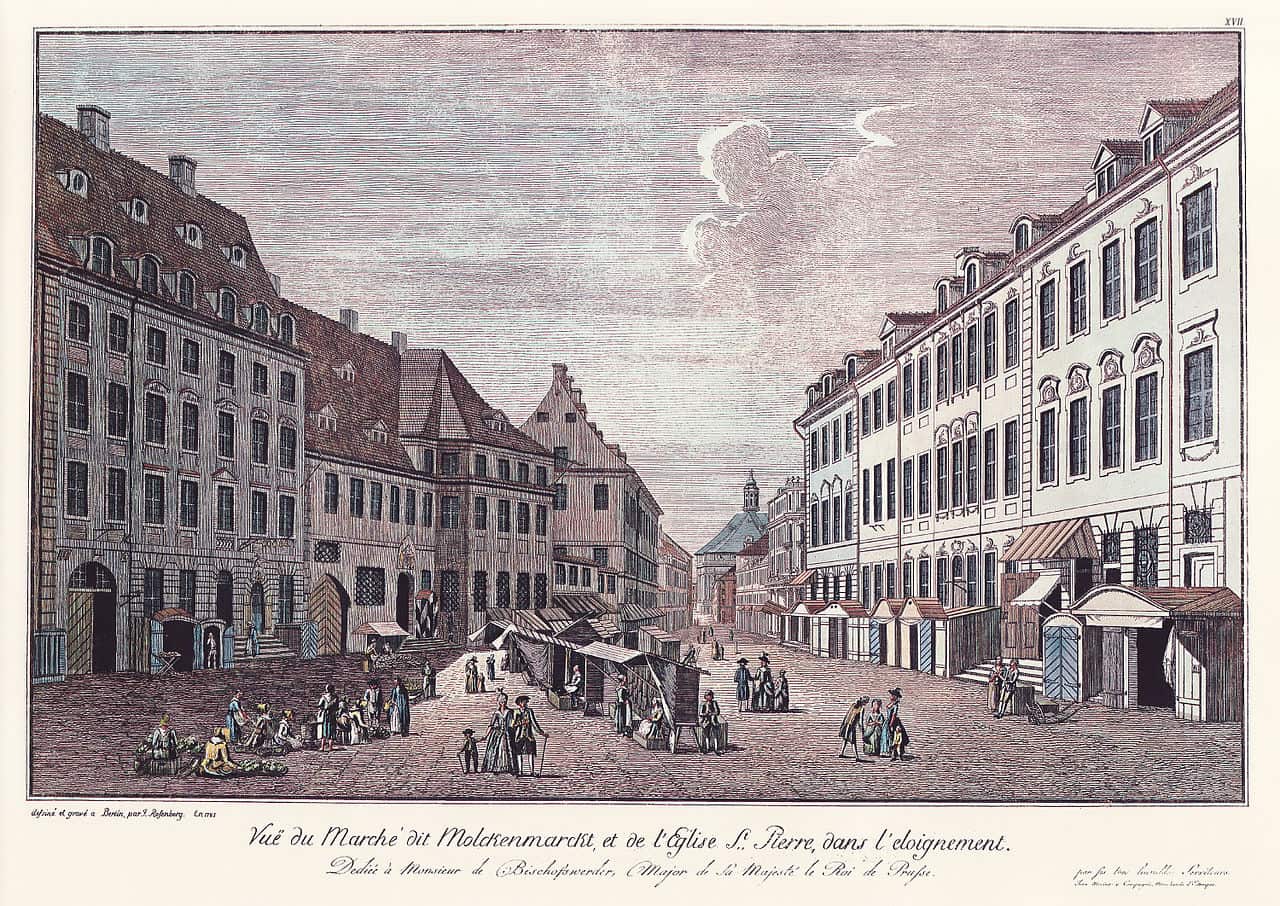
Molkenmarkt means whey market and probably was where milk products were traded in the city’s early years.
The area was flattened, and a more direct road was paved over the center of the area.
Excavations for a new major redevelopment project have unearthed many building foundations dating back to the city’s medieval period, including homes, latrines, and perhaps most interesting a road.
The road was made of thick oak logs carbon-dated to the the 13th-century.
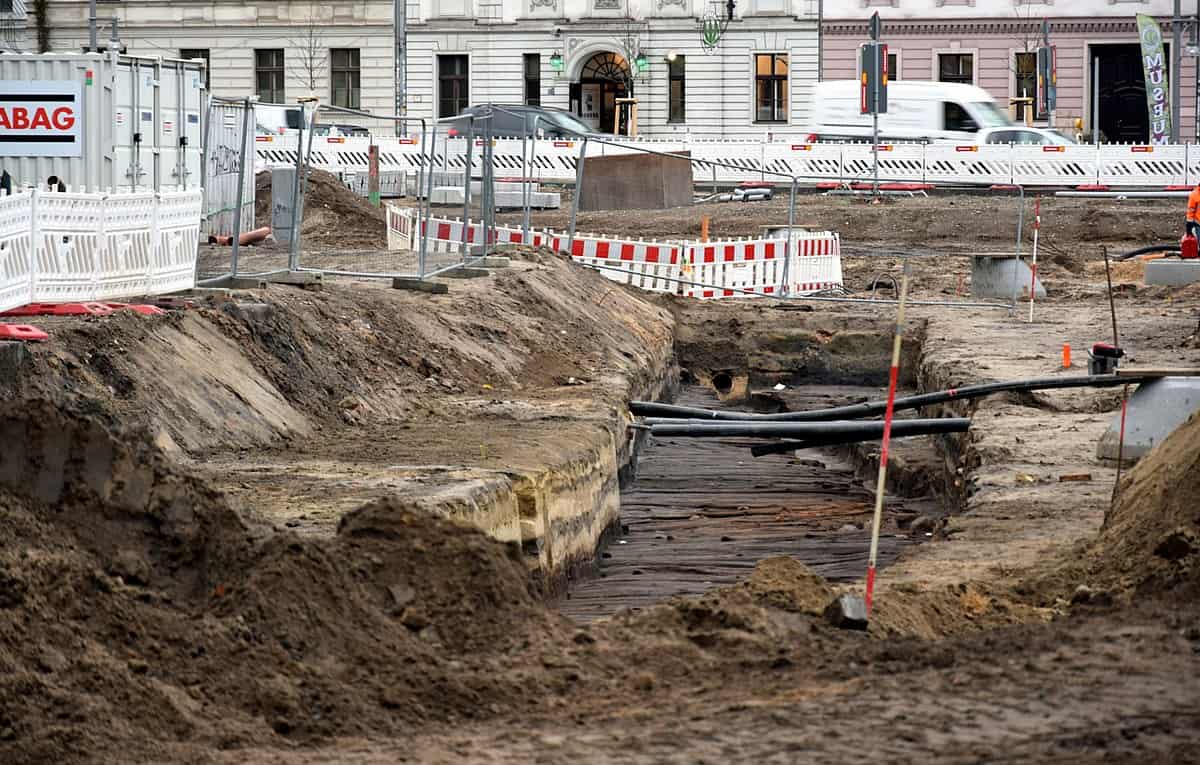
Archaeologists believe it was designed to overcome the marshy and often muddy ground near the river, still a problem for Berlin today.
Many of the artifacts being uncovered should make their way to Berlin’s museums in the near future.
Archeologists plan to finish up their work in 2025.
Some buildings, at least the facades of buildings, of the Molkenmarkt still exist today, such as the Schwerin Palace, which was originally built around 1700.
There’s also the imposing Old Town Hall, both of which I plan to cover in an upcoming video about the Klosterviertel, the area starting just across this road.
OK, let’s head back into Nikolaiviertel. And here we are looking at the west end of the church.
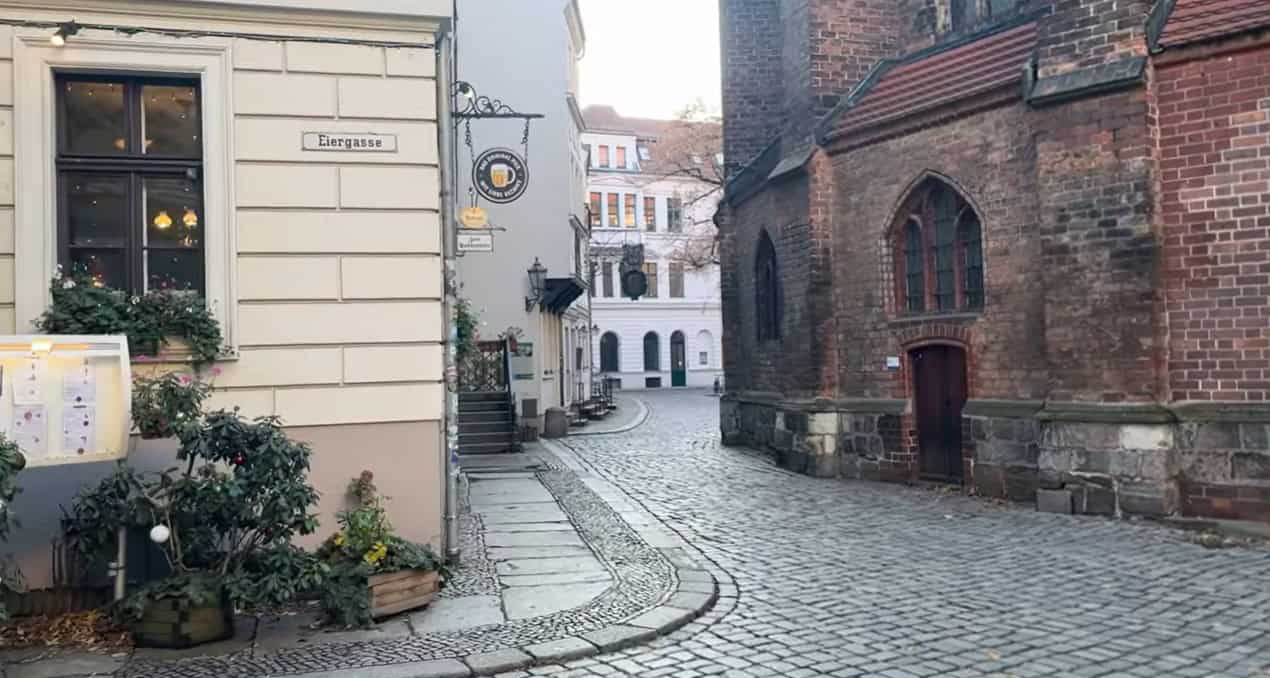
We were just on Eiergasse, which means egg alley, likely an extension of the old market where eggs were sold.
It’s here where you really feel the medieval touches of the reconstruction, with the narrow cobblestone streets.
Gotthold Ephraim Lessing
Here is the reconstructed, 3-story house of Gotthold Ephraim Lessing, a poet and dramatist and an important German figure of the Enlightenment era.
And here are some more medieval touches, pictograms denoting for the illiterate the function of the business or organization.
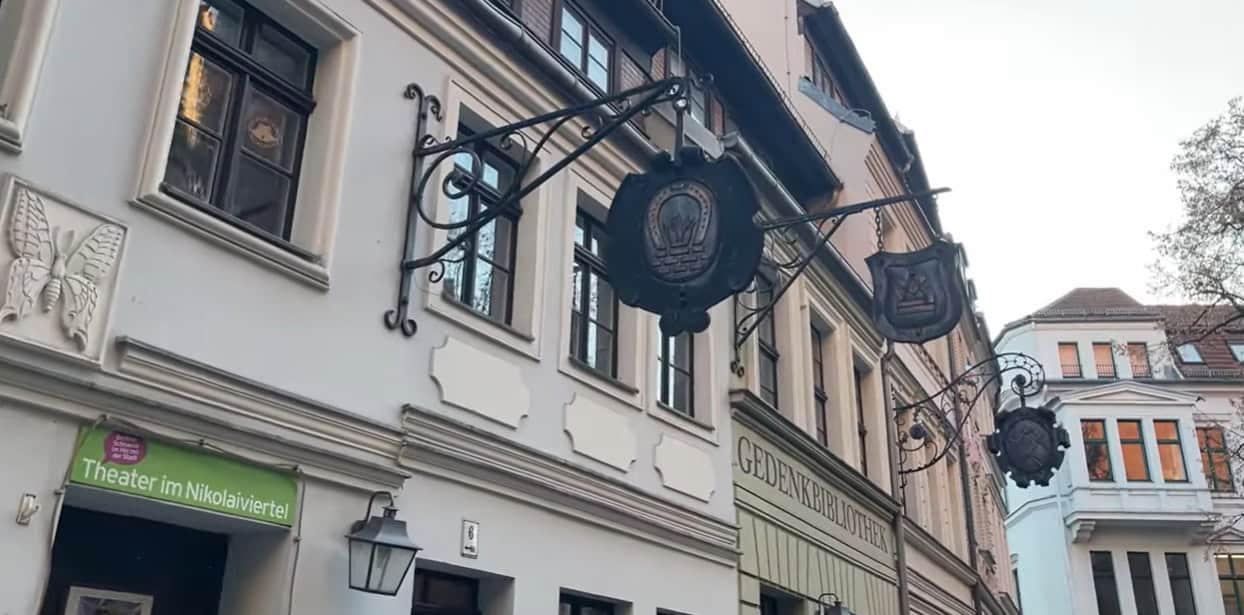
Gedenksbibliothek
And here is the Gedenksbibilothek, translated to English, memorial library.
Its a memorial to all of the victims of communism and was founded on the idea of a collection of books banned by communist officialdom.
But, has expanded to focus on GDR history with a focus on justice and the state security apparatus.
Clio
This is Klio, the muse of historiography.
She is the other statue that was salvaged from the larger station of King Frederick Willhelm that I mentioned just earlier.
Klio was previously leaning against the pedestal with her left arm while writing on it with her right hand.
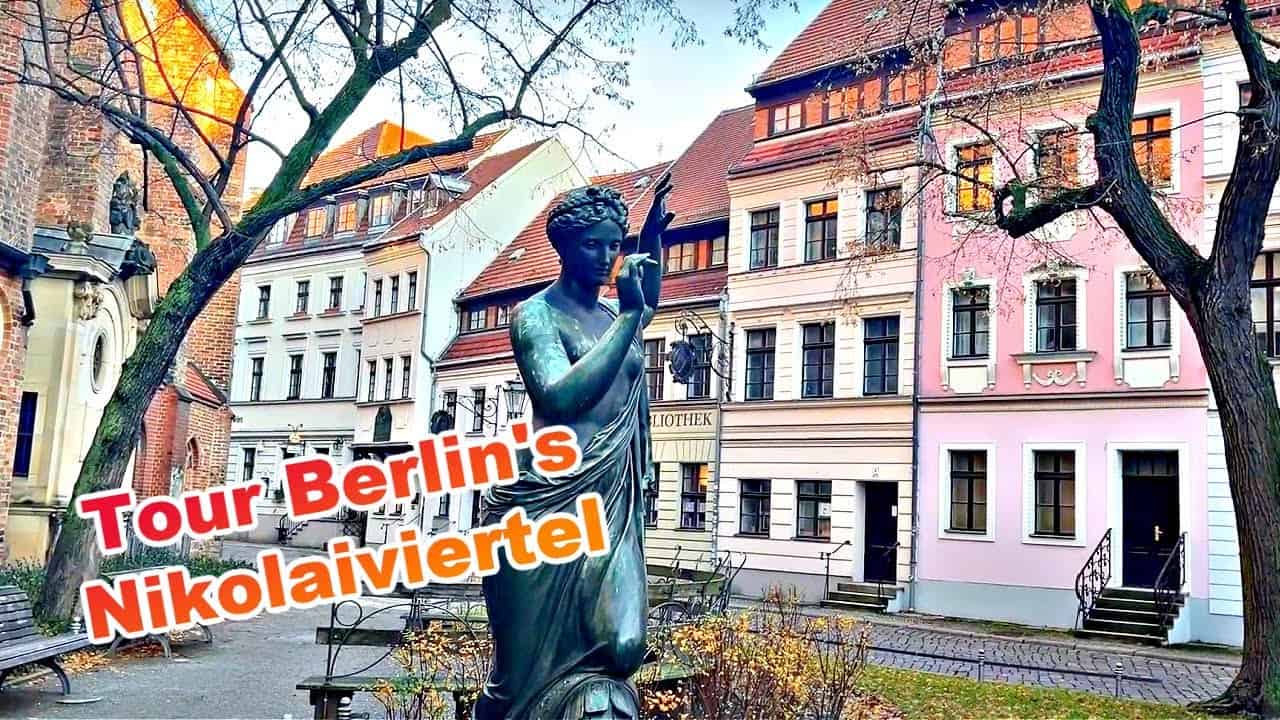
And needless to say, this is a charming location (refilm the intro) with structures of various sizes and styles.
All of the houses were reconstructed based on historical photographs.
Hanf Museum
Now, we head back to the Mullendamm road, and here we have something unexpected: the Hemp Museum.
This museum traces the biology & history of hemp & its medicinal, commercial, and, of course, recreational uses.
Museum Ephraim-Palais
This rococo building houses a museum with exhibits on the history & culture of Berlin's 800 years.
It’s had an interesting history, serving as a mint, offices for Nazi administrators, who eventually demolished the building but saved the facade.
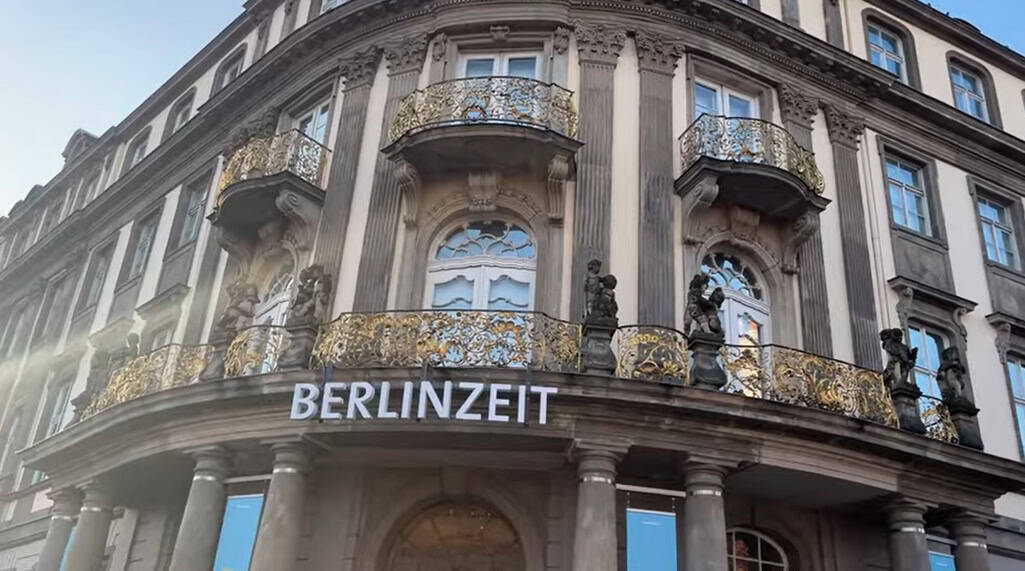
The facade sat in storage until the mansion was rebuilt in time for the city’s 750th birthday.
Muellendambruecke
Now, just a quick stop. Coming up is the river crossing, the Muellendambruecke.
Although, today, it’s a bridge, it’s name (Mill Dam Bridge) hints at its history.
This was once a dam used to power mills, and it was the main crossing from Old Berlin into Coelln and as a way to charge customs.
Even before the 12th century, this general area was an important crossing area of trade routes, both water and land, and the core reason a great city eventually sprang up here.

At one point in this crossing’s history, you might not even know you were on a bridge, as it had buildings on both sides, just like the old medieval London Bridge.
OK. Let’s head back to Nikolaiviertel.
Schuberthaus
This is a relatively late addition to the area. This is the Shuberthaus, built in the 1870’s in the late neo-classical period.
The plaque on its corner reminds the reader that, like most of the area, this building was destroyed by the impact of war.
It was rebuilt in 1957 and used as GDR government offices, and since 2006 has been occupied by the art auction house Lempertz.
Knoblauch Haus
And adjacent to it is the Knoblauch Haus. According to the self-guided tour, this house is the only remaining 18th-century upper-middle-class mansion in Berlin’s center.
The Knoblauch family was a quite prominent Berlin family, and the museum focuses primarily on the depiction of life of the well-to-do of 18th-century Berlin.
Remarkably, it is one of just a handful of structures to survive the bombing raids of WW2 relatively unscathed.
OK, now we come to the front of Nikolaikirche, the Church of St. Nicholas.
It’s one of the nice things about winter in Berlin (when you can catch a sunny day - that is).
Due to the sun’s low trail through the Berlin skies, it’s much easier catching that golden hour. (video opening highlight)
Wappenbrunne
And we are approaching Christmas, as I film this video, so a few pop up market stalls are up and in our way.
What I am walking to now is called the Wapperbrunne, or the coat of arms fountain.
This fountain was built in 1987 to commemorate the founding of Berlin-Coelln. At its base are coats of arms for the 8 trade guilds of the early city, the butchers, bakers, shoemakers, and the like.
Sitting atop a 6-meter-tall column is the city’s supposed namesake, the bear, who is holding the coat of arms of Brandenburg.
And just in front of the entrance to Nikolaikirche is the Guild Seal of Berlin, I believe a coat of arms of the city in the 13th-century and placed here for the anniversary.
Nikolaikirsche
Nikolaikirche, a grand double-spired church that serves as a museum of the church and a concert venue.
It’s look today is a bit different than the original, though the first few layers of stone are from the 1200’s.
It previously had a single asymmetric tower but was redesigned in the 19th-century.
It was completely gutted due to firebombs and only the stone shell of the church stood at the end of the war.
Restoration on the church would only commence in preparation for the city’s birthday celebrations.
Inside you will find a large and colorful central nave with a giant wood carving of the crucifixion hanging from the ceiling.
There is also an array of sculptural and gilded pieces, as well as a large and beautiful organ.
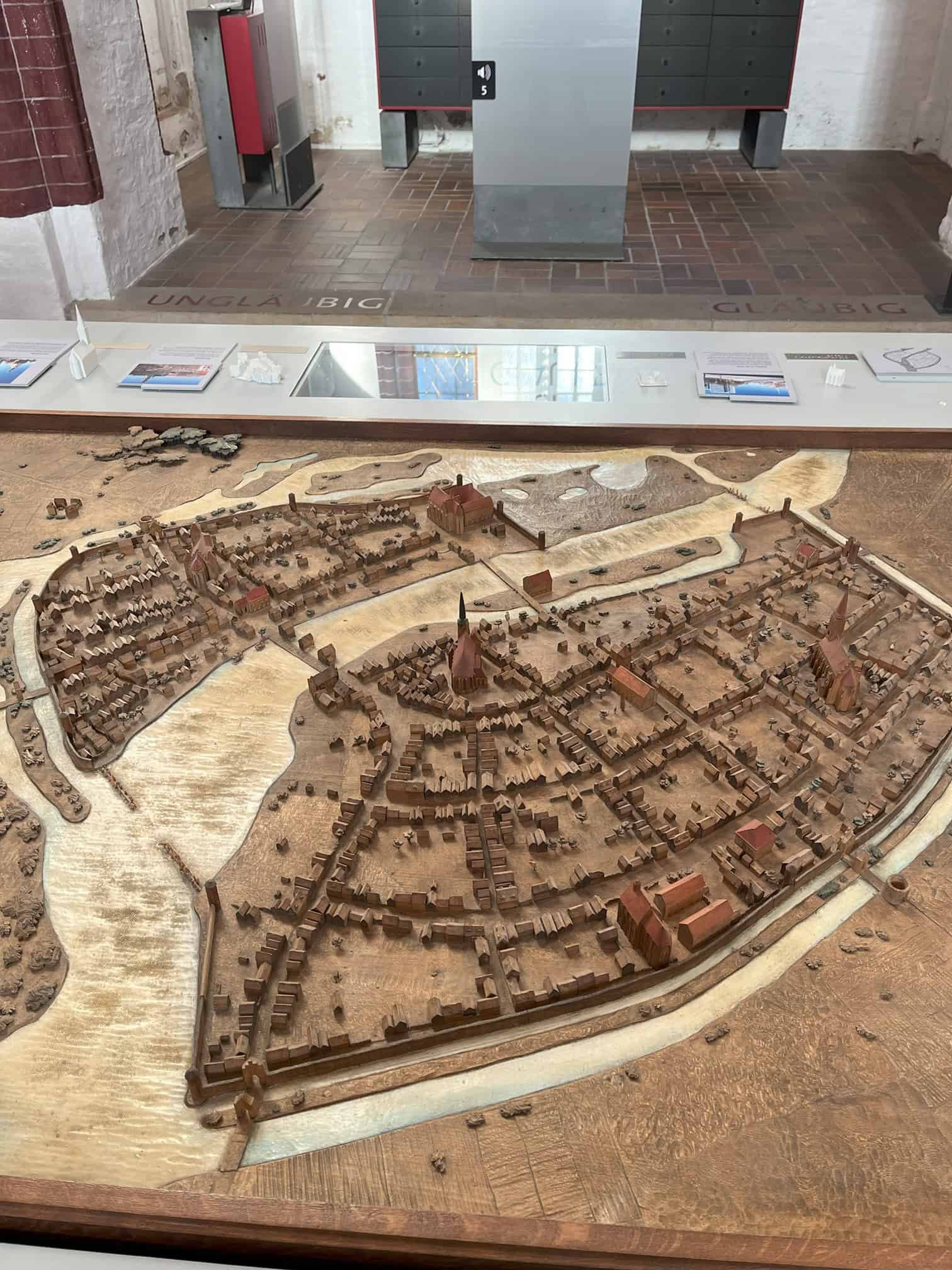
What I find most interesting is the model of the original settlement, which I do believe is on loan from another museum.
It depicts the street and building layout of the twin cities at around the time of the founding.
Statue of St. George
Now, why is there a statue of St. George, the patron saint of England, in the middle of the German capital?
Well, he is a saint.
And all Christian churches celebrate his day in April, and he was a particular favorite of monarchs during the Crusades.
The sculpture was created for the Paris World Exhibition in 1855, and the sculptor’s wife gifted it to King Wilhelm I 10 years later.
Like the other statues mentioned earlier, this one is a transplant, this one having been located in the courtyard of the City Palace until its destruction in WW2.
Heinrich Zille Museum
And for the football fans in the audience who plan to visit Berlin, here’s a pub with Sky Sports and very good reviews.
And it’s right next door to the Heinich Zille Museum. Zille was one of the 3 Berlin originals that we saw at the start of this walk.
It’s an interesting and cozy exposition of one of the most well-known Berliner painters and photographers with both his own photos and photos about him.
Zille was a local and mostly focused on themes of everyday Berlin life.
Zur Gerichtslaube
Here is another example of a building from outside of this corner that was reconstructed here for the city’s big birthday. But in this case, it’s from just around the corner.
This is a reconstruction of the city’s mediveal-era town hall.
Today, it’s yet another well-reviewed restaurant serving mostly German cuisine.
Mother Huppe
The name of the restaurant, ‘Mutter Hoppe’, is a tribute to Ida Hoppe´s pub in the mainly socialist district of Wedding.
It was very popular in the 1920s and 30s, and its name invokes the working-class tradition prior to the war and Berlin’s division, a tradition which has been the subject of many artistic works.
Like most restaurants in this area, the reviews are quite good, and they offer live music on Wednesdays.
This plaque commemorates the revolutionary spirit of the 1848 Uprising that swept through Germany and Europe.
In particular, it recognizes that on the night of March 8th, revolutionaries barricaded themselves here while fighting palace troops, who from just across the Spree were firing cannon shots at them, killing several.
I found this interesting because several of my ancestors emigrated from the Rheinland to New York City around this time. They were referred to in the German American community in New York as the 48érs.
And this statue is simply called the angler, showing a man sitting on a dolphin pier and fishing in a small body of water in front of him.
I like it for it’s simplicity, and perhaps it’s symbolic for a simpler time here on the Spree.
Now, don’t stop here.
I’ve got lots of other walking tours around Berlin, including this one where I walk along the route of the Berlin Wall.
Leave a comment and let me know if you are planning to visit the Nikolaiviertel when you are in Berlin.
And get in touch if you would like a guided walking tour when you are here. My contact details are in the video description below.
And I’ll see you in the next video.