
The United States Holocaust Memorial Museum is one of the more moving museums to visit in Washington D.C.
It explains the history of the Holocaust - what led to it, the horrific events that unfolded, and the aftermath.
While it is not part of the Smithsonian, it is free to visit but timed tickets are required.

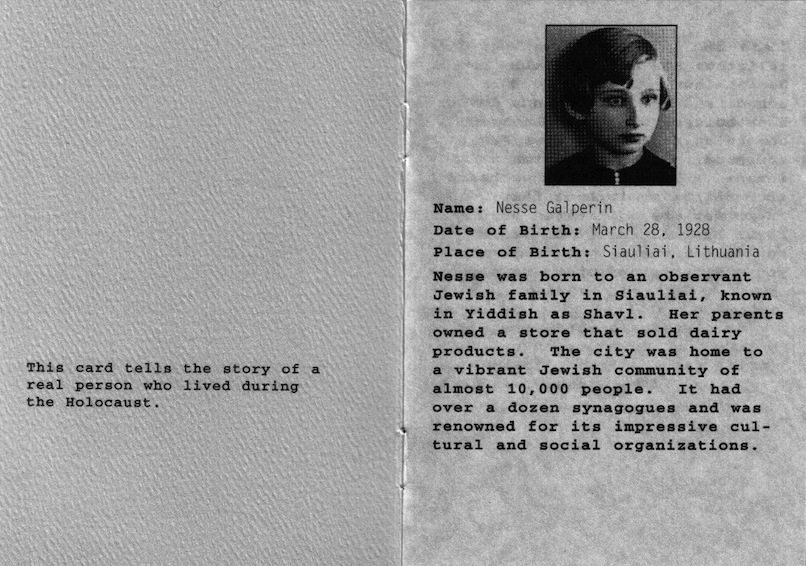
When the Holocaust Museum opened in 1993, I asked my parents to bring me but I was too young to see over the wall covering some of the more intense videos. I still have the identification card telling the story of someone who went through the Holocaust. I've now been bringing groups to the USHMM for over a decade. I find the audio theatre Voices of Auschwitz to be the most moving exhibit.
Should you visit the Holocaust Museum?
Yes; no matter the age or background knowledge of the people in your group or family, this is an incredible experience.
Please note the name of this place The United States Holocaust Museum and Memorial.
It is important that you understand that this place is more than just a standard museum set up to tell stories about the past.
While it does that, it is also meant to serve as a living memorial to the millions and millions of innocent victims of the Holocaust.
That means you should treat the entire building as a sacred space meant to mourn, kind of like Arlington National Cemetery.
It also means that part of the work of the “living memorial” is to make sure the awful things that happened during the Holocaust never happen again.
Part of that work is bringing together visitors to the Museum with actual victims of the Holocaust, some of whom may have been even younger than you at the time, to talk about the terrible things they and their families experienced.
I address more about visiting the Holocaust Museum with kids below.
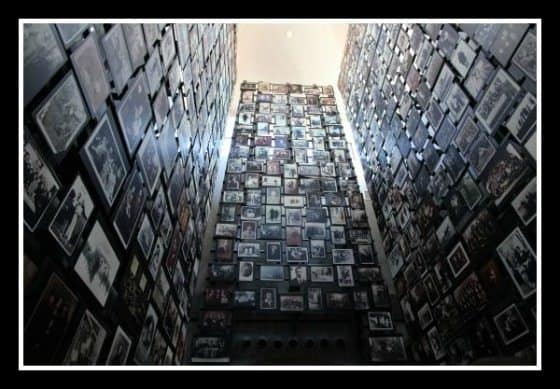
The Permanent Exhibit is the main exhibit for adults and young people.
There are many things to see at the Holocaust Museum, but the Permanent Exhibit is a must-see and the one most people are talking about after their visit.
A visit to the museum can be a full-day experience, most of it spent in the Permanent Exhibit.
It is recommended to reserve at least 90 minutes to fully experience this part of the museum.
Depending on your interests, you can easily spend more.
It is unlike any other museum exhibit you’ve probably ever been to.
It is designed so that you follow the timeline of how the Holocaust happens.
It starts when the Nazi’s rose to power and took over the nation of Germany in 1933, ending at the end of World War II.
It is also designed to make you uncomfortable: it’s purposely dark, cold, and often cramped.
To begin, you are jammed into a large industrial elevator with many other people and taken to the top floor, where the exhibit begins.
You will be handed a small pamphlet with four pages that highlight the life of one real-life victim of the Holocaust.
You are meant to flip a page each time you enter a new floor; that way, you are following the life of a real human being as they lived through the horrors you see around you as you walk through the exhibit.
At the end of the exhibit, you will find out if they survived and what may have happened to them.
Don’t cheat yourself by flipping to the end.
The Permanent Exhibit is divided into levels.
3rd Floor | Nazi Assault: 1933-1939:
This floor is about the rise to power of the Nazis in Germany and how they slowly but surely turned the entire nation against Jews.
2nd Floor | The Final Solution: 1940-1945:
This floor is about what happens to the Jews of Europe as Nazi Germany conquers many neighboring countries.
They didn’t want Jews or other “undesirables” in their new Empire, and had to find a “solution” to this “problem”.
The “Final Solution” mentioned here is the systematic murder of over 12 million people, over half of them Jews.
WARNING: This is the most disturbing floor.
It is meant to shock you with the horrific things that the Nazis did to their victims.
You will find some displays behind short concrete walls meant to protect people from seeing some of the more graphic images of concentration camps accidentally.
If you do not want to see these images, YOU DO NOT HAVE TO! Simply walk by these exhibits.
There is still plenty to see that will shock and disturb you.
Nothing here is probably any worse than things you may have seen in movies.
BUT, these are real images of real people suffering. It’s ok to be disturbed, to cry, or just to walk away.
PLEASE NOTE: At the end of the entire exhibit, there is a place called the “Hall of Remembrance” where visitors are encouraged to light a candle for the victims and remember them, but it is also a space to feel your feelings and center yourself before leaving the Museum.
If you become overwhelmed by what you see here, the Hall of Remembrance is a good place to settle yourself.
1st Floor | The Last Chapter:
This floor is all about resistance to the Nazis throughout Europe by Jews and those who tried to protect them, and the liberation of the Concentration Camps by Allied armies as Nazi Germany fell and lost World War II.
Things to Know if You're Visiting the Holocaust Museum with Kids
In addition to being a tour guide who works with student groups coming to DC, I am, also, homeschooling mom of two elementary students.
That means I have taken kids as young as Kindergarten (mine) all the way up to groups of 5th Graders to this museum.
This museum is worthwhile for all age groups and there are different sections of the museum depending on the sensitivity level of students.
My second grader is too empathetic and my kindergartener is too young for the permanent exhibit, but we have visited the Children's exhibit, Daniel's Story, as an introduction to this event.
There is a special area near the Information Desk where you may see and meet some of these speakers.
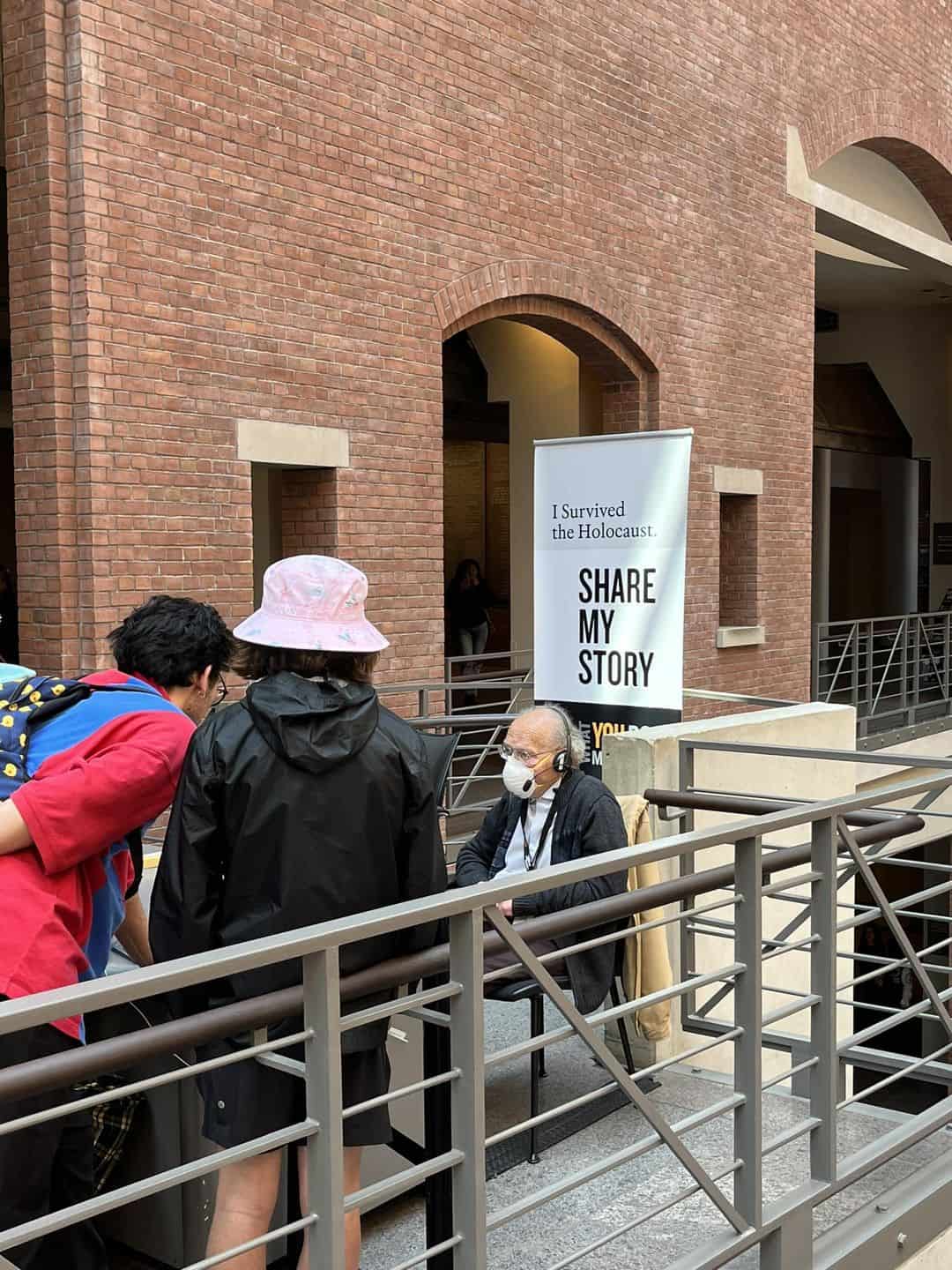
Understand that it can be very sad and emotional for these speakers to relive the terrible things they lived through.
But, they believe so strongly that their first hand accounts passed on to people like you can truly help create a world where the Holocaust can never happen again, that they push through that hurt.
Please take advantage and talk to them if they are present.
Daniel's Story is specifically made for younger visitors, as you hear the entries young Daniel makes in his diary as the Nazis make life more and more difficult for him and his Jewish family.
You will walk through replications of the places he talks about as you hear his story, including his family’s home, the ghetto they were forced to move to, and what happens to them during the Nazi’s “Final Solution.”
Though “Daniel” was not a real boy, there were many, many children just like him, and his diary is based on the writings of several real children who experienced the Holocaust in Germany.
Daniel's Story does not require tickets and you can enter anytime the museum is open.
It is meant for children, so it is a shorter visit.
Most families will find it takes about 45 minutes to walk through, watch all the videos, and experience it.
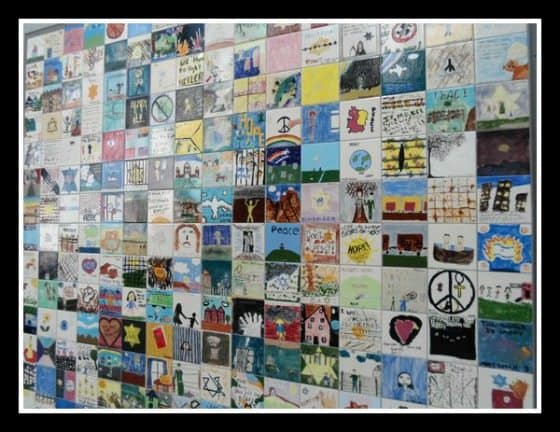
Continuing with an exhibit for children, the Children's Tile Wall is in the lower level.
There are over 3,000 tiles that were created and painted by American students in reaction to learning about the Holocaust in the 1980s.
WHEN DO YOU NEED TICKETS TO THE HOLOCAUST MUSEUM
You do not need a ticket to enter the museum, traveling exhibit, or Daniel's Story.
You will however still need a ticket to visit the museum's permanent exhibition.
Entry is free. In fact, the Holocaust Museum is one of the top free things to do in DC.
However, if you are getting advanced tickets there is a $1 transaction fee.
The tickets are timed for entrance in a 15-minute window.
This means that if you obtain a ticket for 10 a.m., you have from that time until 10:15 a.m. to enter the Permanent Exhibit.
Below are instructions for getting advanced tickets to the Permanent Exhibit, whether you are bringing your family of 4 or a group of 55 students.
Advanced reservations are taken up to 3 months in advance.
Holocaust Museum tickets are timed. You will have a one-hour slot in which to enter the permanent exhibit.
The group must be in the building, through security and the ticket line before the end time on your ticket.
Late arrivals are only accepted if spaces are allowed.
How to Get Tickets:
If you are not affiliated with a school or tour company, or groups smaller than 55 people, tickets can be reserved on the USHMM website.
Tickets for large groups may be reserved up to 3 months prior to the visit.
Groups are given timed tickets, starting at 10 am with the last group going through at 3:30 pm.

INSTRUCTIONS FOR GROUPS
If you are traveling with a group larger than 110 people, you will need to break the group into smaller parts and make a reservation for each individually.
While booking your tickets, you will be taken to a screen and told you have a pending reservation that they will hold for 20 minutes.
If you have never made a reservation on this system before, click on the link that says: Complete My Reservation so you can provide information about your group.
If you have used it before, log in to your account, otherwise, you will need to create an account with your information.
Make sure you take note of the arrival instructions, as groups arrive on the 15th Street side of the Museum, not the main entrance on the 14th.
Plan to arrive a half-hour early, and have your group line up single file from the entrance.
Inform your group that they will be going through security.
It’s important to note that reserving tickets for groups in advance has a convenience charge of $1 per ticket.
Consider DC BY FOOT when bringing your group or school group to Washington, DC.
We are a group of knowledgeable and fun tour guides, experienced with private tours for school, corporate, or VIP groups.
We love what we do and we take pride in our long-term partnerships.
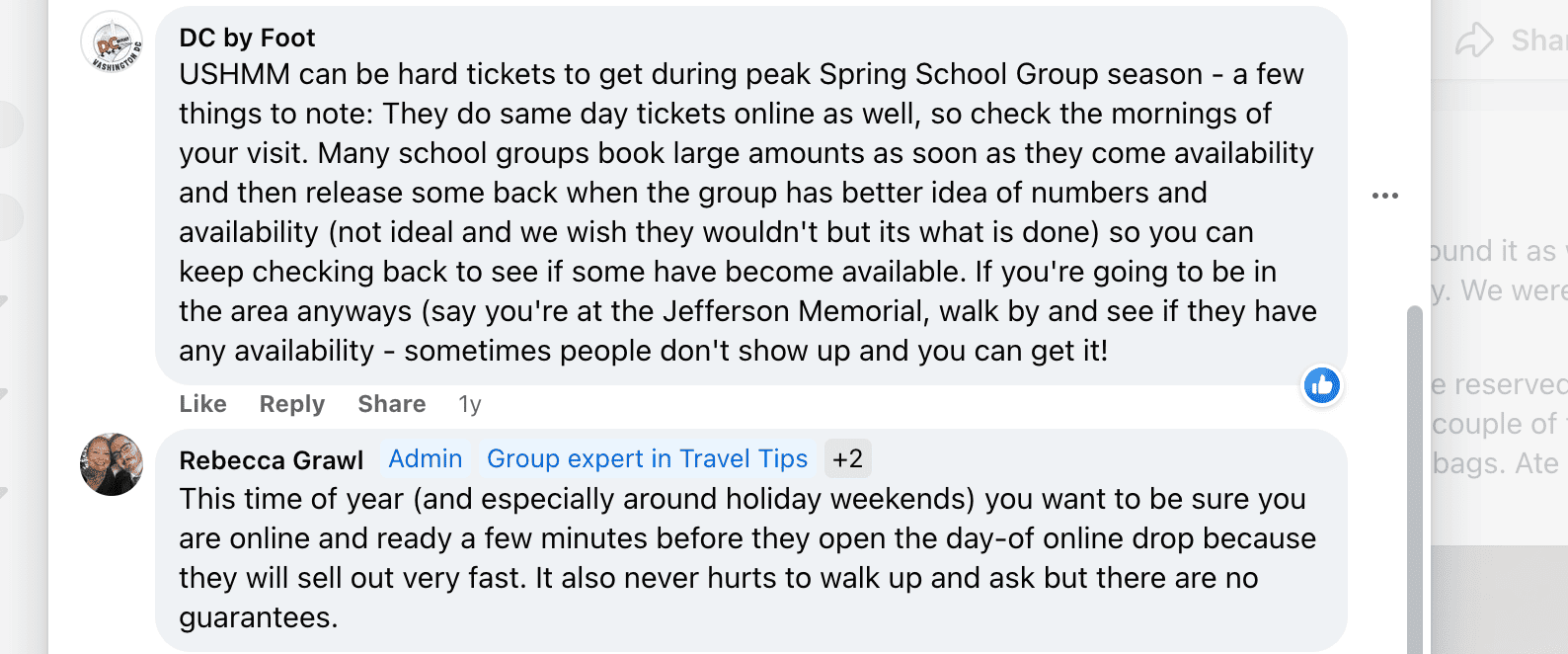
Officially, same-day tickets are NOT distributed at the museum but rather online at 7 a.m. using the same link as above for advanced tickets.
However, we have often seen same-day tickets being handed out at the USHHM in the mornings.
If you are unable to get tickets in advance or want to have some flexibility with your visit to Washington, DC; the Holocaust Memorial Museum does offer same-day tickets.
Tickets are distributed on a first-come, first-served basis beginning at 10 a.m. One person may ask for up to 20 passes.
With proper identification, members of the military, law enforcement, firefighters, and government employees are entitled to obtain non-timed passes.
They must enter the museum and request their complimentary tickets at the information desk.
What time should I line up for same-day tickets?
During the spring season, when there are many school groups visiting the city, the line for same-day tickets begins to form as early as 7 a.m.
If you arrive later the staff will often manage the line so you don't have to wait if they don't think there will be tickets left.
Where to get same-day tickets?
The pass line forms next to the building in the alley with benches.
Staff distributes the passes from the 14th Street side of the alley to allow those with passes to proceed into the building.
The same-day ticket line is one block away from the Smithsonian Metro (Blue/Orange/Silver) Station.
How to get to the Holocaust Memorial Museum
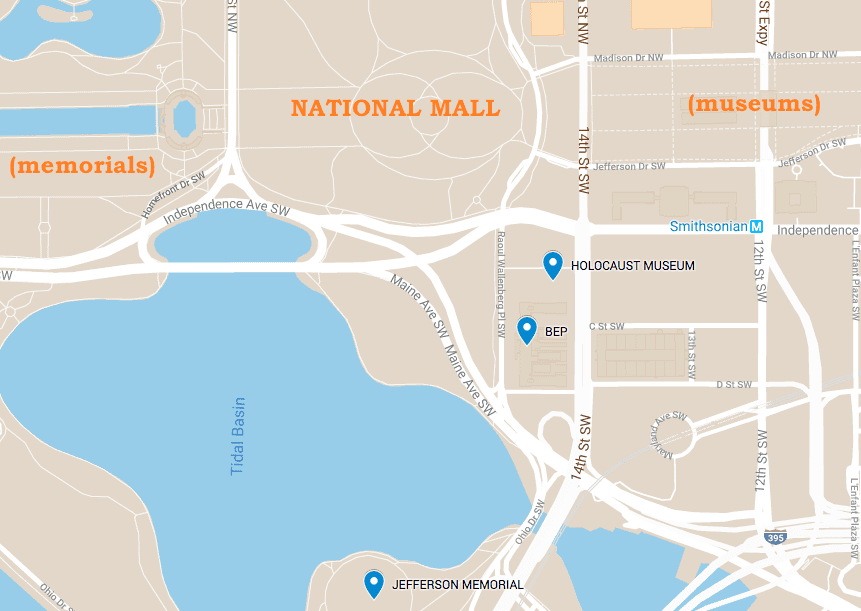
Officially, the Holocaust Museum is located at 100 Raoul Wallenberg Place, but the main tourist entrance is located at 205 14th St. in southwest D.C.
Metro:
The closest Holocaust Museum Metro stop is the Smithsonian (Blue/Orange/Silver) Stop.
Be sure you use the Independence Ave exit and not the Mall exit.
When you exit the station on Independence Ave SW, just head straight two blocks to 14th St SW and you'll see the museum across the street to the left.
Read our tips on how to use the DC Metro system.
Tour Bus:
If you have or are considering purchasing the hop-on-hop-off bus ticket, keep in mind that all relevant companies stop at the Holocaust Museum.
Parking:
Some nearby streets have metered parking but they are subject to hour limits and rush hour restrictions.
There are a few nearby commercial parking facilities.
You can compare prices at these garages and reserve a space at one of your choices through SpotHero.
This service makes the entire parking experience stress-free and can be quite the lifesaver for drivers in Washington DC.
Hours
The Holocaust Museum is open daily with the exception of Yom Kippur and Christmas Day.
- 10:00 am - 5:30 pm (17:30)
The entrance to the Permanent Exhibit closes at 4:30 p.m. (16:30) to allow ample viewing of the exhibit.
Security
The Holocaust Museum has its own police force and security protocols. Entrance to the museum requires airport-like security.
(Keep your shoes on, though!) Any electronics and bags will need to go through the scanner.
While closed food and drinks are allowed, there is no eating, drinking, or gum inside the museum.
Open water bottles are allowed, but you will likely be asked to take a sip before they let it in.
Other beverages are not allowed if already opened.
As a reminder, pepper spray and mace are not allowed in DC!
Accessibility
The USHMM is fully accessible.
While the museum is multi-level, there are wheelchair-accessible elevators and ramps.
For those who are blind or have low vision, guided tours with trained docents with descriptions and touchable objects are available with advanced requests.
Visitors who are deaf or hard of hearing will find closed captioning on all multimedia exhibits.
Guided Tours of the Holocaust Museum
The Permanent Exhibit is self-guided and guided tours are not offered by the museum or third parties.
They do offer a student guide that helps younger visitors understand the museum and not get too overwhelmed.
Can I take photographs at the Holocaust Memorial Museum?
Photography is now allowed inside the museum and exhibits, as long as it is done without flash and without interfering in the experience of others.
Photographs in or around the security area, however, are prohibited.
There is no official dress code at the Holocaust Museum.
However, the museum suggests bringing a sweater because the exhibits are kept cold to preserve the artifacts.
It is suggested that dress is respectful due to the content of the museum.
Food/ Other Attractions
There is a Museum Cafe, though it is a separate building from the actual museum.
You will have to go through security to enter the cafe building as well as to re-enter the museum.
Please note that you cannot take food into the museum.
The Cafe has pre-made as well as hot food, often focusing on traditional Jewish dishes.
For groups, there is a boxed lunch option as well.
The Museum Cafe closes at 4:30 pm (16:30).
The USHMM is just off the National Mall, meaning it is nearby to many other attractions.
We suggest planning your trip to take advantage of things nearby!
The Thomas Jefferson Memorial is about a 10-minute walk so if you plan on visiting the Tidal Basin memorials (Jefferson, MLK, FDR) now is the time to do it.
You are also not far from the museums on the National Mall.
These are free and unticketed so no reservations are required.