

Navigating the New York subway system can seem daunting to visitors to NYC, especially those who don't use mass transit in their daily lives.
As a New Yorker who has used the subway for decades, I can tell you that once you get the hang of it, you will have no problem!
I hear all the time from guests on my local walking tours that with some advance reading combined with that first ride or two, they have been able to navigate the subway with ease.
This post contains helpful tips on using the NYC subway system so that you will feel like locals in no time!
In this video, my fellow tour guide Katie here at Tours by Foot NYC, goes over some of these tips.
OK. Let's get to the tips!
- Our Top 10 Tips
- Which MetroCard to Buy?
- NYC Subway Tutorial Tours
- Hop-On-Hop-Off Bus vs. Subway
- Which Subway App is Best?
- Things to Do in NYC
The New York City public transit system run by the Metropolitan Transit Authority (MTA) is one of the most comprehensive metro systems in the world.
You can use it to travel between four of the five boroughs - Manhattan, Brooklyn, Queens, and the Bronx.
The fifth borough, Staten Island, can be reached by a free ferry and then traversed by a MTA rapid transit train system traverses the island.
The subways and buses run almost 24 hours a day, something you can't say in cities like Paris or London.
It never ceases to amaze me that I can get to just about anywhere without a car and at nearly all times of day or night.
I’ve just gone over the perks. But how to avail yourself of them?
Here are 10 tips to become a subway pro in no time!
1. Deciding what type of MetroCard to buy.
Here’s a summary of MetroCards, the hard cards used to enter the subway and buses.
After looking over this information, I encourage you to read our full post on MetroCards to learn more.
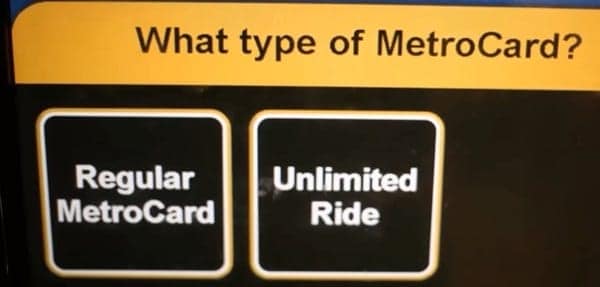
There are two types of cards to choose from: a Pay-Per-Ride card and an Unlimited Ride card.
Pay-Per-Ride cards simply mean that every time you ride the subway you are paying the full fare of $2.90.
With a Pay-Per-Ride, you get one free transfer to a bus within 2 hours.
You can transfer to other subway routes as often as you want as long as you don’t exit the subway system.
Unlimited cards allow you to take as many rides on subways and buses as you want within a set period for a flat cost.
You can choose a 7-day unlimited card or a 30-day unlimited. Most visitors won't need a 30-day card so let me tell you about the 7-day cards.
An Unlimited 7-Day MetroCard costs $34. The more rides you take, the lower each ride costs.
Note that with either type of card you choose, you will pay a $1 fee for a card if you don't already have one.
Before I became a tour guide and blog writer, I used to commute every day for work. That was 10 rides a week.
I also used the subway on weekends and weeknights after work to meet friends or do any number of activities in NYC.
It made sense for me to get an unlimited card at that time since I was using the subway so often.
Now that I don’t take the subway so often, I pay per ride.
If you decide to go with a Pay-Per-Ride card, you can buy a MetroCard, but there is another option that I love.
In the past few years, NYC has implemented a tap-to-pay option called OMNY.
Using a credit or debit card, or a smart device you just tap the display screen and the subway fare is deducted from your form of payment.
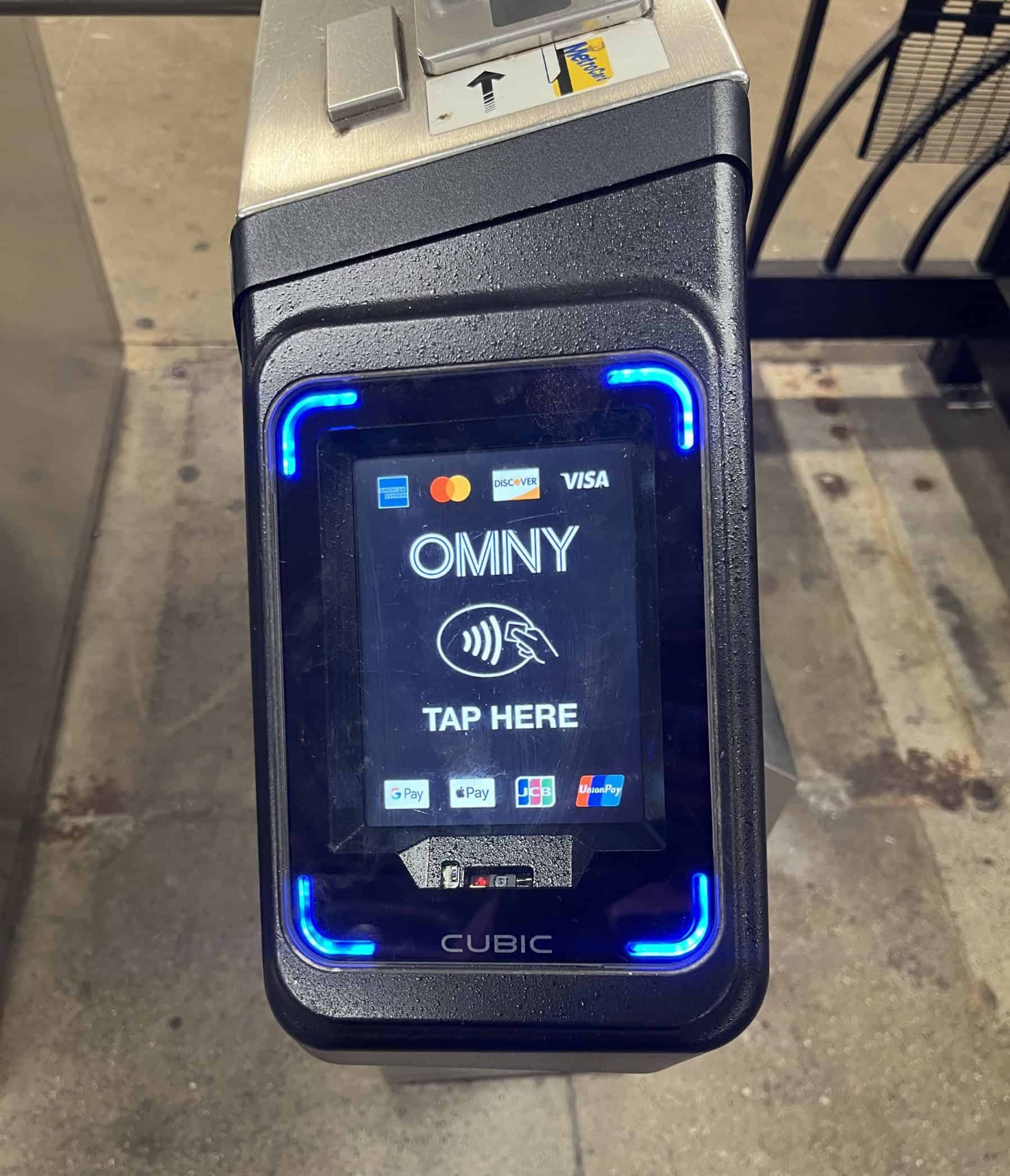
I love not having to buy a hard MetroCard, thereby saving a dollar.
Plus, I am prone to misplacing things and nothing is worse than losing a MetroCard that still has money loaded onto it!
If you can use the tap-to-pay system, I encourage you to do it.
By the end of 2025 or so, MetroCards will be gone completely.
Read more about OMNY here.
2. Make the subway map your friend.
Don’t look at a subway map for the first time when you are already in NYC.
When I travel to another city, I take at least a peek at the local transport map so I am a bit familiar with it.
It’s so easy to look at the map before you arrive by going to the MTA website map section.
You can download the maps to your phone offline. There is no shame in looking at a map!
Even though I’ve been living in New York City for decades, it would be impossible for me to know every subway stop.
Every New Yorker has to look at a subway map at some point!
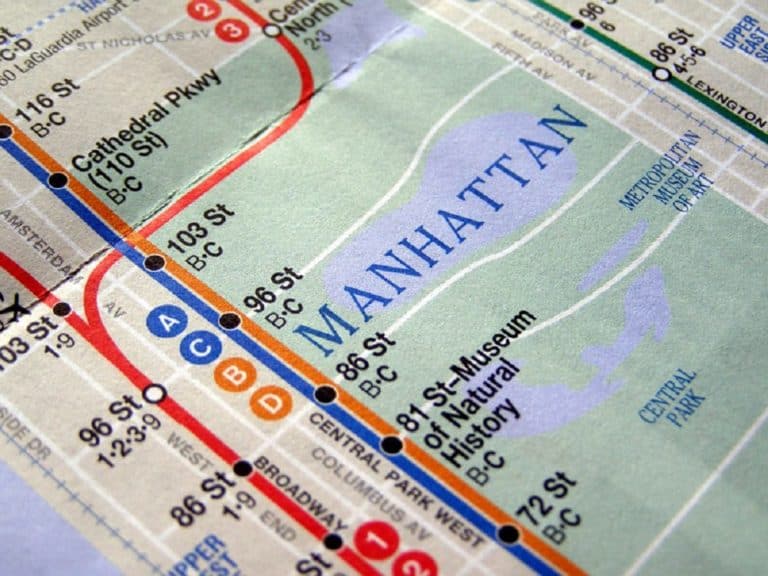
While each subway car does have a few system-wide maps posted, the writing on the maps is so small that I rarely bother looking at them.
Instead, I use a subway app or a downloaded subway map that can be used offline.
By the way, you can get a paper map from a subway booth.
They are massive and unwieldy but make for a great souvenir or, if you get enough of them, use them as wallpaper!
3. Use letters and numbers, not colors.
On NYC subway maps, each train line is colored differently. Each line also is numbered or lettered.
New Yorkers don't call the train lines by their colors but by the numbers.
Always refer to subway lines by their number or letter.
Why?
Because even though the blue line shows lines A, C, and E, these train routes eventually split up and you may end up somewhere completely different from where you intended to go.

Sometimes I refer to a train by its color if I am planning to meet friends using a train line that does not split off.
But I am practically breaking the law when I do that! So don’t do this.
So -- numbers and letters only! Never ask someone how to find the red line. They won’t know what you are talking about.
4. Choose between local or express trains – black or white dots?
We have a system of local trains and express trains thank goodness!
If every train stopped at every station, subway rides would be mighty slow.
Local trains stop at every station on that particular line while express trains skip some stations, stopping only at highly used stations.
On the subway map, local stations are marked with black dots.
Express stations are marked with white dots.
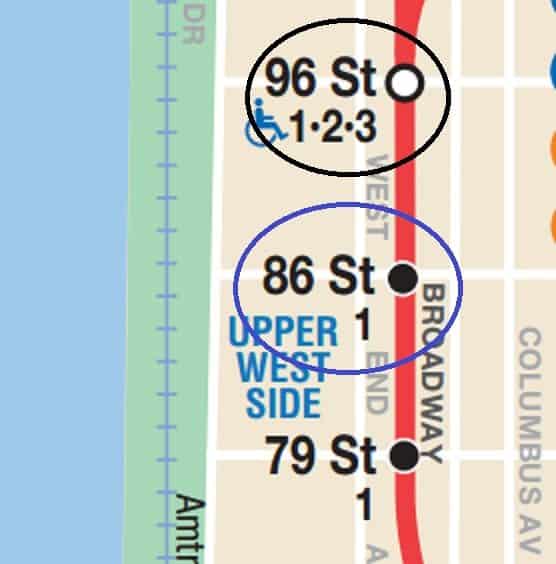
In the image above I’ve circled two stations along the same line, the 86th Street Station and the 96th Street Station.
The 86 St. Station has a black dot with the number 1 underneath it. This means that 86th St. Station is a local stop.
Now, where I circled the 96th St. Station, you can see there is a white dot and beneath the white dot the numbers 1, 2 and 3 are listed.
Thus, the 2 and 3 trains are express trains because they stop only at the stations marked by a white dot.
The same system of white and black dots applies to lettered train lines, which I explain a bit more below.
Express and local trains almost always operate on separate, parallel tracks.
If you are unsure which track is local or express, there are signs above the tracks that will say if the line is Local or Express.
If this sounds confusing or complicated, it isn’t once you know it.
But I do understand it takes time to get it. You will master it at some point!
Let's look at a scenario.
You are planning on visiting the Natural History Museum on 81st Street.
As you can see in the image below, 81st Street is serviced by both the B and C trains.
Since there is a black dot, this is a local station and both the B and C are local trains.
The red circle is around 125th St. Station. This station is serviced by both the B and C trains, but also the A and D trains.
Since 125th Street has a white dot, it means that the A and D trains must be express trains since they do not stop at 81st St. Station or any of the other stations with black dots following 81st Street.
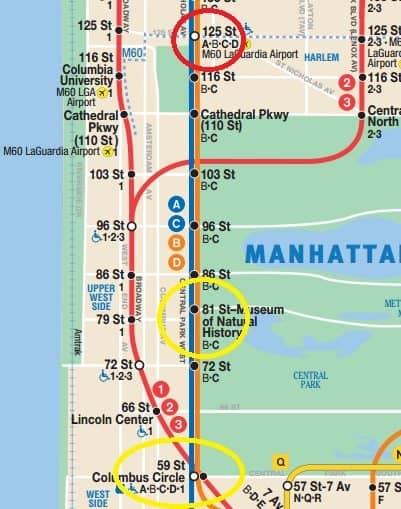
If you are getting on the subway at Columbus Circle/59th St. Station to head north to 81st Street Station, then you must only take the B or C train.
If you were to take the A or D train, then you would be stuck on the subway all the way to 125th St. Station.
How to avoid this error? Use a subway app and don’t be afraid to ask someone.
When I am in doubt about taking a subway line I am not familiar with, I don't hesitate to ask someone.
We New Yorkers are a friendly, helpful bunch!
5. Decide Uptown or Downtown?
Another thing to figure out is if you need to choose a Uptown train or a Downtown train.
Since a majority of Manhattan is laid out on a grid with numbered streets, heading uptown means traveling to higher-numbered streets.
Conversely, going downtown means traveling to lower-numbered streets and neighborhoods where the streets are named.
Our post on New York City Streets and Avenues explains why some streets are named and others are numbered.
If you carried a compass with you (who of us does?!), you would see that heading uptown is to go north and downtown south.
Anyway, once you know if you need to go Uptown or Downtown, you have to figure out the correct platform.
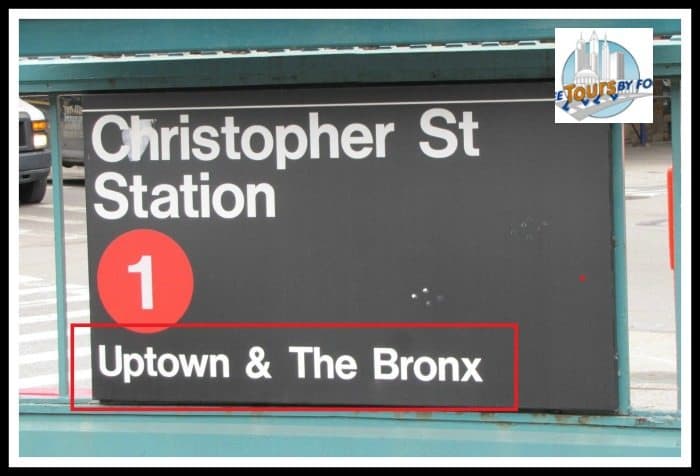
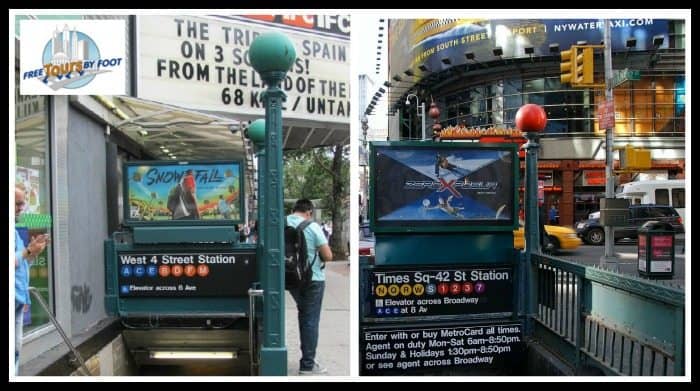
Some subway stations (usually local train-only stations) have separate entrances for uptown (see image above), or downtown-bound trains (see image below).
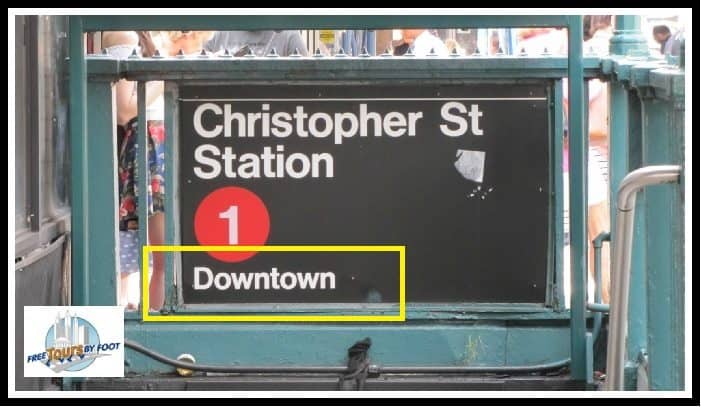
Fortunately, express station entrances give you access to both Uptown and Downtown trains.
If I am being honest, I have entered the wrong station on occasion when I am distracted.
A few times I realized this only after paying to enter the station.
It’s not a good feeling to pay for a dumb mistake.
My suggestion? Pay attention and, if you make this error, don’t feel too bad. Even locals do.
6. Find the correct station.
Station names are pretty straightforward, making it relatively easy to locate them.
Numbered stations are located on those numbered streets. The 86th Street station is on 86th Street.
Named stations, like Christopher Street or Wall Street are on those streets.
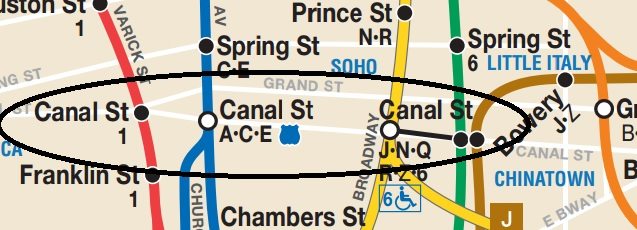
Here’s an important thing to know. If you decide to meet up with someone at the subway stop on Canal Street, be careful.
There are three Canal Street subway stops, each along a different line.
Be sure to say on which subway line!
Most subway stations are quite long and most have two (if not more) entry/exit points.
This is when it is handy to have a subway app. Knowing which exit you need to get you closest to your destination will save you some time.
Sometimes Google Maps will indicate which exit to use. My favorite subway app for this purpose is the aptly named Exit Strategy. For locals, it is worth the $4.
After decades here in New York, I even know which train car to enter to be closest to the exit I need.
I do get some surprised looks from my tour guests when I tell them which train car to go to when they ask me for directions somewhere.
But I’m glad that the years and years of riding the subway helped me to help others!
7. Transferring from one train line to another.
There’s a good chance on your trip that you will have to take two lines to reach a destination.
It’s not complicated to transfer between lines, but it’s better to know a bit about this process before you encounter it in real life.
When transferring from one subway line to another (including transferring from an express train to a local and vice versa) you do not need to exit a station and re-enter another station.
All stations have signs directing you to the other train line.
In some stations, you need to walk up or down a flight of stairs to change trains.
At some stations, you wait on the same platform and take a train on the opposite track.
Other stations where the connected lines are far apart have transfer corridors.
In the picture below, I’ve circled in red a few examples of transfer corridors.
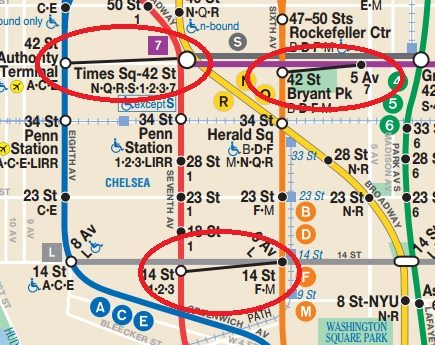
The thin black line between stations are transfer corridors.
They can be quite long as they connect train lines that are an avenue away from each other.
I want to reassure you that these corridors are safe, even if there are not many people walking in them.
More often than not, they will be packed with people. But if you are traveling late at night, fewer people will be there.
These corridors are well-lit and some are decorated with art and some with quotes or even poems!
My favorite poem is in the transfer corridor between the 42 St-Port Authority Bus Terminal station and the Times Sq-42 Station.
The lines of the poem appear mounted on the overhead I-beams. The lines go:
“Overslept, so tired, if late, get fired. Why bother? Why the pain? Just go home, do it again.
Also, buskers playing music hang out in these corridors which is a real treat!
8. Trains run on a schedule….sort of.
During my first years using the subway during college eons ago, it never occurred to me that trains had a schedule.
That’s because so often trains ran erratically.
Two trains would arrive within minutes of each other and then the next train would appear seemingly when it felt like it.
Back in the day, subway platforms didn't have any electronic signs showing when the next train would arrive.
When the next train would arrive was anyone’s guess.
Well, the subway has come a long way!
Here's what you can expect to see on most subway platforms.
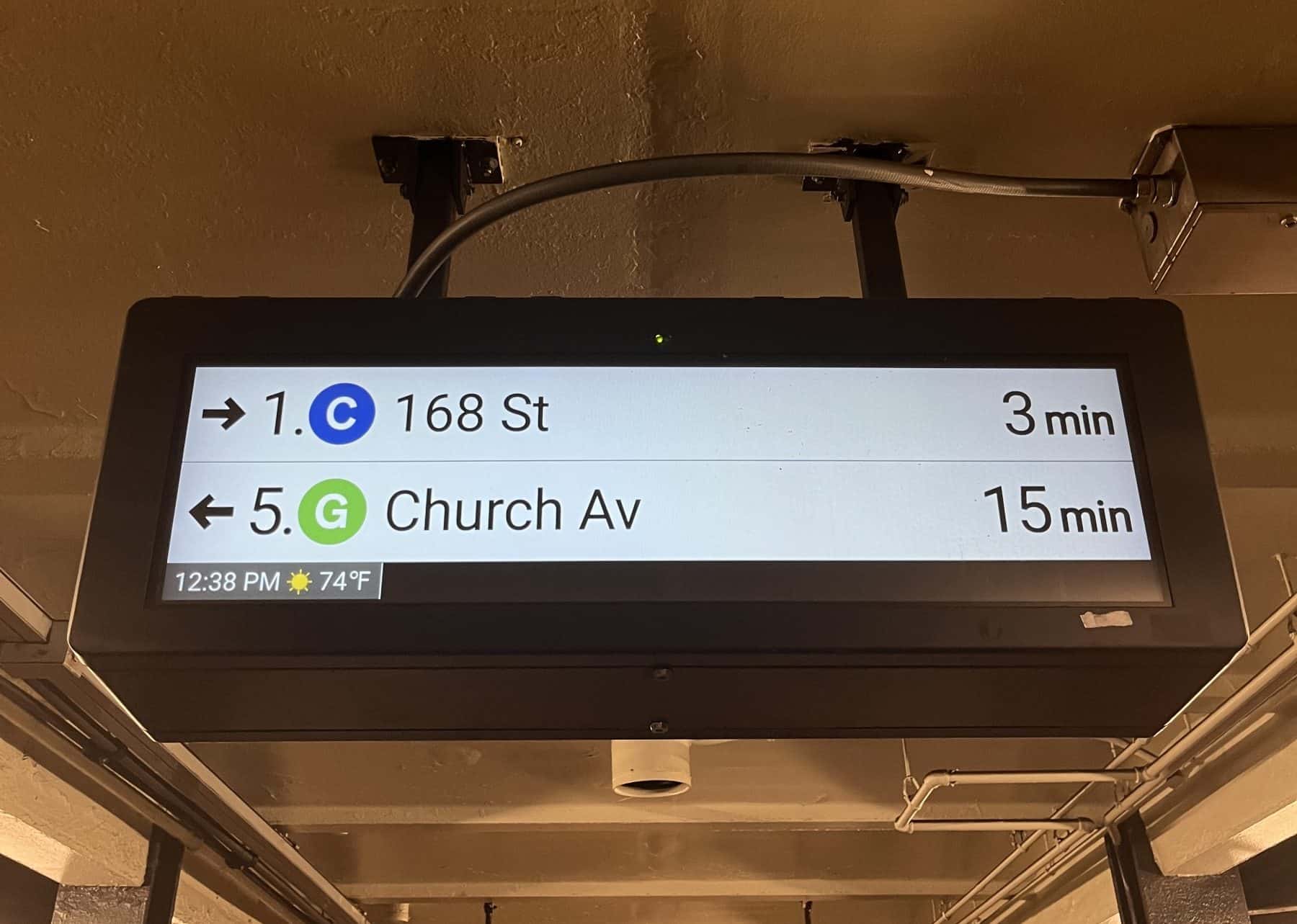
There is some effort to keep trains running on a schedule.
Take that with a grain of salt. I don't mean that trains arrive and depart at the exact times you may see on an MTA schedule.
It means you can expect trains to run at certain frequencies.
I do not advise you to spend your valuable time looking at subway schedules.
Instead, use Google Maps or an app to plan your route and you can see the frequency for that train line.
Apps also show real-time arrivals.
9. Get an app.
I’ve already mentioned subway apps several times.
As far as I am concerned, they are the best invention since sliced bread!
I can't even remember what straphanger life was like without them!
Subway apps are a must in NYC. Most are free too.
Read my review of the best subway apps.
10. Ask someone
If you are still not sure whether you are getting on the right train or standing on the right side of the platform, ask someone.
Most New Yorkers are happy to help you out.
TIP: There is Wi-Fi in the subway!
You can pick up Wi-Fi in subway stations but not while trains are moving through tunnels.
The MTA is making strides in bringing Wi-Fi to train tunnels, though it will take years to wire all 418 miles of underground track.
Lucky me...my line is the first to be wired!
We at Tours by Foot NYC offer several tours that utilize the NYC subway (and buses) to get around the city.
While these are not specifically subway tours, your tour guide will assist you in learning how to master the system.
Your guide will also discuss the history of the subway and its role in the lives of New Yorkers and in popular films.
NEW YORK IN ONE DAY TOUR
This tour, which runs several days each week @10 am, is a 6-hour tour that visits the Financial District, Lower Manhattan, the 9/11 Memorial, Chinatown, Little Italy, SoHo, Greenwich Village, and the High Line, with a 45-minute lunch break.

You will ride the subway at least 2 times with either a 3rd ride or one ride on the bus. We use this time to explain and demonstrate how to master the system.
Watch the short video below or visit the tour page for more information. You can book the tour here.
We also offer a 3-hour version of this tour, called the Downtown Manhattan Tour, that uses the subway once and covers the Financial District and Lower Manhattan, the 9/11 Memorial, Chinatown, and SoHo.
MIDTOWN MANHATTAN NIGHT TOUR
From March through October, we offer this evening tour 3x a week. You will ride the NYC subway twice during this tour.
This tour begins at Grand Central Terminal, which is within walking distance of most Midtown Manhattan hotels.
If you arrange an early arrival with your tour guide, he or she can help you sort out purchasing a MetroCard (which you can learn more about here).
Learn more about this tour or go straight to our booking page.
HOP-ON-HOP-OFF BUS VS. NYC SUBWAY
Hopefully, the 8 top tips above, as well as our guide to choosing a subway Metrocard, have made you more confident and willing to use the subway to get around New York City.
If you plan to do a lot of sightseeing at popular landmarks, tourist double-decker buses are an alternative to using the subway.
Hop-On-Hop-Off buses are useful to get an overview of the city during the day or for enjoying a stress-free night tour.

Learn more from our post on NYC bus tours,
While I recommend to my tour guests to look into these bus tours, I don't feel strongly that they are the best choice for getting around NYC if you are here for more than a day or two.
Here are some pros and cons of each service to help you discover which mode of transport suits you (if not both).
Pros of a Bus Tour
- easy to understand routes
- convenient stops at the most popular tourist attractions
- climate controlled all year
- tickets often include night tours, boat cruises or free attractions.
- commentary along the routes
Cons of a Bus Tour
- more expensive than riding the subway
- routes are only one-direction
- wait times can be long in high season due to traffic
- buses can be crowded
- bad weather is always a risk
Pros of Riding the Subway
- affordable
- flexible routing
- warm in the winter
- you get to meet real New Yorkers
- faster than tour buses in most instances
Cons of Riding the Subway
- trains can be re-routed without notice (though not common)
- not all stations are accessible for wheelchairs and strollers
- hot and sweaty in summer
- crowded during rush hours
- no commentary (unless you are on one of our tours)
FUN FACTS
What are those globes?
Some stations have poles with globes on top. Some are red and some are green.
Historically, these were installed to tell riders which stations are open 24 hours (green globes) and which stations are closed at night (red globes).
The black and white striped boards.
At each station, there are black and white striped boards that conductors on the train must point at (to prove they didn't fall asleep)!
Related Posts
- As a backup plan, there are always hop-on-hop-off buses to get you around the Big Apple.
- Check out our comparison post on New York boat tours and cruises.
- Many of these options are included free with an NYC concession tourist pass.