

Hi and welcome to the British Museum. My name is Jessica and I'm one of the guides with Tours by Foot London.
It’s almost impossible to contain all the British Museum Highlights in just one blog post.
This museum is based on the original collection of a man called Sir Hans Sloane who we're going to meet a little bit later on.
It's one of the world's biggest museums with over 8 million different artifacts and it's one of the most famous.
And, let's face it it's also one of the world's most controversial.
I always say that I could spend weeks here, and I am not kidding!
But what if you only have a few hours to explore what’s in the British Museum?
Well, I’ve put together a highlights guide that will change how you explore this fascinating institution.
Think of this as your “British Museum Must See” guide.
You can also watch my video version of this post.
What to See Inside the British Museum If You Have Just a Few Hours
My first top tip is to not enter through the main entrance unless you need to use the cloakroom facilities.
Instead go around to the back of the museum and use the rear entrance at the Montague Place.
There's really short queues even in the summertime and sometimes you can even walk in.
The first place I'm going to start on our museum tour today is room 33: China and South Asia.
There's Ming Dynasty blue and white porcelain, Tang Dynasty tube figures, tons of jade and bronze sculptures.
But, today we're going to walk through the South Asian side featuring the rich and diverse cultures of Nepal, Pakistan, India, Bangladesh and Sri Lanka.
I just passed by the dancing Nataraja from around 1100 and I'm just coming up on my left hand side to a Hindu temple figure of the goddess Kali. But, We're here to see Tara.
The Tara Sculpture – Room 33
At the back end of this gallery you can see her shining like a golden beacon.
Admire the stunning solid bronze statue of the Mahayana Buddhist deity Tara.
She was originally cast in 8th century Sri Lanka and then coated in gold, and we think the only reason she survived the millennia, we think, is because she was buried.
And thank goodness for that – she’s stunning.

Her right hand is in a shape (mudra) that symbolises giving, and her left hand likely held a lotus flower, the symbol of Buddhism.
Finally, you’ll see an empty hole in her crown, which likely held a giant ruby, for which Sri Lanka is famous.
Next, it’s time to head back out through the back entrance and enter the Wellcome Trust Gallery of Living and Dying, Room 15.
Hoa Hakananai'a – Room 15
Now this is a completely different kind of gallery that we're about to enter into.
It's a gallery that's curated around a central theme rather than a time period or a geographical region.
So it's got pieces that are from all different time periods and all different geographical regions based on the theme of life, death, medicine, and how people from indigenous cultures around the world deal with sickness and the transition from our world to the realms beyond whatever their culture believes that to be.
Enter this innovative gallery and admire the different cases – but we’re here to see Hoa Hakananai'a.
This monolith comes from the isolated Polynesian island of Rapa Nui.
You might recognize Rapa Nui by its more common name – Easter Island, so named because the first Dutch explorers landed there on Easter Sunday in 1722.
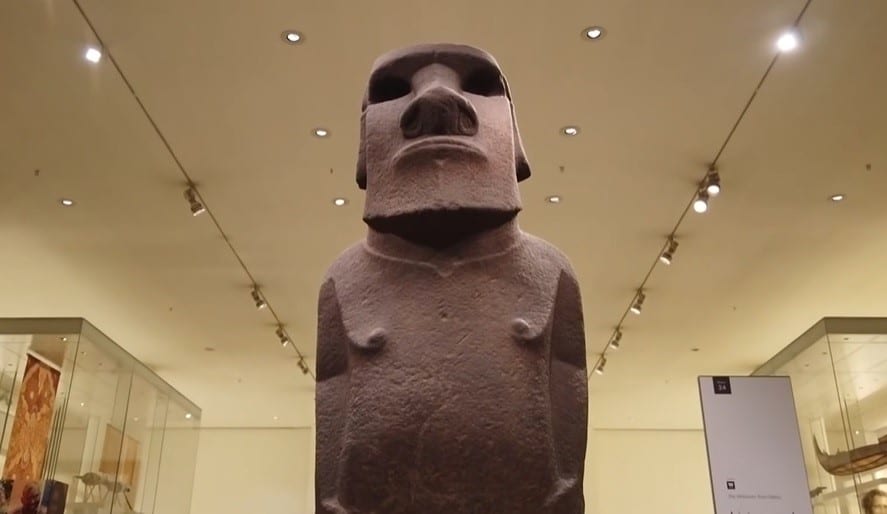
They, and Spanish and British explorers after them, encountered people living amongst the toppled moai – the name for this type of sculpture.
The Moai date back to the 12th to the 16th century and they represent specific ancestors.
He's not just a sculpture. To the people of Rapa Nui he is a living being.
When the HMS Topaz arrived in 1868, Hoa Hakananaia was in a ceremonial house, but British sailors dragged him down the beach and locals were crying and begging, running after it.
As a result, this is one of the most heavily contested objects in the museum, and as the information panel details, the British Museum is in talks with Rapa Nui delegates for a resolution.
Next, we're going to head downstairs to the Africa Galleries.
The Ife Head – Room 25
The African Galleries are divided into East and West Africa, mostly focusing on the Sub-Saharan regions of Africa.
Next, head downstairs to the Africa Galleries to see the Ife Head.
So the Ife head is one of 18 heads that were excavated in Ife, Nigeria in 1938 by a team led by German archaeologist Leo Frobenius.
This was the former royal center of the Yoruba people, a place of rich culture from then to today, much earlier to today.
Just look at the peaceful beatific expression on his face.
This man is serene, yet he's powerful. He's viewing us slightly from above.

His face is decorated with ritual scarification, which would have been considered exceptionally beautiful, and his crown is topped with a rosette and a plume slightly bent to one side, but it would have been painted red and black.
Most scholars believe that the Ife head depicts a ruler called Oni. The head is made from an alloy of copper and bronze.
Upon encountering this stunning head, Frobenius simply couldn't believe or wouldn't believe that it was from Nigeria.
He tried to come up with an alternate story.
He actually went so far as to state that the Ife heads must have been created by a lost colony of ancient Greeks in the 13th century BCE.
We now know it dates to the 14th or 15th century and was likely made by an individual artist in a single workshop.
Totem Poles - The Great Court
Head back upstairs and be prepared for a truly marvellous site - the Great Court, which is the largest covered public square in Europe.
In 2000, architect Norman Foster, famous for Footbridge, Gherkin, and London City Hall, designed this impressive glass and steel roof and it was renamed The Queen Elizabeth II Great Court.
In the Centre of the Great Court, you can see the famous Reading Room, which is sadly closed to the public.
This was once a world-famous private library that welcomed Bram Stoker, Sir Arthur Conan Doyle, and even Vladimir Lenin!
All right, I'm back in the Great Court.
And, this time I'm here to see some Coast Salish house poles, sometimes called story poles, or you might have heard of them as totem poles.

They're usually a symbol of Indigenous people for all around North America.
You'll see them in gift shops, but poles like these are only actually carved by a small group of different First Nations on the north coast of the continent.
One of these poles is from the Nisga’a people, while the other is from the Haida people of Haida Gwaii, formerly called the Queen Charlotte Islands and now a UNESCO World Heritage site.
They're carved from cedar wood, which naturally repels insects and water.
But after around 100 years of being erected, they would naturally fall down.
They would then be allowed to decay back into the earth, and that would feed the next generation of totem poles.
They're carved to mark significant occasions such as anniversaries.
But, carving totem poles was actually illegal in Canada from the mid-19th century through to 1951, because Christian missionaries and government forces saw them as barriers to First Nations assimilation.
When European explorers arrived in these coastal regions, they often took the poles they saw lying on the ground, assuming they were unwanted.
They also bartered and bought some of the poles, which is the case of the Haida pole here, purchased in 1903 by Charles Newcombe from Chief Wiah.
Totem poles often depict animals and supernatural creatures, and family crests, and detailed stories.
This pole tells the story of a life-giving raven spirit called Yettle, who could also swim beneath the sea and steal hooks and fish from rods.
Today there are totem poles in museums all over the world, and some of them have been acquired ethically, and others have been taken without.
The Enlightenment Gallery – Room 1
The Enlightenment Gallery gives us a glimpse into how the museum would have looked when it was first founded.
In the 18th century, wealthy learned men rushed to collect treasures and replicas of treasures from all over the world.
This collection is housed in the oldest room of the museum, which was originally designed to be King George III's library.
In the center of the Gallery, you’ll find a bust of Sir Hans Sloane, often called “the founder” of The British Museum.
He was an Irish botanist, physician, and collector who traversed the globe collecting objects and plant specimens.
His wife, Elizabeth Langley Rose, was the heiress to sugar plantations that were worked by slaves, and the profits from the slave labor funded Sloane's immense personal collections.
Sloane left 71,000 objects to the king in his will, intending them for public display, and his collection forms the backbone of the museum's collection.
You can see here in the case lots of interesting information and very important information about what the British Museum is doing moving forward to reckon with how a lot of its objects have been acquired in the past.
And, this is going to be an interesting project moving forward.
The Rosetta Stone
A few steps away, you’ll be in front of a replica of the Rosetta Stone.
Feel free to touch it and get up close – you won’t get a chance to do this with the real one a bit later!
After all, the actual Rosetta Stone is the British Museum’s most popular exhibit.
The real Rosetta Stone has been in the British Museum for over 200 years and has always been one of the museum’s most popular objects.
You’ll visit the real stone later, but you can see the details up close on this replica, usually without the crowds.
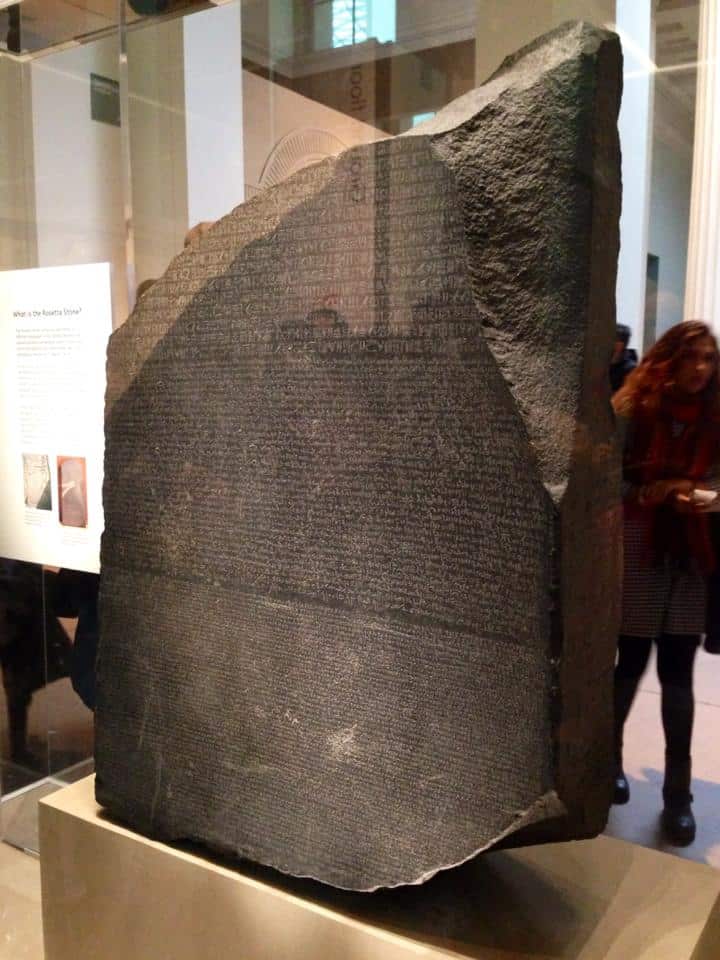
This is a great place to talk about why we are so fascinated by a broken slab of stone.
First, let me just tell you how it was discovered before I tell you what it is.
In 1799, some of Napoleon's men discovered the slab being used to hold up the wall of a fort in the village of El Rashid, which was known to the French as Rosetta.
They were shocked to see three languages on the tablet, each seeming to say the same three things.
Egypt mania was sweeping across Europe, and the public was fascinated by all of the objects that the British and the French were bringing home in their battles.
They wanted to understand what all of the temples and sarcophagi said.
The French who found this object never actually had a chance to decipher it.
The British acquired the stone in the Treaty of Alexandria, and they whisked it to London.
That's when the race to translate it started.
French scholar Jean-Francois Champollion who had the first major breakthrough and realized that the hieroglyphs, the name of the Egyptian language here, was both pictorial and phonetic.
That means they give clues about pronunciation.
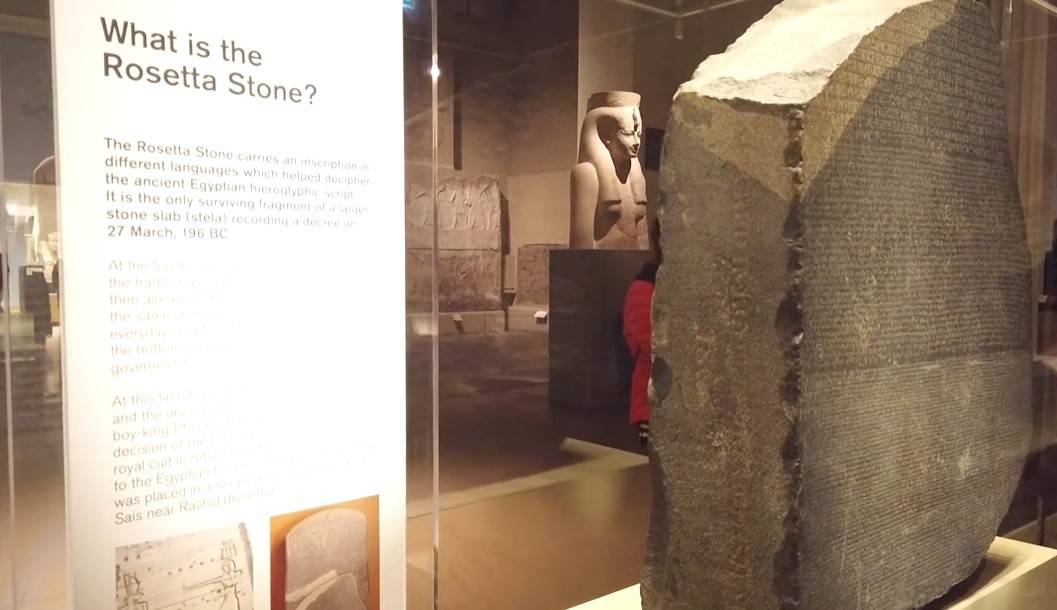
Scholars began to translate the hieroglyphs and found out that they detailed an ancient tax break given under King Ptolemy V.
At this time in history, only the priests could understand hieroglyphs – the average person either spoke and read Demotic or Greek.
Within a few hundred years more, not even the priests were using hieroglyphs – and the language was lost.
That’s why the Rosetta Stone was such an incredible discovery.
Without this stone slab, we may never have learned how to understand the treasures and wonders of Ancient Egypt.
The Lewis Chessmen - Room 40
I'm heading towards the case right now to go and look at the Lewis Chessmen.
Now it's always a bit of a challenge to look at the Lewis Chessmen because there's always a ton of people gathered around them.
These are some of the most famous objects in the museum.
These curious little pieces were discovered in a church on the Isle of Lewis in the Outer Hebrides in 1831, but they are much, much older.
They date to the 12th century, or maybe even earlier.
Most of the pieces are made from walrus ivory, but a few are carved from whale teeth.
When found, the hoard contained 93 items in total. That was 78 chess pieces, 14 table men, and one belt buckle.
82 pieces are here at the British Museum, and 11 are at the National Museum of Scotland in Edinburgh.

So just look at the carvings on the back of the king and the queen's chairs.
So some of them are pieces that we recognize today, with the addition of the warders, and also some very peculiar chaps, the berserkers.
Berserkers are fighting knights that bite the edge of their shield to show us, the audience, how mad they are with rage.
There you can see him, see what I mean about how he's biting the edge of his shield, and that's to bare his teeth.
The queen looks quite introverted, she almost looks miserable. She's meant to be deep in thought, so that she can give wise counsel to the king.
By the way, if these pieces look familiar, you might recognize them from Harry Potter and the Philosopher's Stone.
So you often get a lot of kids in here who are really excited to have a look at the Harry Potter chess set, the Harry Potter chess set.
The Sutton Hoo – Room 41
Now here is another amazing piece that helps us step back to an even earlier Europe, to the centuries of AD 300 to 1100 in this room, room 41.
That time period used to be called the Dark Ages.
But, we now know that there was an immense amount of craftsmanship and global trade going on during this period.
We're here to see the Anglo-Saxon ship burial at Sutton Hoo in Suffolk.
This is arguably the most important archaeological discovery in British history.
You’ll step back in time to 1939 when a woman called Edith Pretty decided to have one of the mounds on her property excavated.
She herself had taken part in archaeological digs in her younger years.
But, she was in poor physical health and she hired amateur archaeologist Basil Brown to do the dig.
He would soon find massive ship's rivets, which would lead him to the most intact early medieval grave in Europe, a 27 meter ship, that's nearly 90 feet, fully loaded with rich treasures buried beneath the earth.

The ship contained unimaginable riches, including a solid gold belt buckle, silverware from Byzantium, garnets from Sri Lanka, huge feasting bowls, sumptuous textiles, dazzling swords, and as I zoomed in on at the beginning of this room, a helmet with a human mask.
This mighty ship would have had to been dragged uphill from the river Debden and then buried in a deep trench mounded with soil. Clearly this grave belonged to somebody important, but we don't know exactly who.
This is likely the final resting place of Anglo-Saxon King Rehwald, who ruled East Anglia. However, no body was discovered.
However, no body was discovered. It was likely dissolved by the acidic soil, along with all of the wood, cloth, and bone.
Make sure you spend some time admiring the iconic Sutton hoo helmet.
It's got deep cheek pieces and a vaulted cap. It's covered with imagery and symbolism, including fighting warriors and mythical creatures.
The entire shape of the mustache, nose, and brows make a flying dragon. Now this one is a recreation.
The Royal Game of Ur – Room 56
I just want to stop here quickly in room 56, which is home to some objects from Mesopotamia that span 4,500 years, between 6,000 BC and 1,500 BCE.
We're going to see another important Mesopotamian object at the very end of our tour that connects to something in this case here.
So think of this as a little preview.
The Royal Game of Ur is one of the oldest board games in the world, originating around 4,600 years ago.

We know the rules because a Babylonian astronomer wrote them on cuneiform in 177 BC, and we've been able to decipher the rules from this.
Two players would race from one end to the other, and the central squares were used for fortune telling.
Now this Royal Game of Ur, you can come to visit it in room 56, but I just wanted to stop here quickly because we're on our way to the Egyptian galleries.
Egyptian Galleries - Rooms 62 and 63
Now we're heading into the most famous galleries in the entire British Museum, the Egyptian galleries that explore death, funerary customs, and the afterlife.
The afterlife held a deep, important meaning for ancient Egyptians.
After all, most of what we think about when we think of ancient Egypt is ritual and mummification, and of course pyramids.
So we could spend all day, and in fact we could probably spend weeks, in these galleries.
Egyptian Mummies
Death and the afterlife held deep importance and meaning for ancient Egyptians – after all, we all know about their love of magic, ritual, and mummification.
While there are many awe-inspiring mummies in these rooms, head to see the cat and kitten mummies.
So much so that they mummified their cats! Not just one cat, but many, many cats!

Now Egyptian pets, humans were mummified in ancient Egypt and so were animals, so common ancient Egyptian pets included cats, dogs, monkeys, birds, gazelles, and even mongooses.
And so you might already know that cats were worshipped and venerated in ancient Egypt, and cats and all their animals were mummified for a few specific reasons.
First of all, they were beloved pets, so mummifying cats allowed them to join their owners in the afterlife.
They were also offerings to different gods and they were considered incarnations of specific gods, such as the cat god Bastet, who had the head of a cat and the body of a woman.
In other cases, animals such as ducks were mummified in order to serve as food in the afterlife.
Before they were mummified, the cat's body would have been dried and filled with a dry material like sand, and then they were arranged in a lifelike way and wrapped in linen.
Just remember, cats were not the only animal mummies here at the British Museum.
There's also a baboon, crocodiles, dogs, and many others.
By the way, did you know that in the 17th and 18th century and earlier, people in Europe used to eat the human mummies by crushing them up and putting them in tinctures and medicines?
Again, that's another one of those things that sounds like an urban legend, or myth, not even an urban legend, but I promise you that is true.
Egyptian Sculpture Gallery – Room 4
Enter the Egyptian Sculpture Gallery, one of the most impressive rooms in the British Museum.
It's filled with sculptures that span 3,000 years of fascinating history, and there's different monoliths and broken busts.
But, you'll find one of the most famous objects in the world, and that's the real Rosetta Stone.
This time it’s the real one!
Next, walk to the massive bust of Ramesses II and think of these famous lines of poetry:
“My name is Ozymandias, king of kings
Look on my works, ye Mighty, and despair!"
Percy Shelley wrote this poem in 1818 in his despair over Europeans removing precious antiquities from Egypt.
Ramses II, who ruled from 1279 to 1213 BCE, was one of Egypt's greatest pharaohs, much so that nine further pharaohs took his name to try to cash in on his name and success!
He was a warrior king, but he was also the ultimate self-publicist. He loved his own image.

I think of him as the selfie king, because he erected more statues than any other Egyptian pharaoh, and he even changed the inscriptions on other pharaoh statues to have his name.
So he really loved his own image, and he had more than 100 children to prove that as well.
So this statue is called the Younger Memnon. It flanked the entrance to the Romesium, a massive funerary complex at Luxor.
When Napoleon's men tried to move it in 1798, they only succeeded in damaging it badly because it weighs seven tons.
The French troops abandoned the statue, and it sat dejected and abandoned.
That is until the British Consul General Henry Salt decided he was going to be the one to bring it to the UK.
They used a complex system of hydraulics and hundreds and hundreds of men to pull it onto the banks of the Nile, and it finally arrived in England in 1818.
Assyrian Guards – Room 6
These human-headed, winged bulls are two of the heaviest items in the museum.
These weigh about 16,000 kilos. That's roughly about 8,000 pounds, so they're extremely difficult to lift.
So when they arrived to the museum in the 19th century, they actually had to be chopped into four different pieces, each of them to travel here.
They come from the 8th century BCE, that's about 2,700 years ago, situated on the gates of the city of Khorsabad in ancient Assyria.
Today that's situated in northern Iraq. Khorsabad was a walled city, so people had to enter through gateways.
So these human-headed winged bulls were really important to the Assyrian empire because they signified strength.
They also protected the city from evil spirits.

These sculptures have this really remarkable, almost 3D effect.
I don't just mean the way that they're popping off the walls like this in in both high and low relief, but in the fact that from the front the Assyrian guards have two legs and from the side they have four.
So it appears that they have extra legs as if they are walking in motion towards us at all times.
But why the human-headed, winged bulls?
The Assyrian empire stretched across what is now called the Middle East.
These winged bulls partly signify the strength of the empire.
The borders were busy, but there were also quieter times.
So, what did guards do when they got bored?
They played “The Standard of Ur” (just like the one you saw upstairs) - look at the markings on the side of the bull on the right!
The Parthenon Sculptures – Room 18
End your “Highlights of the British Museum” Tour with the iconic Parthenon Sculptures, often called The Elgin Marbles.
Start by checking out the model of the Parthenon, a temple built on the Acropolis, in the small room on your right-hand side.
You can see exactly what the Athena Temple looked like in ancient Greece when it was built on a hill above Athens in 447 BCE.
Next, enter the main gallery, built specifically to house these sculptures, which were removed under highly contested circumstances by British Ambassador to the Ottoman Empire, Lord Elgin, in 1801.
He claims to have had permission from the Ottoman rulers, but the Greek government today disputes this.
Admire the friezes around the room's perimeter, and then make your way to both ends to see the pediment sculptures.
This depicts the birth of Athena, with many broken and damaged statues telling the unbelievable tale of the fully grown goddess emerging from Zeus’s forehead.
And that's it for this tour.
One of my favourite ways to explore what is inside the British Museum is with a private tour and we at London Tours by Foot offer a public tour of the museum.
The right British Museum tour guide can really make the exhibits come alive and give you a deeper understanding of what you are seeing.
It’s also a great idea to watch our British Museum Highlights Video to get a feel for the route before you arrive.
And we have a post to help you plan your visit and learn what parts of the museum are free and what parts have costs.