

One of the most amazing things about Barcelona is that it is home to so many of Antoni Gaudí’s masterpieces.
As a tour guide who travels abroad often, I have been to Barcelona twice and both times I visited all the stunning Gaudí buildings in this post. Once is simply not enough!
I made this self-guided tour so you too can discover the magnificent city architecture associated with Gaudí and his interpretation of Art Nouveau and Modernism.
The self-guided tour takes you to the main Gaudí sites and provides background information, which I think is necessary to understand his unique style.
For those of you who, like me, hunt down UNESCO World Heritage sites, you are in luck since many of Gaudi's buildings are designated as such.
The sites are spread out, so must take the metro. The Barcelona metro is so easy to use and is safe, clean and efficient.
Important tip: You must buy tickets to enter all Gaudí buildings and sites. BOOK AHEAD, especially for Park Güell and Sagrada Família.
Otherwise, you will have to wait in line to buy tickets, which I unfortunately found out the hard way.
1) The lamp posts at Plaça Reial
Begin the tour in Plaça Reial, just off Las Ramblas (closest metro, Liceu on line 3, the green line).
You can learn about this plaza from our free self-guided gothic walking tour.
Here are some basics to know about Antoni Gaudí i Cornet. I will write more about him throughout this post.
His father was a coppersmith and following in his father’s footsteps, he trained as a craftsman in metalsmithing and ornamental and basic copperwork.
With this background, Gaudí integrated metalwork into his designs, which is readily apparent.
He came to Barcelona to study architecture, graduating in 1878. As a student, he worked on many projects under various masters.
His first and only public works were street lamps commissioned in 1879 by the Barcelona City Council for Plaça Reial, and 10 years later, for Plaça de Palau.
At Plaça Reial, you can find the two lamp posts on either side of the fountain.
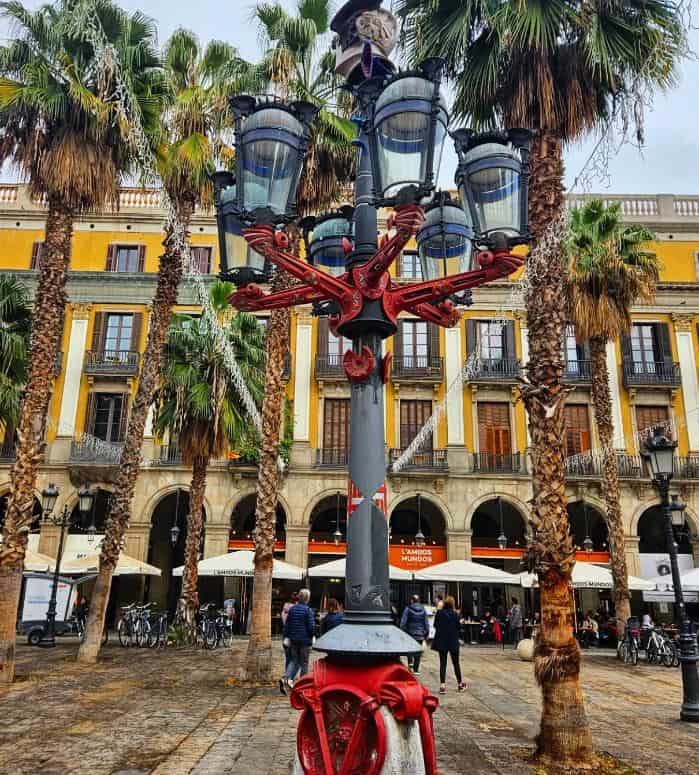
I have never seen such evocative lamp posts! The cast iron columns are decorated with small red floral designs and the Barcelona coat of arms.
The posts have six arms holding glass lanterns that were gas-lit before the use of electricity.
The lanterns are crowned with a winged helmet, representing Hermes, the Greek god regarded as the protector of Barcelona, according to Greek mythology.
Looking up at Gaudí's lamp posts, I find it hard to believe that these posts were created before the 1900s as they are ahead of the style of the times.
From here, you'll walk just a few minutes to the next stop.
Head back to Las Ramblas and take the road opposite, C/Nou de la Rambla to Carrer Nou de la Rambla, 3-5 (map).
On the left, you will see Palau Güell (also covered in our free, self-guided gothic walking tour).
2) Palau Güell
Gaudí designed and built this mansion between 1886 and 1888 for the industrial tycoon Eusebi Güell.
Güell was Gaudí’s primary patron throughout his life. When you enter, look for the initials E and G sculpted into the two metal gates.
The parabolic arch of the two gates is typical of Gaudí and would be a recurring feature in his designs.
The building is quite handsome, but not exemplary of the whimsical Gaudí style I was familiar with, so I was a little surprised that this was his design.

Then again, I’m not a trained architect.
But then I spotted the colorful, swirly chimneys decorated with broken ceramics.
Yeah…it’s a Gaudí!
This is the cheapest Gaudí building to enter. As of early 2025, the price for an adult is 12€, but if you have a BCN Card/BCN Card Express it is 9€.
The ticket office is to the left of the building. Buy your tickets here.
TIP: On the first Sunday of the month there are a limited number of free entrances available after 4 pm. Go for it if you can!
The next stop on this tour is Manzana de la Discordia on Passeig de Gràcia. You'll be taking the metro to get there.
Head back to Las Ramblas and turn left, up the hill.
Go down into the metro using the stairs on the right of Las Ramblas as you look up the hill.
If you do not already have a ticket, use the touch screen machines to buy your ticket in cash or by card. Read about using the Barcelona transit system and how to buy tickets.
Take Line 3 (the only line in this station) in direction "Trinitat Nova". Get off at Passeig de Gràcia station.
Head to the exit and up into the light. You will come out of the metro at the next tour stop, Manzana de la Discordia.
Gaudi's connection to religion:
Before going into the details of the next building, I think this is a good time to tell you about Gaudi's connection to ,religion which influenced his work greatly.
Though not religious when a young man, Gaudi became a devout Catholic later in life.
Many of his works have religious elements and his grandest work was the cathedral Sagrada Familia (which I discuss below).
Gaudi was nicknamed “God’s architect”. A,mazingly a campaign for his canonization as a saint in the Catholic Church began in 1992
In 2024, the Vatican took up the case for review. Will Antoni Gaudí become Sant Gaudi?
As if his creations weren't enough to make him one of a kind, I don't think there is any other architect in the world who may become a saint one day.
3) Manzana de la Discordia
On Passeig de Gràcia, one of Barcelona's most famous boulevards, there is a most unusual block of buildings.
On the stretch of Passeig de Gràcia, between Arago and Consell de Cent street, on the odd numbers side, you will see five striking modernist buildings next to each other.
Here's how this remarkable site came about.
Five most prestigious architects of the time (including Gaudí) were commissioned to design a building on that stretch -- next to each other!
A competition ensued, as each architect wanted to outdo their rivals by creating the most impressive facade.
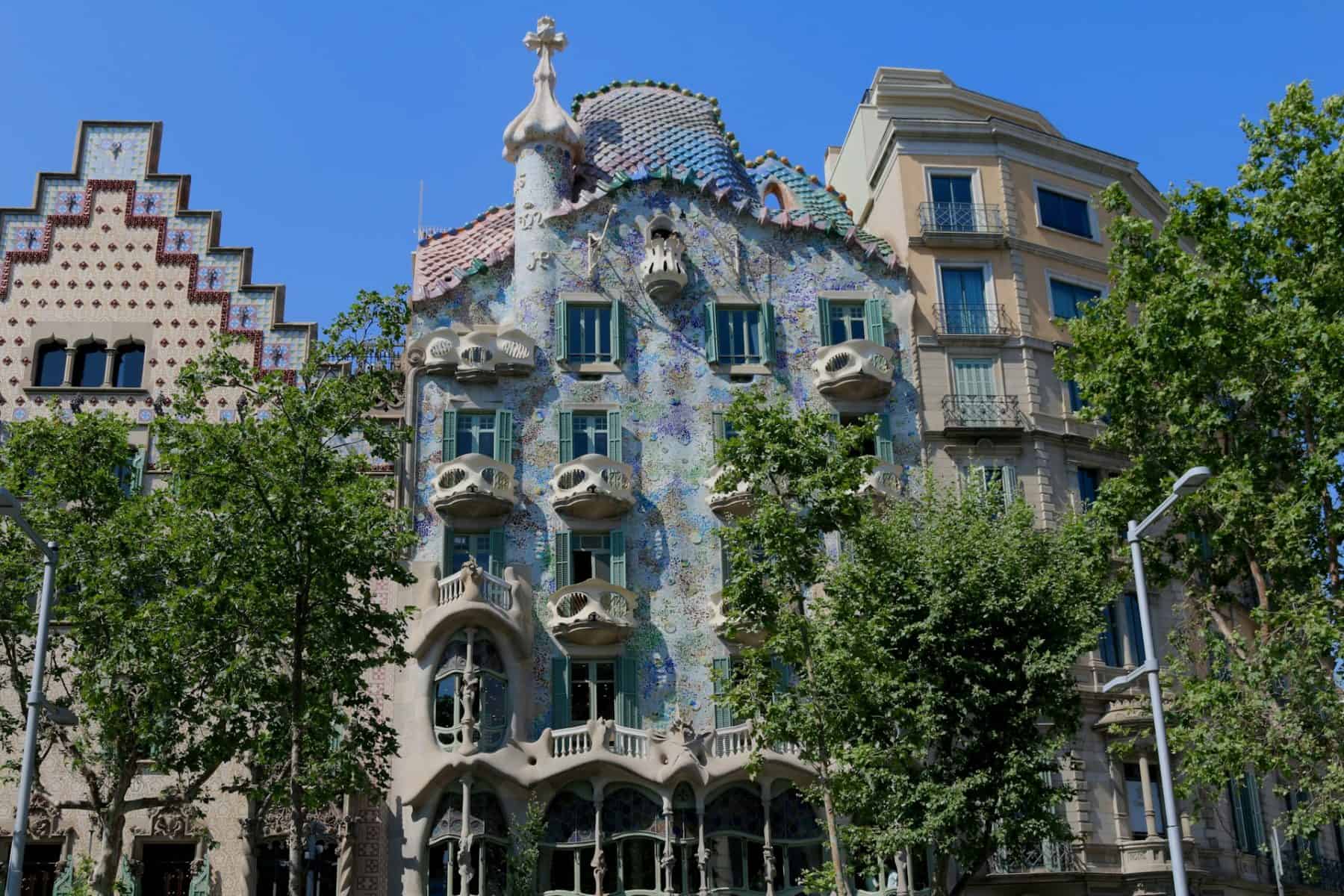
When all the buildings were complete, the public was shocked by the clash of styles.
Newspapers dubbed the block “manzana de la discordia“ which translates to the "Apple of Discord".
Why this name?
Very briefly, there is a Greek legend in which the goddess Eris was not invited to the wedding of Peleus and Thetis.
Eris sneaks a golden apple into the pile of wedding gifts. But several goddesses see the golden apple and fight for it.
Whoever got the apple would be deemed the most beautiful.
Similarly, the five architects fought for the prize of being the most beautiful - winning the apple.
Eris was the goddess of, discord so the phrase the apple of discord came about.
The five buildings certainly are all beautiful, but many (including me) think that Gaudí won the battle with his exquisite Casa Batlló.
4) Casa Batlló
Casa Batlló was renovated by Gaudí between 1904 and 1906, for Señor Batlló, a rich textile magnate.
While smaller than his other works, I think this is a remarkable work.
The imaginative facade is extraordinary. I can only imagine what the public thought at the time.
Its ripples and curves display Gaudí's dislike of straight lines. The balconies are like nothing I have seen before (or since).
The balconies resemble skulls and as such, Casa Batlló is nicknamed the 'house of bones'.
I find the design a bit eerie but that is offset by the playful aquatic colors.
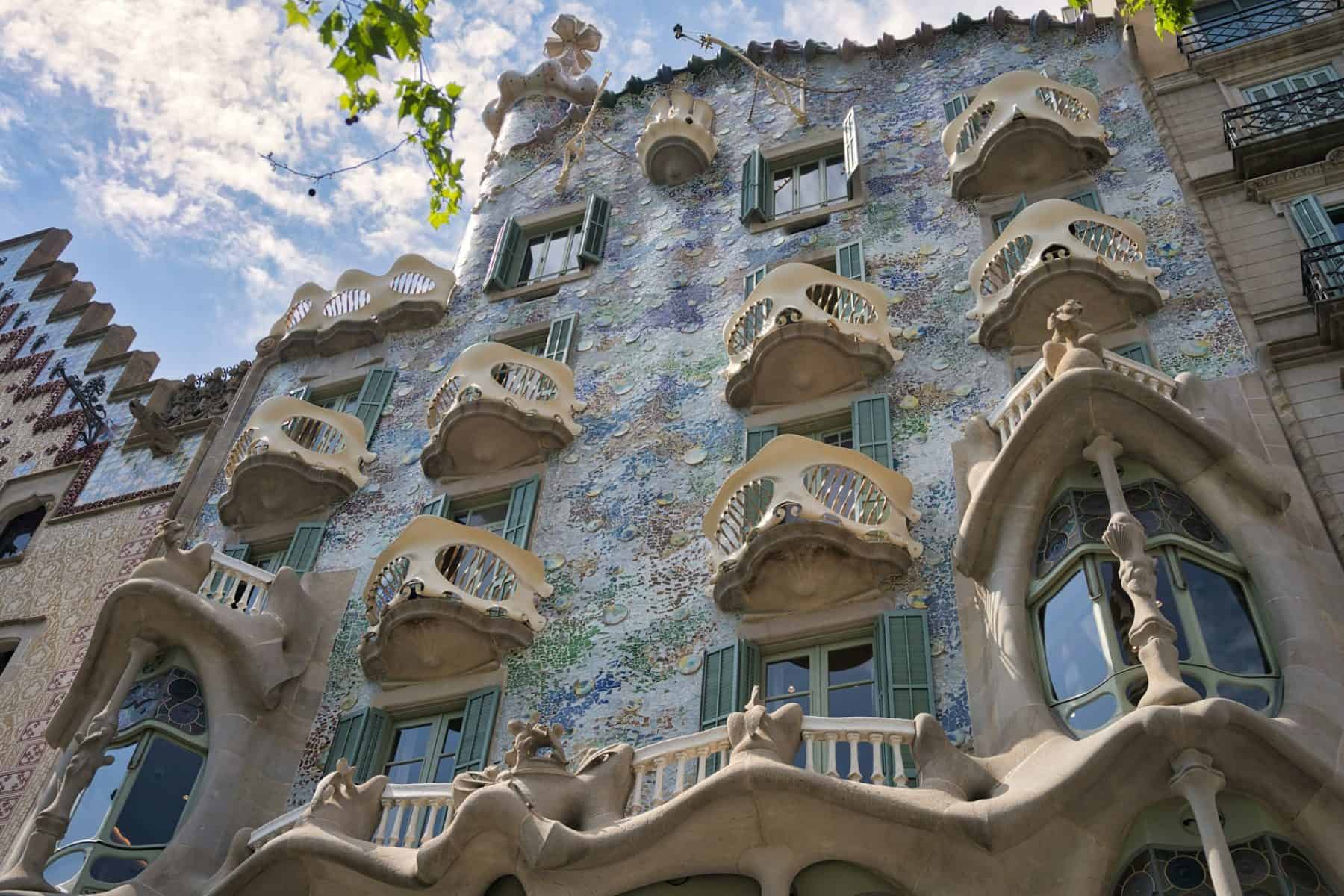
You may see a resemblance to a contemporary painter Claude Monet. But I think that Gaudí cannot be compared to any other artist now or then.
Some interpret the facade as a depiction of the Catalan legend of Saint Jordi, the patron saint of Catalonia.
In the legend, Saint Jordi slays a dragon with a sword. The tiled roof has a scaly look and the adjacent tower looks like a sword topped with a cross.
As of the end of 2025, tickets for Casa Batlló start at 29€. Children 12 and under are free, thank goodness, because like so many of Gaudí's works, this building will delight kids.
I highly recommend booking in advance to avoid waiting in a long queue,
TIP: Here's a neat trick a local friend told me about, and here I pass it on to you
For a free peek at the courtyard of Casa Batlló, go around the corner onto C/Aragó.
Go into the hardware store Servei Estació (C/Aragó 270-272) and head to the 2nd floor where there is an outdoor terrace. What a secret!
Now to the next gorgeous casa, La Pedrera.
Head up Passeig de Gràcia to Casa Milà. Note the tiles under your feet on Passeig de Gràcia, they were designed by Gaudí for the inside of Casa Batlló.
5) La Pedrera (Casa Milà)
Casa Milà, also known as La Pedrera, was designed as a luxury apartment building for the Milà family.
It was built between 1906 and 1912 and was the first building in the world where the walls were not load-bearing.
Gaudí designed a central skeleton frame and then hung the giant, rippling stones off of the frame.
Gaudí was not able to complete the building as he would have liked.
This was due to disagreements over the design with the Milà family as well as the Barcelona City Council and locals who felt that such an unsightly building did not belong on elegant Passeig Garcia.
The public insultingly nicknamed Casa Milà “La Pedrera”, translated as The Quarry, for the stone look of the facade.
As I wrote above, Gaudí’s works evidenced catholic beliefs and Casa Mila is a perfect example.
Where the façade meets the roof there are small inscriptions in Catalan of Catholic prayer.
Directly above the door there is a small letter M, for the Virgin Mary.
The outside of the building is fascinating, but the roof terrace is what excited my architectural sensibilities the most.
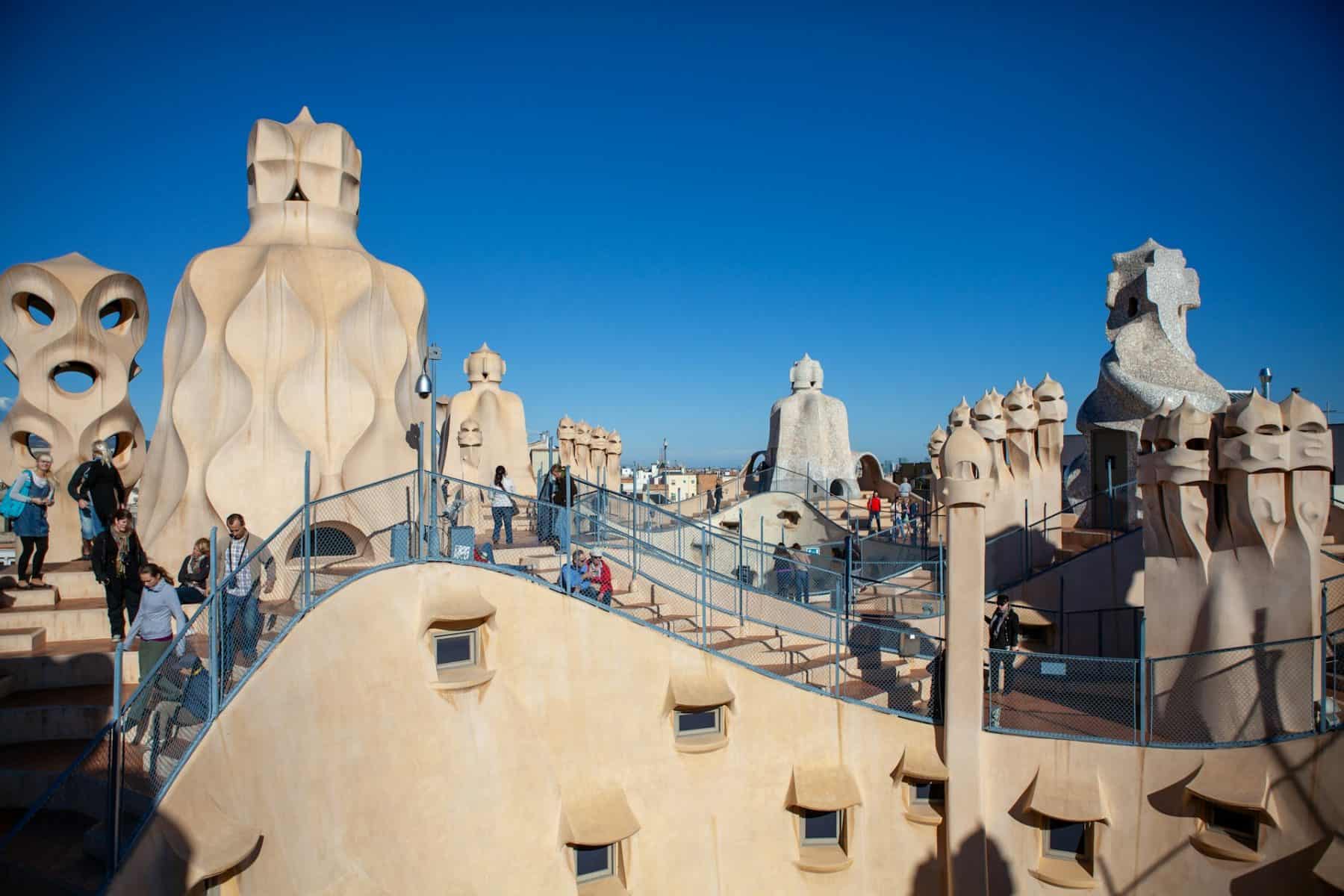
With swirling chimneys (known as Warriors) and serpentine passages, it is otherworldly!
You may have already seen the roof in Michelangelo Antonioni’s film, “The Passenger” featuring Jack Nicholson. The roof is incredibly cinematic.
The views of Barcelona are amazing, but I was more captivated by the roof’s design. Sagrada Familia can be seen from the rooftop.
This was a deliberate move by Gaudí as he wanted people to admire the cathedral, undeniably his greatest work.
You should get tickets to La Pedrera in advance.
A basic unguided daytime visit to La Pedrera is 28€, Junior (12-17 years) 12,50€ and free for children 12 and under.
For about 10€ more, you can opt for a very cool nighttime experience.
I did this on my second trip to Barcelona, having toured the building during the day on my first trip.
This includes a guided tour of the various spaces of Casa Mila (La Pedrera) including the rooftop.
There are audio-light installations, a show on the rooftop and a glass of Cava.
Here are directions to reach the next stop on this self-guided tour, the fantastical Park Güell.
Continue up Passeig de Gràcia and enter the Diagonal metro station.
Take Line 3 again (the green line) to Lesseps or Vallcarca Station, a 15-20 minute walk to the main entrance.
Instead of walking, you can take buses 24, 32, H6, or 92 and get off at the Park Güell stop.
6) Park Güell
This is yet another of Gaudí’s works that is a designated UNESCO World Heritage site. It is easy to see why when you visit this 42-acre (17 hectares) park.
The park was originally conceived as a luxury gated community for Barcelona’s elite.
Due to its remoteness from the city, there was little interest in building residential dwellings here.
Luckily for us, it didn't work out. In its stead, the land was used for a public park. This magical landscape was designed by Gaudí and Eusebi Güell, one of Gaudí’s patrons.
The park was built between 1900 and 1914 and opened to the public in 1922. It is named for Güell.
The use of the English word “Park”, rather than the Catalan word “Parc”, reflects Güell’s interest in the English garden city movement of the era.
Inspired by the elements of a garden, the park combines nature and architecture in a fairytale-like motif.
Just a few of its features are columns that resemble tree trunks and animal sculptures, decorated with Gaudí’s trademark colorful mosaics.
As you enter the park, you will be greeted with a large lizard covered with mosaics, one of Gaudí’s most iconic sculptures.
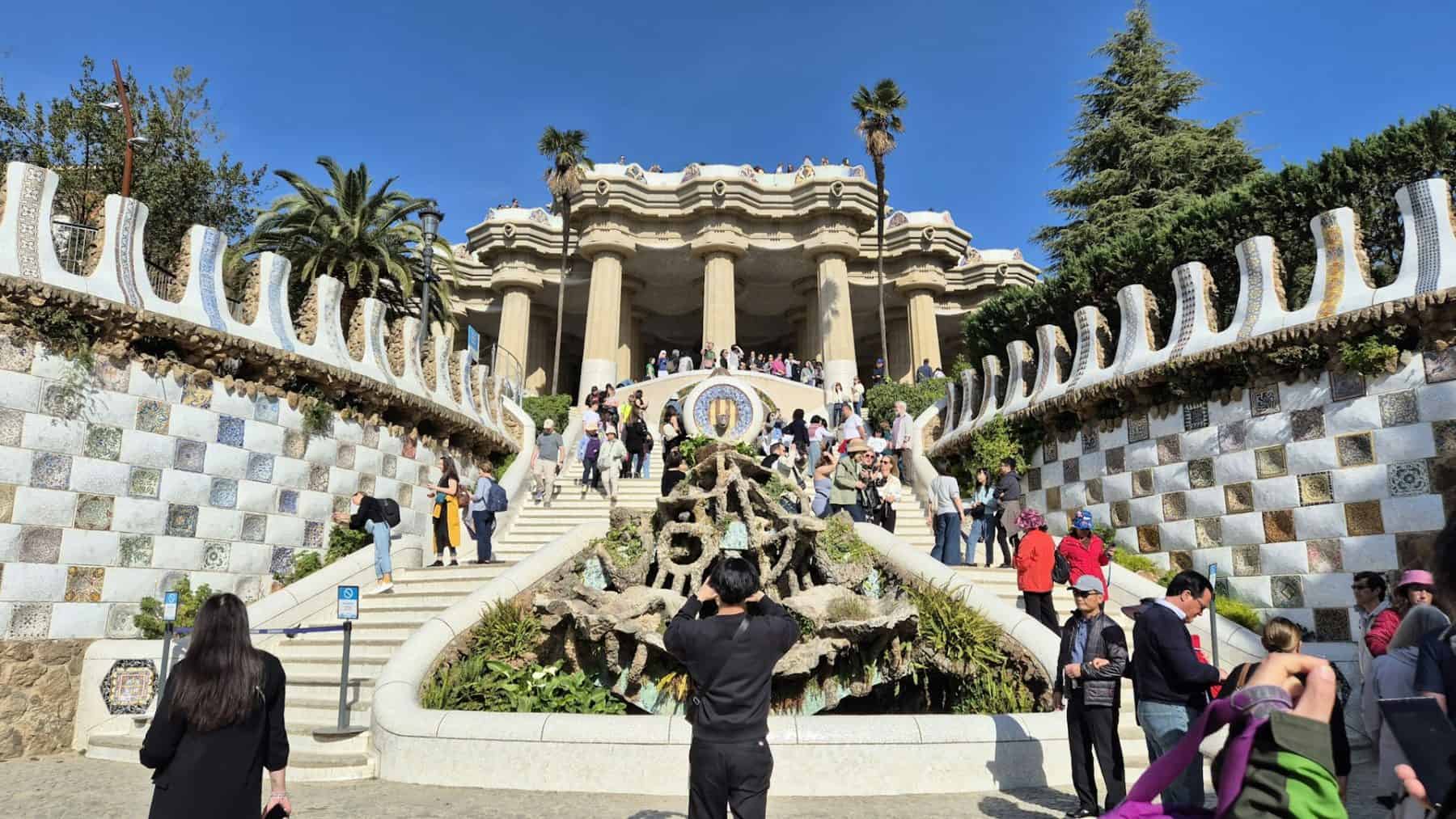
As you wind your way through the park, you will be heading up to the terrace with spectacular views of Barcelona.
There you can sit on the world-famous rippling 360-foot-long bench covered with mosaics.
I am scratching the surface of the park’s features. Every inch of the park is alive with color, shape, and whimsy. Please go and see for yourself!
You can visit the Gaudí Museum in the park, in the house where he lived with his family between 1906 and 1925.
I can't say that it is a fabulous museum, but if you are very interested in Gaudí’s life, you may want to visit.
You can stay in the park until closing, so if you have the time, enjoy this one-of-a-kind greenspace for as long as possible!
IMPORTANT: A limited number of visitors can enter Park Güell a day, so tickets must be reserved ahead of time.
General admission is 10€ and with a guided tour 22€. Buy your tickets here.
You should definitely download the park’s free app before you go. It’s available for both Android and Apple.
Ok...onto the last stop on this tour.
Once you’re done with the Park, head downhill to the Travessera de Dalt ring road and turn right until you see Lesseps metro.
More energetic travelers may wish to take the ring road the other way, walk to the Modernista Hospital Sant Pau by the architect Domènech i Montaner, and then down to La Sagrada Família.
If you’re taking the metro, it’s line 3 again, this time in direction "Zone Universitària". Go two stops to Diagonal and change for the blue line, 5.
Take this in direction "Vall d’Hebron", two stops and get off at Sagrada Família.
7) Sagrada Famíla
I saved the best for last!
While I have expressed my love for some of Gaudí’s other buildings, there is no denying this work is a masterpiece, not only among structures in Barcelona but the entire world.
It is one of Gaudí ’s seven UNESCO World Heritage sites and deservedly so. La Sagrada Familia is monumental in size and spectacular in design.
Besides being known for its grandeur, Sagrada Familia is also known for the fact that, as of 2025, it remains incomplete.
It’s quite a story!
Work on the church started in 1882 under the architect Francisco de Paula del Villar y Lozano.
A dispute over the church’s planned design resulted in Gaudí taking over the project in 1883.
From then on Gaudí spent the rest of his life working on the church which, given his devotion to Catholicism, makes sense.
Tragically, Gaudí was run over by a tram and died. He would not see the church’s completion. But he knew that he would not.
He accepted the fact that it would take well over a century to finish the church. He famously said, 'My client is not in a hurry', his client being God.
In the 44 years between the start of construction in 1882 and Gaudí's death in 1926, less than a quarter of the church had been built.
At that rate, it would take 176 years for the church to be completed. Moreover, since his death and today, there have been work stoppages.
The projected completion date is 2026, just in time for the 100th anniversary of Gaudí’s death.
The great architect’s tomb is inside his masterpiece.
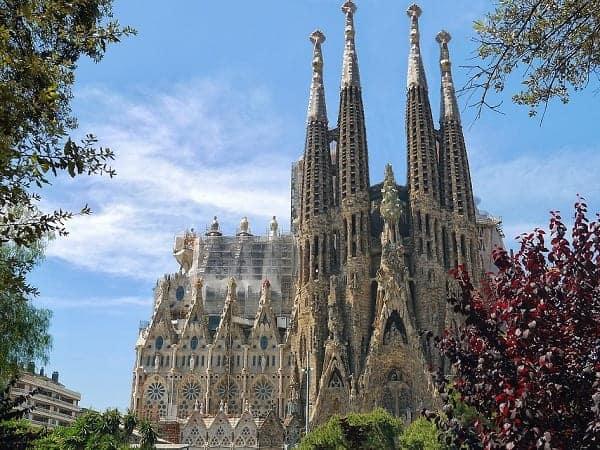
So enough with the backstory, let’s talk about the magnificent design, starting with the exterior.
Gaudí envisioned the church with 18 huge towers/spires. Twelve represent the Apostles, four honor the Evangelists and two are dedicated to the Virgin Mary and Jesus Christ.
They are not all complete but should be by 2026 (fingers crossed!)
The central spire represents Jesus and when finished will be a staggering 172.5 meters (566 ft) tall making Sagrada Familia the tallest church in the world.
For an added fee to your general admission ticket, you can go up one of the two towers. See the ticket section below.
The facades
There are three stone façades, the Nativity facade, the Passion facade, and the Glory facade (not yet complete).
The Nativity facade is on the church’s eastern side and is the only part of the Sagrada Família built during Gaudí’s lifetime.
The central triangular portico is dedicated to Jesus and shows the baby Jesus in a manger at the bottom above the doors.
The small triangular portico to the left is dedicated to Joseph and portrays scenes before the birth.
The small portico to the right is dedicated to the Virgin Mary, depicting scenes of Jesus growing up.
To the left and right are the shepherds and kings bringing gifts. All around, angels celebrate the birth with celestial music.
The Passion facade faces west and depicts the Passion of Christ.
Gaudi designed the facade, but work began after his death, in 1956.
If you view the depictions from bottom left to top right in an S shape, you can follow the story from the Last Supper on the bottom left to the crucifixion at the top.
The interior
As you enter the church into the soaring main nave, you will be awed by the dazzling stained glass windows.
I was incredibly moved by the colors and light streaming through.
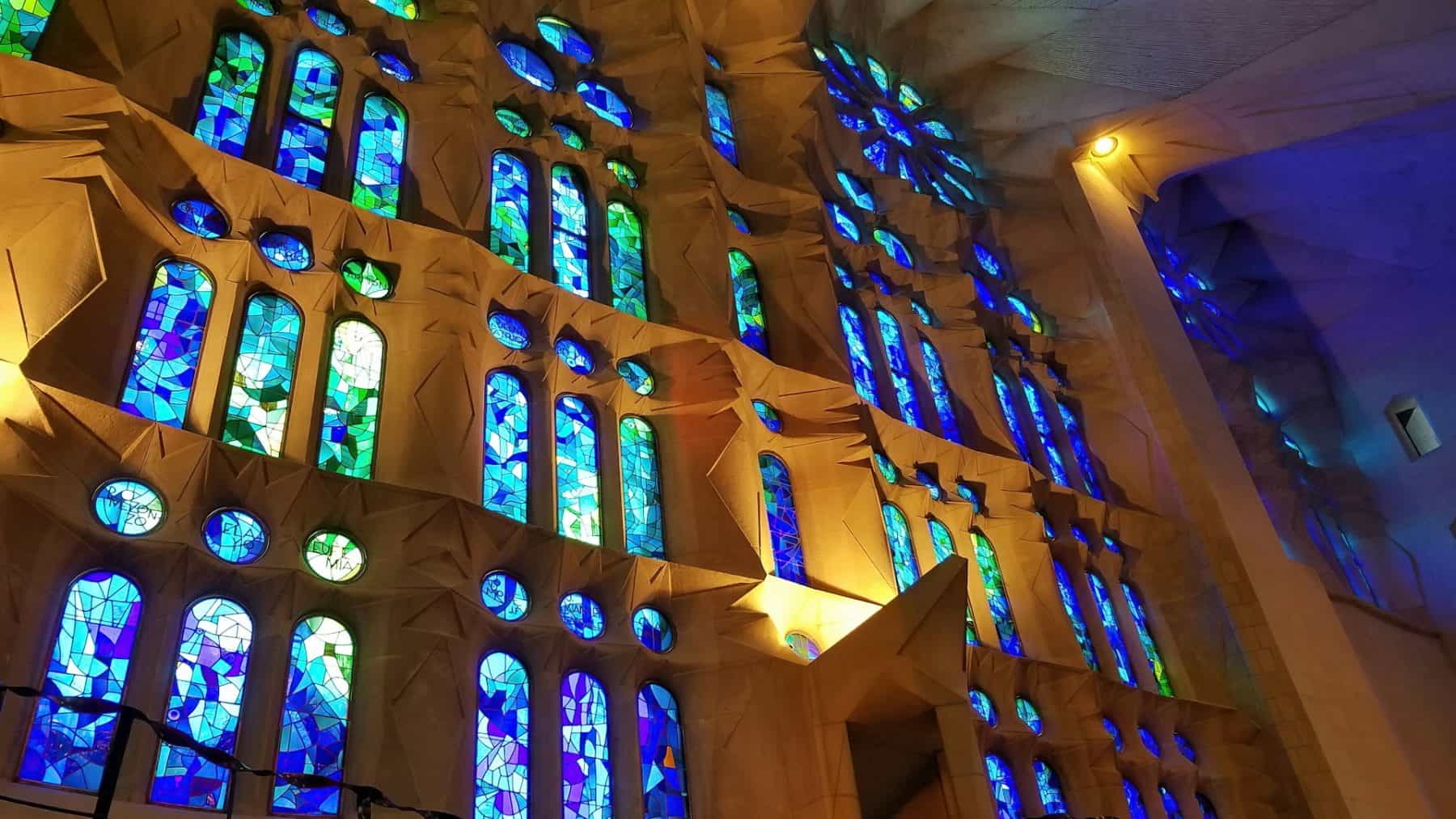
The arboriform columns create a forest and as they branch upward, they form a canopy.
The apse at the end of the nave is adorned with several reliefs and sculptures narrating biblical passages and aspects of Jesus’ life.
Below, Gaudí’s crypt can be visited. There you will find an exhibition about the life and work of the architect.
There is also a museum covering the history of the Sagrada Familia’s construction.
You can look at models, blueprints and artifacts showing how the project evolved over the years.
I’d pass on spending too much time in the museum. There is so much more to see in Barcelona and you can learn a lot from looking at the official website.
TICKETS
- General Admission with audio guide 26 €
- Sagrada Família with guided tour
- Sagrada Família with one tower 36 €
- Sagrada Família with guided tour and tower 40 €
Purchase tickets here or through the official app.
The church accepts worshipers for free every Sunday at 9 am and on holy days. This is subject to capacity.
In closing, this self-guided tour of Gaudí’s works, I encourage you to see as many of his wonderful works as possible.
If you can only visit one or two, that would have to be Park Guell and Sagrada Familia.
What is wonderful about many of his works is that you can admire them from the outside and not spend any money!
