

As a London Tour guide, I take hundreds of people to watch the Changing of the Guard every year.
But there's another guard change in Westminster that is less well known, but no less impressive!
The Changing of the King's Life Guard and the Horseguard's Parade is one of my favourite things to do with my groups.
If you're not able to join me on my Royal Westminster Tour, I have written this guide to give you all the information you need to see this spectacle for yourself!
I'll also include how to visit the Horse Guard Parade for free, see the Changing of the King's Life Guards, and visit the Household Cavalry Museum.
And, in this video, Sinead, a guide with us, London Tours by Foot. walks you through the Changing of the King's Life Guard at the Horse Guards Parade.
- What is Horse Guard Parade?
- Changing of the King's LifeGuards
- Hourly Change & Dismounting Ceremony
- Trooping The Colour
- The Cavalry Museum
- Other Things to Do in London
WHAT IS THE HORSE GUARDS PARADE?
The Horse Guards Parade is a large parade ground used for public and royal ceremonial events throughout the year.
This is almost always a stop on my Westminster Tour.
Although, during preparation for things like Trooping the Colour (the King's birthday parade), or various military ceremonies, public access to the square is limited.
But I always get my group as close as I can!
This parade ground is named after the troops that have protected the Sovereign since the restoration of King Charles II in 1660.
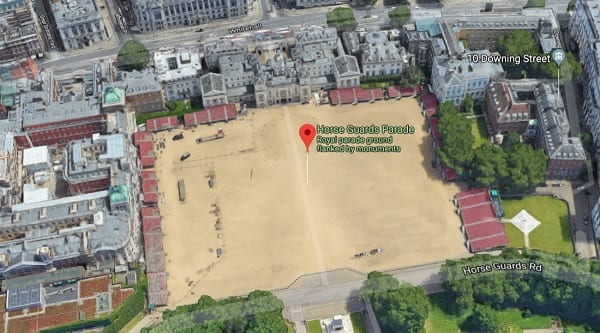
The Horse Guards Parade ground was originally a palace courtyard in the time of Henry VIII and was used for tournaments.
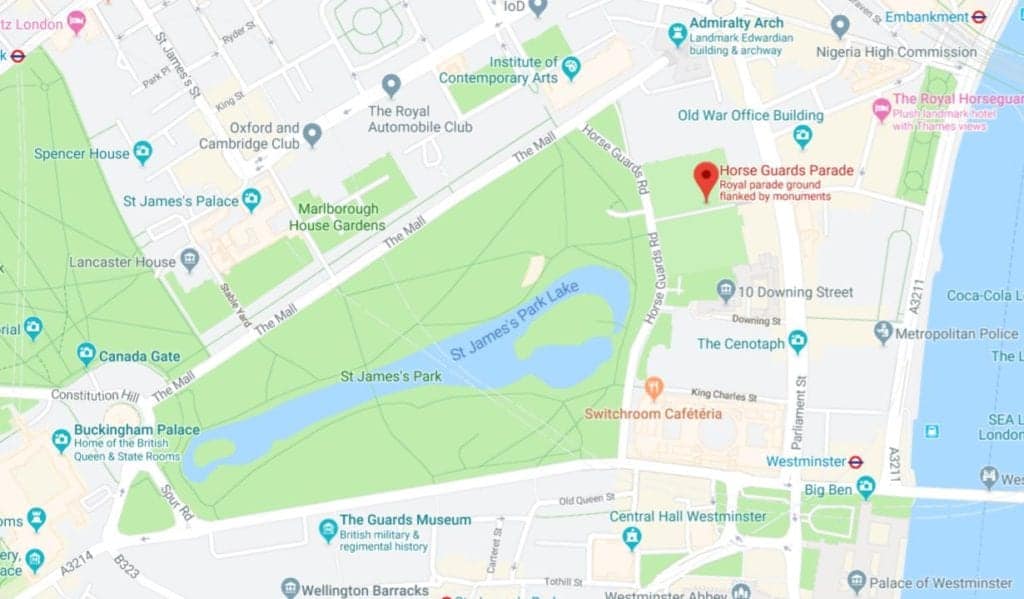
Today it is flanked by St. James's Park, Old Admiralty House (former Navy headquarters), Dover House, and No. 10 Downing Street, the official residence of the Prime Minister.
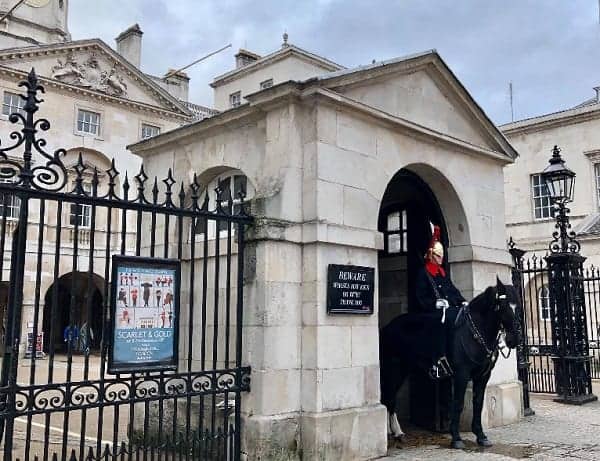
At the front (or Whitehall) entrance of the Horse Guards Parade, you will see members of the Household Cavalry Regiment, who are there to protect the official entrance to St. James’s Palace and Buckingham Palace.
I always take this moment to point out that there are clear signs telling people NOT to touch the horses.
I can't tell you how many times I've seen somebody ignore this sign but please don't.
I've seen people get bitten by a horse, or yelled at by the guards, neither of which are particularly fun!
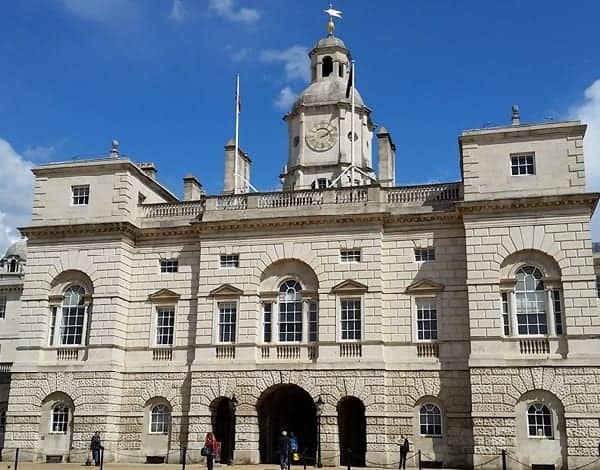
On the parade ground, is a white building, the Horse Guards Building, with an archway in the middle, capped by a clocktower.
The building dates from the 18th century and was designed by William Kent, Chief Architect to George II.
It also holds the tiniest memorial in the capital - and my favourite "hidden" London gem.
At the 2:00 position on the clock there is a small black mark.
This commemorates the fact that it was just outside this building, at 14:00 on the 30th of January 1649 that King Charles I was beheaded at the orders of Oliver Cromwell.
I see hundreds of people looking at the clock every day but I suspect very few of them notice this tiny memorial.
The archway in the middle of the building is used as the official ceremonial entrance to St. James’s Palace and Buckingham Palace - located a quarter of a mile away.
The arch of Horse Guards has witnessed countless significant events.
Whenever the Royal Family is traveling to or from Westminster Abbey or the Houses of Parliament, they normally pass under this archway as they proceed.
This is because, technically speaking, the archway is the formal entrance to Buckingham Palace.
I always say that this archway is most recognisable as the pathway taken by the Prince and Princess of Wales at their 2011 wedding.
Although, more recently people have seen it during the funeral of Her Majesty Queen Elizabeth II.
Notice that the road leading from Horse Guards Parade to Buckingham Palace is paved in red, to represent a red carpet rolled out for the Royal Family.
Another of my favourite Westminster facts!
CHANGING OF THE KING’S LIFEGUARD
Although this Ceremony is similar to the Changing of the Guard at Buckingham Palace, it is a much smaller and shorter event, that usually lasts around 30 minutes daily.
Because it's not as well-known as the Changing of the Guard by Buckingham Palace, this event is less busy and also you can get up close to the cavalrymen and their horses.
This ceremony is free for the public to watch!
Whenever the guards are in position, it is possible for visitors (and locals!) to see them, as well as get a good position for some fantastic photos.
The courtyard is large, so it is easy to get a good view.
Personally, I like to stand with my group between the Guards and the western edge of the Parade.
This is because the soldiers usually march right past us after the ceremony is over so I can make sure my groups get a front-row view and an unobstructed angle for their photographs.
Even though, as I said, this ceremony is not as popular as the Changing of the Guard, the courtyard is still a popular destination in central London.
So, make sure to head over a few minutes early to get the best vantage point.
And definitely come say "hi" if you see me or one of my fellow tour guides from London Tours by Foot!
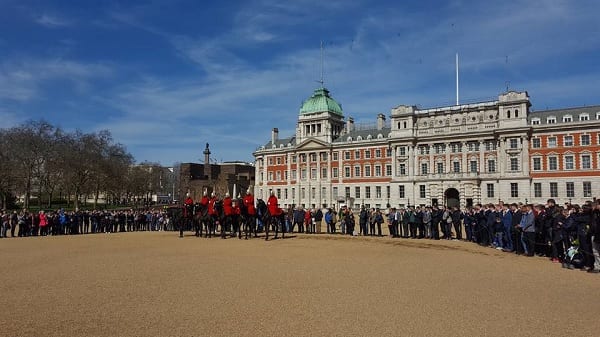
This event sees the two Squadrons that make up the Household Cavalry Mounted Regiment (one squadron is the Life Guard and the other is the Blues & Royals) - end and/or begin their shift.
These sentries change every hour until the final Dismounting Ceremony occurs at 16:00 (4 pm) when the sentries are posted and the horses are returned to their stables.
MY TIP: If you don't manage to time your visit right to catch the ceremony, but you still want to see the horses, remember that from the hours of 10:00 - 16:00 (4 pm), there are always two mounted sentries positioned at the front of the building.
The Ceremony Explained
The New Guard (either the Life Guards or the Blues & Royals) start their day by leaving their Hyde Park Barracks at 10:28 am Monday - Saturday (9:28 am on Sundays).
It is possible to see the Barracks in Hyde Park, but I always point out to my guests that it is not a particularly exciting building.
So, I recommend heading to Horse Guard's Parade to see the soldiers, even if you don't intend to watch the ceremony.
Once the Cavalry leave their Barracks, they proceed past Buckingham Palace, down the Mall, along St James's Park and into Horse Guards Parade.
During my Royal Westminster Tour, I like to take my groups to stand in the Mall for the best views.
And in this video, my collegue Sinead, captures the moment the Horse Guards trot past the Kings Guard along the Mall.
Once the King's Guard soldiers have gone past, I sometimes keep my guests on the same road so we can watch the New Guard of the Household Cavalry make the march from their Barracks to Horse Guards Parade.
I usually say this is a sneak peek of what's to come later (the ceremony itself).
I'll then take my group to see St. James's Palace, and we will reconvene with the Cavalry at Horse Guard's Parade, where, by that time, both the old and the new Guard are lined up facing one another.
As a side note, you can tell the difference between the two units by their uniforms:
The Life Guards wear red tunics and have white plumed helmets, and the Blues & Royals wear blue tunics with red plumed helmets.
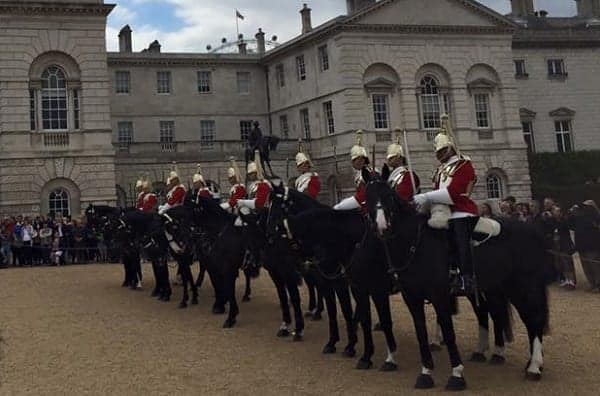
The two groups face one another for around 30 minutes while the Corporal Major and the sentries of the first relief of the New Guard leave for the Guard Room.
Once the sentries of the Old Guard are relieved, they join the other soldiers in the courtyard.
Then, the remainder of the New Guard proceeds through the archway to the front of Horse Guards to take their positions.
Meanwhile, the Old Guard travels back toward Buckingham Palace, up Constitution Hill, and into the Hyde Park Barracks.
This is the part where I usually line my group up in single file so we can get those great views and photographs of the soldiers passing us by.
And I always tell my groups to listen out as the Household Cavalry march through the Parade because occasionally, we will hear a trumpeter playing as they travel.
This is the Royal Salute and it only happens whenever the King is in residence, so it's not a guarantee but a fun little bonus I always get excised to hear.
It is very easy to see the Household Cavalry traveling to and from Horse Guards Parade.
Simply await their procession from their barracks near Hyde Park Corner, down Constitution Hill, and then onto the Mall, passing a number of memorials along the way.
So if you don't want to stand at the places I would recommend, you still have those options!
Although I do think the views on Constitution Hill and the Mall are the best.
The New Guard will pass Buckingham Palace around 10:40 and the Old Guard will pass from the opposite direction at around 11:30.
You can see the New Guard trotting down The Mall in our video on the Changing of the Guard at Buckingham Palace.
MY TIP: Our All-In-One Tours or Westminster Tours include a visit to the Horse Guards Parade where (weather and schedule permitting) you can see the Changing of the King’s Lifeguard up close.
I - or one of my fabulous colleagues - will get you to the best spot for a great view and perfect photographs.
HOURLY CHANGE
The gates at Horseguards Parade are open, from 7:00 - 20:00 daily.
And, the Mounted Sentries stay in position, guarding the entrance to Buckingham Palace, at the front courtyard from 11:00 (10:00 on Sundays) until 16:00.
While the mounted guards are present, there is a small, but still very interesting, ceremony that takes place every hour in the courtyard.
This ceremony is easily viewed by the public and you can actually get quite close to the action!
I've seen this a few times, and usually try to take my guests on private tours into the courtyard to see it as I think it's more of an intimate experience.
From 11:00, the Mounted Sentries are positioned in two guard boxes on either side of the main gates, facing Whitehall.
Each guard box enclosure has a door on one side, and an opening on the other, where the guards face out onto the street (and where tourists get their photos!
That's where you'll find those signs I mentioned above about not touching the horses.
The guards, on horseback, stay there - unmoving (provided they're not yelling at tourists to stop touching them) - for an hour, before they are replaced by two new guards.
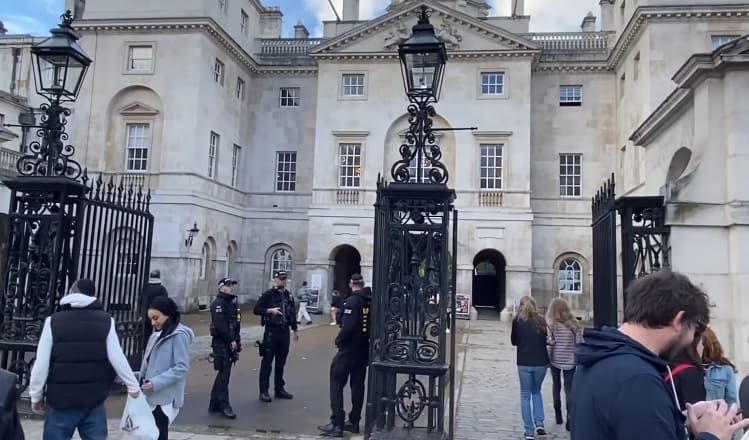
Firstly, the doors on the back of the guard boxes are opened, then, two members of the Household Cavalry, on horseback, come out of the nearby stables, ready to begin their shift.
They are followed by another Guard, on foot, who inspects the soldiers, their uniform, their weapons, and the horses.
This is my favourite part of the ceremony, just because it's a military tradition that the general public don't usually get to see.
Then, the two guards on horseback head for the back of the two guard boxes.
The soldiers who are being relieved, walk their houses straight out of the guard boxes, make a U-turn, and go straight back into the courtyard.
The new guards urge their horses forward, and they then stand in the now-vacant guard boxes and the box doors are closed behind them - they are now on sentry duty for the next 60 minutes.
The soldiers who have just been relieved, halt in the courtyard, sheathe their swords, dismount, and take their horses back to the stables.
I've noticed that this little ceremony is even less well known than the large one that takes place in Horse Guards Parade which means there's very little competition when tying to get a good view.
I think most tourists only happen to see it if they are coincidentally passing through the courtyard but I encourage you to make the deliberate choice to go check it out!
I promise you'll be surprised by how close you will get to the Guards.
DISMOUNTING CEREMONY
At 16:00 every day, the Dismounting Ceremony - sometimes called the Punishment Ceremony or Punishment Parade - takes place in the courtyard that faces Whitehall.
This ceremony is an official inspection of both Mounted and Dismounted members of the Household Cavalry, before members of the Cavalry, on foot (known as Dismounted Sentries), take over the job of protecting the entrance to Buckingham Palace until 11:00 the next day.
It is sometimes called the Punishment Parade because, in the 1890s, Queen Victoria came to Whitehall to see the Household Cavalry and was shocked to find them drinking and gambling while on duty!
Having known a few members of the Household Cavalry, I have to say that this reputation may very well have been based on merit...
She demanded that an official inspection of the guards should be carried out, every day, at 16:00 for the next 100 years - a tradition that has yet to cease.
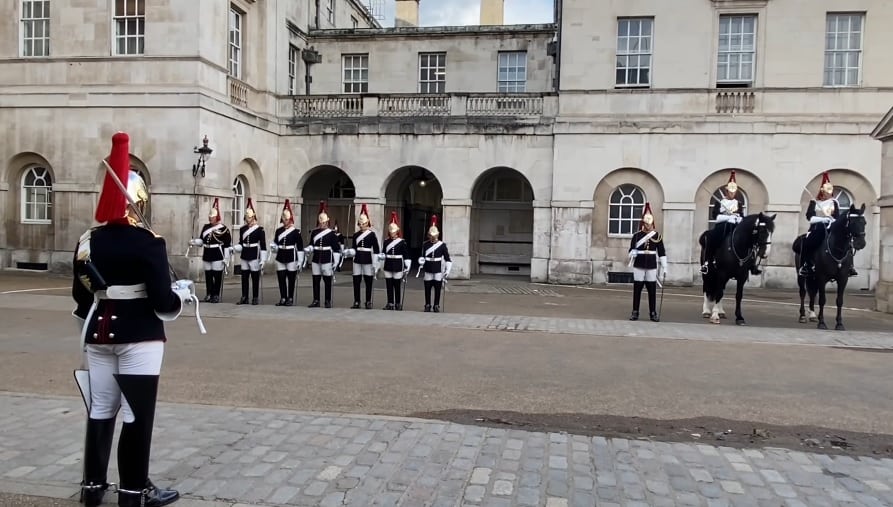
Just as with the hourly ceremony, the Guards on horseback lead their mounts out of the guard boxes, make a U-turn, and return to the courtyard.
They remain there, while a group of Dismounted Sentries emerge from within the stables area and form a line.
They are all formally, and fully, inspected before being given permission to return to the building and take charge of the area.
Two of them will remain, on foot, in the courtyard until 20:00, and after that, one Dismounted Sentry will stay in the courtyard until 7:00 the next morning (these duties will be shared by the whole group of Guards, each doing an hour shift).
Then it is the turn of the two Mounted Sentries to be inspected.
When approved, they then sheathe their swords, dismount, and take their horses into the stables and the Dismounting Ceremony is complete.
Here, I always like to point out that the stables where the horses are kept are built within a beautiful white stone building, that blends in with all the other government offices and former palace rooms in the area.
This means that the horses here live in a much nicer house than I do..!
TROOPING THE COLOUR
This is one of the most important celebrations of the year in London and is one of those traditions that, no matter how many times I've seen it, I always look forward to attending!
It is the annual celebration of the Monarch's “official” birthday and is the highlight of the Royal Family’s ceremonial calendar.
I like to mention to my guests that the ceremony is always held on a Saturday in June - despite the fact that the King's birthday is November 14th!
This is a tradition dating back to the 18th century.
I also like to point out that His Majesty doesn't get to choose the date of his birthday party as it is decided by the government!
To see the exact date in June each year, check my post on Things to Do in London in June that I update yearly.
During the event, over 1,500 soldiers, 200 horses, and over 400 members of the Massed Bands of the Household Division all take part.
The King proceeds down The Mall from Buckingham Palace to Horse Guards Parade, escorted by the Household Cavalry.
The Queen used to ride a horse during her procession, but in later years she took to riding in the carriage or a car.
I was excited to see that King Charles III has chosen to ride the horse as well. I just think it's kind of cool to see!
He will be followed by other senior-ranking members of the Royal Family, as well as hundreds of military personnel.
His Majesty arrives exactly as the clock strikes 11:00 and he then takes his place on the “saluting base” platform.
Here he receives his salute as the Band of the Household Cavalry, a Corps of Drums troupe, and members of the King’s Guard all play music.
After the salute, the King inspects all his troops either on foot, horseback, or in a carriage.
Then the massed bands perform a musical ‘troop’ and the Regimental Colour is escorted up and down the ranks of the Guards.
After, the Household Cavalry, the King’s Troop, and the Royal Horse Artillery march past His Majesty with their Guns.
Then the King rides back to Buckingham Palace at the head of his Guards.
He takes the salute from a raised dais in front of the Palace as the troops file past back to their barracks.
Then comes my favourite part where the King and other members of the Royal Family then file out of Buckingham Palace to stand on the balcony in front of the Palace to watch a fly-past at 13:00 by the Royal Air Force.
In 2023, I was amazed to see the aircraft flying over the Palace were formed into the shape of the King's initials!
There's also always an appearance by the Red Arrows, who trail red, white and blue smoke all up the Mall and over Buckingham Palace.
I think is a fantastic "grand finale" moment.
Although I do have to point out that in the case of bad weather, the flypast might get cancelled.
But June is usually pretty dry and warm.
(Yes, I know that will surprise some of you, as it does the guests on my tours who forget to pack their sunglasses and sun screen!).
HOUSEHOLD CAVALRY MUSEUM
If you’re keen to know more about the Household Cavalry, consider a visit to their excellent museum.
I find that this is one of those London museums that not many people know about, but I think it's fantastic, even though it's quite small.
It is just one of London's many military museums.
(I am personally not super-into military history as I tended to focus more on the social side at University, but our military museums in London are incredible, even if you think you might not be interested!)
Expect compelling personal stories, a trip through 250 years of history, interactive displays, and up-close views of rare and royal objects.
Not only will you get all sorts of information on the troops but you’ll get a behind-the-scenes glimpse into how they operate as well as a secret view into their 18th-century stables!
Hours:
Open daily (with exceptions below)
- 10:00 - 18:00 - April to October
- 10:00 - 17:00 November to March
- Last admission 60 minutes before closing
Closed on:
- Dec 24th - 26th
- Marathon Day
- Easter Friday
- Trooping the Colour
Check their website for closures when choosing your date to visit the museum.
Ticket Prices
- Adults - £10.00
- Children aged 5-16 - £8.00
- Concessions - £8.00 online
- Family Ticket (2 adults and 3 children) - £27.50
- Purchase tickets here.
Free cancellation with 48-hour notice.
Concessionary Prices
- Entry is free with the purchase of the London Pass, a tourist attraction concession pass.
- Military:
- Serving Household Cavalry Personnel and families - Free
- Veteran Household Cavalry Personnel - Free
- Serving Military Personnel - 50% Discount
Address: The Household Division, Horse Guards, Whitehall, London SW1A 2AX
Nearest Underground Station: Westminster, Embankment, or Charing Cross
Nearest Railway Station: Charing Cross
Bus Routes: 12, 24, 26, 87, 88, 159, 453
Use this Google Maps link to get exact directions from your point of departure.
EXPERIENCE THE CHANGING OF THE HORSE GUARDS WITH TOURS BY FOOT LONDON
Our Westminster Walking Tour makes a stop at the ceremony whenever it takes place.