

As someone fortunate enough to study in Paris for a year, I had to learn to use the metro as soon as I got off the plane!
I planned to take the metro from the airport to my destination in the center of Paris.
I had figured out which metro lines to use, but before I could get on the metro, I needed to buy a ticket.
But which type of ticket?
It turned out that choosing the right ticket was more complicated than I expected.
I sorted it out and started my journey into Paris from the airport.
As the train neared the city centre of the city, I saw the Eiffel Tower and immediately fell in love! Since that first trip, I've returned many times and think of Paris as a second home.
My goal in writing this article is to help you know before your arrival which metro tickets or passes to buy based on your plans.
I go over each type of ticket and pass available and how to buy them.
Plus, I share tips on how to save money on your metro tickets and passes and riding the metro.
Before I go into the details, here are some good-to-knows:
Who runs the transit system?
The RATP (Régie Autonome des Transports Parisiens) is the agency that manages public transit in and around Paris.
I highly recommend you take a look at the RATP website before your arrival to get a sense of how the public transportation system works.
It has lots of helpful information in English, including a trip planner, a Paris metro map, and more.
Even though I have been to Paris many times, I still find the website incredibly useful.
Who needs a ticket?
Everyone aged 4 and older needs a valid ticket to use public transit in Paris.
Children ages 3 and younger ride for free, although they can't take up a seat.
I always found this rule a bit cruel. What if an adult has two children 3 or under? One child gets a lap and the other has to stand?
You’ll find out that there are some strange rules in Paris. The French do things their way and you have to conform. C’est la vie!

IQuick Intro to Ticket Types
Here is a quick intro so you can cut to the chase. I go over the details, prices, etc. further down in this article.
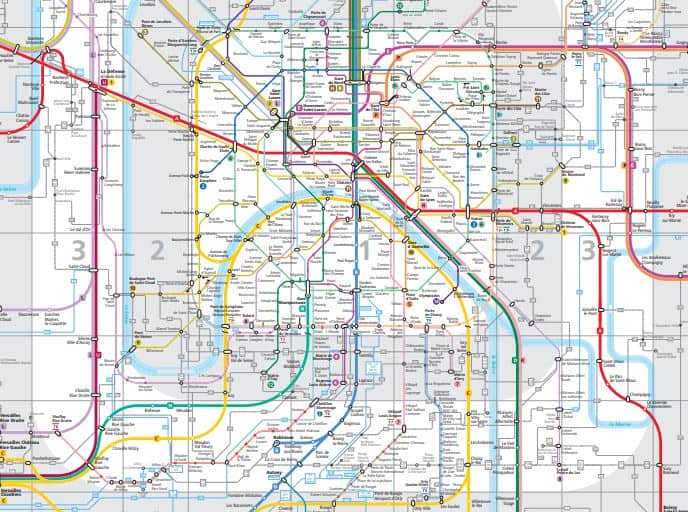
Paris’s transit network is sprawling so the city is divided into 5 zones. Zone 1 is the centre and the zone number increases as you go farther away from the city.
Most visitors to Paris who plan to sightsee in the city centre (Zone 1) will do fine with individual t+ single ride tickets.
When I visit Paris for a few days and know I won't be going beyond the city centre, I use t+ tickets.
Then there is the Navigo Pass, sold as a weekly, monthly or annual pass. It includes travel on all of Paris’s modes of transit.
You choose what zones you want to be included in your pass.
On a month-long stay a few years ago, I chose to use the Navigo monthly pass due to the length of my stay.
I purchased the pass to include Zone 1 and 2 since I was staying in Zone 2 in a neighborhood called Vincennes near the beautiful Bois de Vincennes park.
Since I was traveling into Zone 1 every day, I needed a pass to include Zones 1 and 2.
The Navigo was perfect for my needs! It might be good for you as well. The details are below.
Then there is the Paris Visite Pass which comes in 1-day, 2-day, 3-day, and 5-day increments.
It can be ordered for either zones 1- 3 (Paris proper) or zones 1-5 (which includes the airports, Disneyland Paris and Versailles).
Ok, that was the intro. If you are already feeling overwhelmed, don’t worry.
Below I break down the different options so you can figure out what works best for you for getting around Paris.
How do you pay for the Metro in Paris?
Contactless Credit Card Usage
While you can't simply use a contactless credit card to pay for entrance on the Paris Metro, you can use one to purchase a Navigo Easy Pass, which is itself a contactless form of payment.
Passes and Tickets
As we mentioned, you can buy a Navigo pass to pay for the Paris Metro.
This is one of the easiest methods, but you can also buy paper tickets and use them to get around as well.
Tickets and passes can be purchased via the following methods:
- Ticket Machines
- Ticket Offices
- Metro Apps
- Metro Stations
- Retailers using the RATP sign
The Best Metro Ticket For Getting Around Paris
The best ticket for you depends on how long you're planning to stay.
If you're only going to be here for a few days, a carnet of tickets (a 10-pack of tickets) might work just fine.
However, if you're going to be in Paris for a week, you might want to get a day or weeklong pass to make things easier.
There are a few different types of standard tickets available, so you’ll have to consider where you plan to go and how long you plan to spend there.
Single Tickets/T+
The simplest way to get around is to purchase a paperless/contactless ticket, however, you can also get paper tickets.
Word is that these are expected to be phased out by the end of 2025.
Single one-way tickets, called t+, if paper, are still sold through machines in RER/train and Metro stations, but no longer at manned station counters.
To purchase a paperless/contactless t+ ticket instead, you first need to purchase a pass to upload it onto.
See below under Metro Passes and Prices for information on the various passes you can choose from.
Once you have the pass, you can then load it/purchase tickets and ticket packs through the following apps: Bonjour RATP and Île-de-France Mobilités and any ticket counter or ticket machine.
- Single t+ tickets: €2.15
- Carnet/10-Pack t+ tickets: €17.35. This is only €1.74 per ticket, which is around a 19% off.
t+ tickets are valid on the metro as well as Zone 1 RER lines, some Île-de-France and tramway lines, and the Montmartre funicular.
You can transfer for up to 90 minutes between metros and RERs, and between buses and trams, on a single t+ ticket.
(Yes, there are also trams, but they only run in the suburbs, so most tourists never use them.)
Point-to-Point Tickets
While the t+ tickets will get you around Paris, if you have farther-flung destinations like Versailles, Disneyland Paris, or the Charles de Gaulle airport, you can purchase point-to-point tickets to get there and back.
This ticket type does not have set prices, and the cost depends upon where you’re going and how far it is between the stations you are traveling between.
Use the quick calculator on this page to see how much tickets cost between destinations.
Paris has refillable cards for its transit system, similar to London’s Oyster card or the SmarTrip card in Washington, DC.
These travel cards can be used for future trips to Paris and eliminate the need for paper tickets floating around your pockets (and possibly getting lost!).
Navigo Passes
Here we cover several Navigo passes to suit your travel needs.
All involve physical cards that can be used on the metro, but they also allow for phone swiping as well.
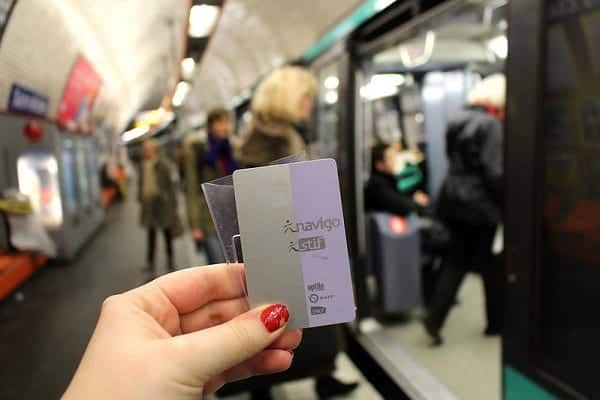
The Navigo Easy Pass is great for the short-term tourist.
It lets you top up a few different types of tickets and is valid for 10 years.
It's also not tied to your name so others can use it, although not during the same trip.
You can purchase a Navigo Easy Pass for €2.00 at any counter in any station and at RAPT-approved shops (such as Tabac and newspaper kiosks).
Here's a full list of locations here, sorted by arrondissement.
Once you have the pass, you can then top it up with payment for the types of tickets you want.
You do this through the Bonjour RAPT app, the Île-de-France Mobilités app, at RAPT-approved shops, station ticket counters, or at station ticket machines.
For "occasional or regular passengers and tourists for short periods" you could also do the Navigo Decouverte Card.
The card is personalized with your picture on it so others cannot use it.
The cost for the card is €5.00 and you would then, as the the Navigo Easy Pass, upload your chosen tickets onto it.
Fun fact: you will find photo booths all over Paris (ever seen the movie Amelie?) if you don’t already carry around tiny pictures of your face.
The Navigo Weekly Pass (Navigo Semaine) may be the best option for tourists visiting Paris, provided a few things:
- You are staying in Paris for three or more days.
- You are arriving in Paris before Thursday at midnight.
- You are planning to use public transit several times a day.
It costs €30.75 for seven days of transit across the entire Paris metro system, including Metro, RER, trams, buses, and even the Montmartre funicular.
The downside to Navigo weekly passes is that they are only valid Monday at 12:01 a.m. through Sunday at midnight, and can only be purchased for the current week until Thursday at midnight.
After that, if you buy a Navigo weekly pass, it will only be valid starting the following Monday
If you’re lucky enough to stay more than two weeks, consider the Navigo Monthly Pass (Navigo Mois) which is valid beginning the first of the month.
It gives you unlimited travel for a month and the cost depends on the zones you'll be traveling in.
Paris Visite Passes
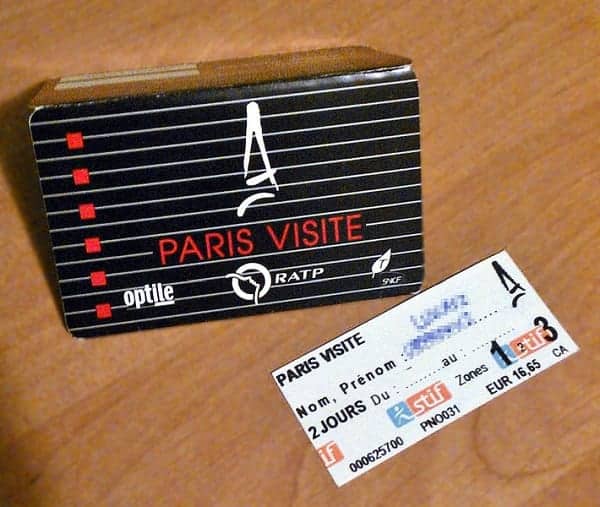
The Paris Visite passes can be a good option for visitors.
They come in 1, 2, 3, and 5-day increments, and you can purchase them for either zones 1-3 (central Paris and close-in suburbs) or zones 1-5 (which includes airports, Versailles, Disneyland Paris, St. Denis, and more).
It works on every form of public transportation within those zones.
The passes also give users money off of several Paris attractions, and they can take some of the guesswork out of how many tickets to buy ahead of time.
Paris Visite can also be purchased as part of the Paris Passlib package, which includes the Paris Museum Pass, a boat ride, a bus tour, and more.
For a rough idea as to whether a Paris Visite pass is more economical than a single t+ ticket costing €2.10, here is how many times you would need to ride in a certain period for the cost-per-ride to be less.
- 1-Day Zone 1-3 Pass: €13.95
- Equal to almost 7 t+ tickets
- 2-Day Zone 1-3 Pass: €22.65
- Equal to almost 6 t+ tickets per day (12 total)
- 3-Day Zone 1-3 Pass: €30.90
- Equal to almost 5 t+ tickets per day (15 total)
- 5-Day Zone 1-3 Pass: €44.45
- Equal to 4 t+ tickets per day (20 total)
The math changes a bit for the Zone 1-5 Paris Visite passes, which can then cover your ride to the airport and anywhere else on the RER, such as Versailles.
- 1-Day Zone 1-5 Pass: €29.25
- 2-Day Zone 1-5 Pass: €44.45
- 3-Day Zone 1-5 Pass: €62.30
- 5-Day Zone 1-5 Pass: €76.25
Note that Paris Visite passes are half-price for children.
You can purchase Paris Visite passes at Charles de Gaulle or Orly airports, any Metro or RER station, visitor centers, or other authorized vendors.
It's valid from the first time you use it, and your first and last name must be written on it with the dates of validity.
Mobilis One-Day Pass
What if you’re only going to be in Paris one day? Quelle dommage! (Well, one day is better than no days, right?)
Or perhaps there’s only one day you know you’ll be using Paris public transit.
Whatever the case, you might want to consider the Mobilis One-Day pass. It’s available in the following options.
We’ll compare the price to standard tickets to give you an idea of how you might use them.
- 2 Zones: €8.45
- Equal to 4 t+ tickets
- 3 Zones: €11.30
- Equal to 5 t+ tickets
- 4 Zones: €14.00
- Equal to 6 t+ tickets
- 5 Zones: €20.10
- Equal to 9 t+ tickets OR
- 1 RER Airport transfer (€11.40) and 4 t+ tickets
If you plan to move around the city a lot in one day and you expect to use the Metro more than 6 times, this pass could save you a lot of money and it will save you some time.
Are you arriving in Paris by train? Buy a one-day Mobilis pass and ride four times to get your money’s worth.
Mobilis passes are available at all RATP vendor points.
Note that the pass is only valid for one calendar day, i.e. from midnight to midnight.
Passes for Young People
While children 4-11 get special deals with all the other passes, those aged 25 and younger can take advantage of special transit passes for youth.
The Navigo Youth Weekend Pass is like the other passes - available from midnight to midnight - but they are only available on weekends and holidays. Passes are a great deal:
- Zones 1-3: €4.70
- Zones 1-5: €10.35
- Zones 3-5: €6.05
This pass is contactless and is one of the types of tickets you can upload to your Navigo Easy Pass.
If you buy a zone 1-5 ticket upon arrival at the airport, by the time you get into downtown Paris it will already have paid for itself, because the RER Airport Transfer is €11.40 on its own.
If you buy a zone 1-3 pass once you’re already in the city (such as arriving by train or bus), you only need to take three trips on public transportation to make it worth the cost.
For those under the age of 26 who are studying in Paris at a high school or university, the Imagine R Pass covers all zones for one whole year, for €375.00 - which is just over €1 per day!
Ticket and Pass Savings
There are a few ways to save for visitors to Paris, though there are some exceptions.
- Children aged 4 to 10, and groups of students traveling with chaperones (who must carry a Declaration of Honor), are eligible for half-priced fares.
- Depending on how you use the Paris Metro Passes, you could also save a lot of money on tickets simply by using the card as many times as possible. Since each pass provides unlimited rides and they all have one flat price, the more you use them, the more money you’ll save.

TIPS FROM LOCALS AND TRAVELERS
While we do our best to provide all the information you'll need to ride the Paris Metro, sometimes you need answers to specific questions related to your personal experience.
Thankfully, our Paris Travel Tips group on Facebook is the perfect place to look for any answers you may need.
Here are a few examples of interesting and helpful tips and tricks provided by members of our group:
- Here is what a few folks have to say about what to see during a short time in Paris and about how best to get around.


2. To locate a metro station, look for lampposts or wrought-iron entryways that have METRO or METROPOLITAN written on them.
3. Ticket machines in the stations can be set to other languages, including English, and are easy to use. They accept both cash and chip-and-pin cards.
4. The direction of the train is indicated by the name of the last station on that line.
5. The doors to the train do not always open automatically. You need to push the open button or unlatch in the older trains.
6. You can (and many Parisians do) unlatch the doors to open them before the train comes to a complete stop.
7. If you need to change trains, look for stations denoted by a white circle, which will then have the different train lines that stop there underneath.
8. Paris Metro Lines are numbered and color-coded.
9. You'll need to know the last station to know what direction you're heading. There will be a list of stops on each platform, so it's not hard to follow.
10. Stations where you cannot transfer have solid circles.
11. The Paris Metro is open from 5:30 am - around 1:15 am (2:15 am on weekends/holidays).
12. Keep moving. When you board a train, move to the center. When you get off a train, move away from the doors if you need to figure out which way to go. There is almost always someone behind you trying to get off of the train.
Related Posts